
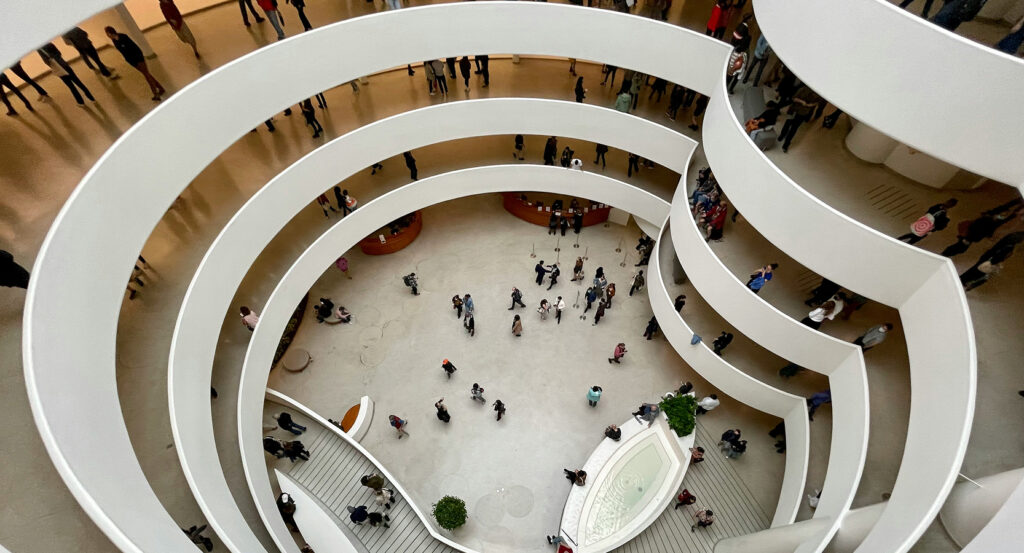
Why you should experience Guggenheim Facade in New York, NY.
Guggenheim Facade is an act of rebellion cast in concrete. Where the surrounding Upper East Side presents symmetry and restraint, the museum curves outward, daringly asymmetrical, a white ribbon uncoiling toward the sky. To stand before it is to witness Frank Lloyd Wright's defiance made tangible, a structure that refuses to conform. The smooth, continuous form suggests movement, even when still, and its monochromatic purity lets the natural light sculpt shadows across its surface throughout the day.
Visiting the facade feels almost cinematic. You'll catch glimpses of its reflection in nearby glass, or the way its spiral appears to twist more dramatically from certain angles. Unlike most museums, whose exteriors serve as mere thresholds, the Guggenheim's skin is the experience, a prelude to the journey within, a promise that what awaits will challenge how you think about space itself.
What you should know about Guggenheim Facade.
What most overlook is that the Guggenheim's design was nearly never realized. Wright fought for over fifteen years to bring his vision to life against a storm of resistance, from city planners, critics, and even artists who feared the museum's architecture would overshadow their work. But Wright's design philosophy was unwavering: “The building should not be a shell for art, it should be art itself.” The facade's continuous curve was inspired by the organic geometry of seashells and whirlpools, and its cylindrical form mimics the way a painter might spiral around a canvas.
Even the color, that soft “Wright white,” was chosen for its ability to transform under sunlight, an evolving palette of ivory, rose, and silver depending on the hour. The Guggenheim is among the few buildings that genuinely moves with time, its appearance never the same twice. Wright saw this not as vanity, but vitality, architecture as a living, breathing force.
How to fold Guggenheim Facade into your trip.
When planning your visit, approach Guggenheim Facade as its own encounter before you even enter. Start across the street in Central Park, where the museum rises like a modernist monolith framed by elm trees, and walk slowly toward it, letting its curvature unfold from afar.
Arrive just before sunset, when the white exterior begins to glow with the warmth of the day's fading light, and watch how the shadows of passing cars ripple across its surface. Pair your visit with an early evening stroll along Museum Mile or a quiet cocktail at a nearby hotel bar, where the city's hum softens to a murmur. The facade reminds you that beauty often begins in defiance, and that the most iconic art doesn't always hang within a frame.
Where your story begins.
Foresyte Travel reveals places that feel extraordinary long before you arrive.
Experience premium editorial crafted for luxury travelers.







































































































