
Why Hollywood & Highland matters.
Hollywood & Highland is a major entertainment complex where Hollywood's movie-premiere corridor meets open-air public architecture, theatrical scale and direct views toward the Hollywood Hills.
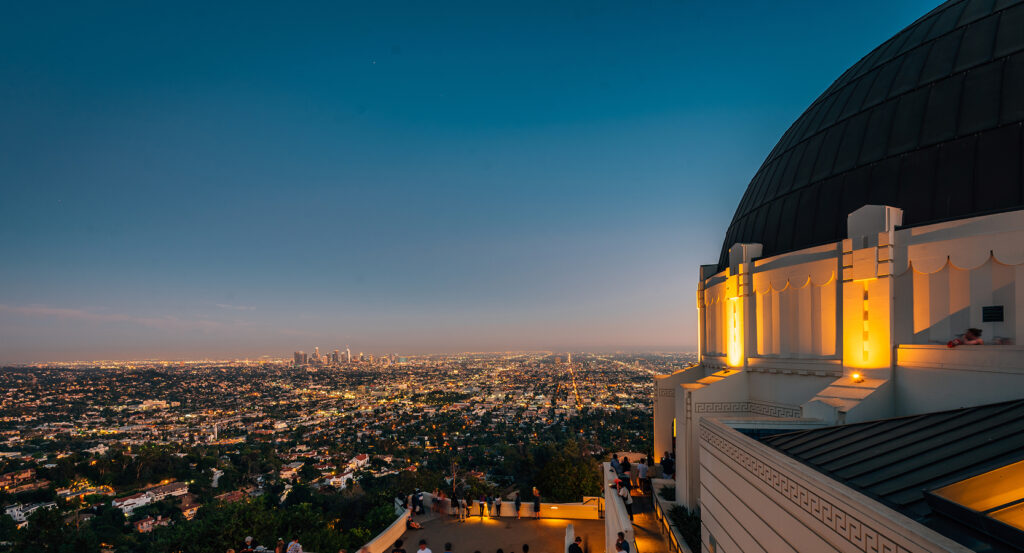
Set at Hollywood Boulevard and Highland Avenue near Orange Drive and just steps from El Capitan Theatre, the complex occupies a prominent Hollywood intersection above the Metro rail station that preceded its opening by a year. Ehrenkrantz Eckstut & Kuhn Architects organized the original center around multiple retail levels and a large central court, using elevated walkways and broad openings to connect its interior circulation with Hollywood Boulevard. The original courtyard rose through four stories around immense architectural elements derived from a silent-film set, with an axial opening framing the Hollywood Sign in the hills beyond. A network of terraces and upper-level passages gave the interior substantial vertical depth, turning movement through the complex into repeated shifts between enclosed commercial floors and open views across Hollywood. The result is a large urban entertainment center whose multilevel circulation, open central court, hillside sightlines and direct transit connection concentrate several defining components of Central Hollywood into a single site.
What defines Hollywood & Highland.
Hollywood & Highland is best known for forming the centerpiece of a major early twenty-first-century effort to revive Central Hollywood through entertainment, retail, transit and the return of the Academy Awards to the neighborhood. Canadian developer TrizecHahn undertook the project with the Los Angeles Community Redevelopment Agency and Los Angeles County Metropolitan Transportation Authority, integrating the development directly above the Hollywood/Highland Metro station. The $615 million complex opened on November 9, 2001, encompassing 640,000 square feet of commercial development alongside a six-screen cinema and a purpose-built theater for the Academy Awards. Ehrenkrantz Eckstut & Kuhn Architects designed the principal development, and its most conspicuous original architectural conceit drew from D. W. Griffith's 1916 film Intolerance. The central court reconstructed elements of Griffith's enormous Babylon set, including a grand gateway and elephant-topped columns that translated an artifact of silent-era production design into permanent architecture. Rockwell Group designed the adjoining Kodak Theatre, later renamed Dolby Theatre, around the technical demands of the Academy Awards telecast; the auditorium brought the ceremony back to Hollywood beginning with the 74th Academy Awards in 2002 after decades of ceremonies at other Los Angeles venues. The undertaking joined redevelopment policy, rail investment, movie-industry performance and architecture on a site intended to operate as a new commercial anchor for Hollywood Boulevard.
Ownership changes subsequently produced a second architectural chapter that substantially altered the 2001 complex. CIM Group acquired Hollywood & Highland from Trizec in 2004 for $201 million after the original development suffered financially during its first years, then invested more than $20 million in planned improvements. CIM sold the 460,000-square-foot retail and entertainment portion in 2019 to DJM Capital Partners and Gaw Capital USA, retaining the 180,000-square-foot Dolby Theatre outside the transaction. The acquisition price reached $325 million, and the new owners pursued a fundamental redesign aimed at opening the inward-facing center more directly toward surrounding streets. Gensler joined the redevelopment, and the undertaking removed the Babylon-themed architectural treatment that had defined the original courtyard, redesigned facades and landscaping, revised wayfinding and changed the commercial program. DJM places the investment in the renovation near $80 million and characterizes the work as touching the full property. The complex emerged under the Ovation Hollywood name, closing the architectural chapter in which Griffith's Babylon had dominated its public imagery and repositioning the property around a more contemporary visual treatment. The sequence from TrizecHahn's ambitious 2001 opening through CIM's acquisition and the DJM-Gaw redevelopment gives the site an unusually compressed history of Hollywood regeneration, commercial reinvestment and architectural revision.
How Hollywood & Highland fits.
Hollywood & Highland works as the anchor for a Hollywood outing connecting Sid Grauman's movie-palace culture, the Academy Awards' earliest ceremony and the emergence of the red-carpet premiere.
Begin at TCL Chinese Theatre, developed by showman Sid Grauman and opened on May 18, 1927 with Cecil B. DeMille's The King of Kings, accompanied by an elaborate stage prologue and a 65-piece orchestra. Meyer & Holler designed the theater with Raymond M. Kennedy as principal designer, creating a 90-foot pagoda-shaped roof, immense columns, imported temple bells, stone Heaven Dogs and other decorative pieces from China. The forecourt became inseparable from Hollywood celebrity culture through its handprint and footprint ceremonies, whose early participants included Mary Pickford and Douglas Fairbanks. A $7 million rehabilitation in 2000 and 2001 restored obscured architectural details, and a second major project converted the auditorium for IMAX presentation in 2013. Continue to The Hollywood Roosevelt, financed by Douglas Fairbanks, Mary Pickford, Louis B. Mayer and Sid Grauman and opened in 1927 as a 12-story Spanish Colonial Revival hotel. The property became the setting for the first Academy Awards on May 16, 1929, when 270 attendees gathered in the Blossom Ballroom for a private dinner and a ceremony lasting 15 minutes. The building later became associated with residents and performers including Marilyn Monroe and Montgomery Clift, and artist David Hockney painted the bottom of its swimming pool. Los Angeles designated the Roosevelt a Historic-Cultural Monument in 1991, preserving a hotel whose history connects Hollywood real estate, studio-era social culture and the earliest Oscars. Conclude at Egyptian Theatre, created by Grauman and developer Charles E. Toberman and completed by Meyer & Holler in 1922 during the silent-film era. Its October 18 opening with Allan Dwan's Robin Hood, starring Douglas Fairbanks, produced Hollywood's first major movie premiere and helped establish the ceremonial arrival culture subsequently associated with the boulevard. The American Cinematheque acquired the theater from Los Angeles in 1996 and reopened it after rehabilitation in 1998, then partnered with Netflix in 2020 on another extensive restoration. The projection booth had gained the capability to screen highly flammable 35mm nitrate film in 2016, preserving a technological link with early cinema exhibition. The restored theater reopened on November 9, 2023 with David Fincher's The Killer, continuing American Cinematheque programming alongside Netflix screenings and premieres. The progression moves from Grauman's elaborate Chinese Theatre through the hotel ballroom that hosted the first Academy Awards and culminates at the Egyptian Theatre, where Hollywood developed the premiere ceremony that helped turn movie exhibition into public performance.
Where your story begins.
Foresyte Travel reveals places that feel extraordinary long before you arrive.
Enjoy editorial crafted for luxury travelers.
Foresyte may earn a commission when you book.





































































































