
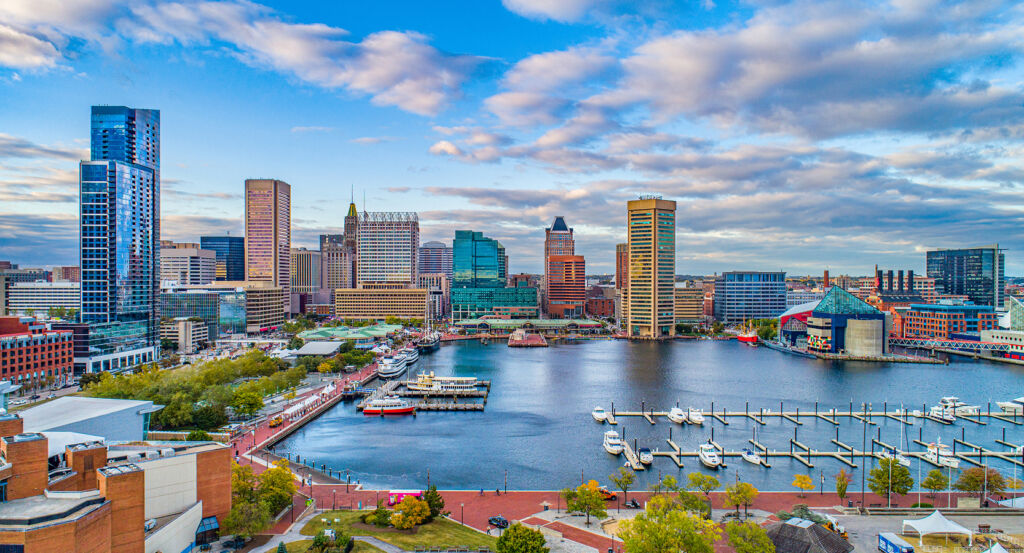
Why you should experience Hyatt Regency Baltimore Inner Harbor in Baltimore, Maryland.
Hyatt Regency Baltimore Inner Harbor is a hotel that operates as a civic threshold, a place where Baltimore's public energy and private recovery coexist without friction, allowing you to experience the city with scale, clarity, and control rather than noise or novelty.
The moment you arrive, the hotel establishes its role as an organizer of experience. This is not a property designed to impress through intimacy or theatrical design; it impresses through competence. The building's massing and orientation make immediate sense in context. It sits with authority along the harbor, not as a performance but as a stabilizing presence, one that absorbs crowds, events, weather, and motion. Entry feels purposeful and efficient. You are guided, not dazzled, from exterior movement into an interior environment that prioritizes legibility. Sightlines are open, navigation is intuitive, and the transition from city pace to interior calm feels deliberate. Public spaces are expansive yet disciplined. The lobby does not attempt to seduce you into lingering unnecessarily; instead, it gives you options. Seating areas are arranged for actual use, conversation, waiting, planning. The atmosphere carries a sense of momentum without pressure, signaling that this is a hotel designed to support full itineraries rather than interrupt them. Guest rooms reinforce this functional confidence. Layouts are immediately readable, eliminating the subtle friction that often undermines comfort in large urban hotels. Beds are substantial and built for reliability, delivering consistent, restorative sleep after long days spent navigating the harbor, attending conventions, or exploring Baltimore's neighborhoods. Furnishings are restrained and practical, positioned to support rest, light work, and downtime. Storage is generous and well-integrated, allowing you to unpack fully and establish routine. Windows are a defining feature. Many rooms frame wide views of the Inner Harbor, open water, or the city's architectural layers, keeping Baltimore visually present. Light moves predictably through the space, reinforcing time and orientation rather than flattening the day into sameness. Bathrooms prioritize function and reliability, strong lighting, consistent water pressure, and layouts that support daily rituals. Sound behavior throughout the hotel reflects its operational intelligence. Despite the scale of the property and its proximity to one of the city's busiest districts, exterior noise registers as distant context. This containment allows focus and rest to coexist even during peak activity. Dining and shared amenities align with the hotel's role as an anchor rather than a destination. Food and beverage offerings are designed to support schedule and flow, meals between meetings, gatherings before events, resets after long days. Service mirrors this philosophy. Interactions are courteous, responsive, and efficient, delivered. Staff understand the hotel's role in your larger itinerary and assist accordingly, helping your day move forward. The location completes the picture. Positioned directly along the Inner Harbor, the hotel places you steps from waterfront promenades, convention spaces, cultural institutions, and downtown corridors.
What you should know about Hyatt Regency Baltimore Inner Harbor.
Hyatt Regency Baltimore Inner Harbor is engineered around the idea that predictability, spatial clarity, and operational steadiness are not compromises in hospitality, but advantages, especially in dense, event-driven urban environments.
One of the hotel's most overlooked strengths is how deliberately it manages complexity. Large waterfront properties often collapse under their own scale, becoming disorienting or impersonal. Here, size is treated as an asset. Circulation is logical, vertical movement is clearly signposted, and public zones are segmented in ways that reduce cognitive load even when the building is full. This matters deeply for travelers balancing conferences, family logistics, or tightly scheduled visits. Another defining element is the hotel's relationship with the harbor itself. Rather than turning the waterfront into constant performance, the design treats it as orientation. Views are expansive but composed, allowing water and skyline to serve as grounding reference points. This balance helps guests remain connected to place. Materials and finishes throughout the property emphasize durability and consistency over trend-driven expression. This creates an environment that ages quietly rather than loudly, allowing returning guests to find familiarity rather than disruption. The hotel's character does not depend on novelty; it depends on reliability. Operational systems reinforce this stability. Check-in flows predictably, room functions behave as expected, and daily rhythms are supported. This consistency is particularly valuable for guests who need the hotel to disappear into the background while their schedules take priority. Service culture reflects this same discipline. Staff engagement emphasizes situational awareness and practical assistance. Help arrives when needed, in forms that are relevant, directions that make sense, recommendations grounded in proximity, logistics handled. Another lesser-known strength lies in how the hotel supports coexistence. Business travelers, families, solo guests, and large groups operate simultaneously without friction because the space is designed to absorb variation rather than amplify it. Updates and maintenance focus on preserving system reliability and comfort consistency rather than dramatic redesigns that would destabilize familiarity. In a harbor district often defined by performance and visibility, Hyatt Regency Baltimore Inner Harbor stands out by offering order, access, and a sense of operational calm that endures.
How to fold Hyatt Regency Baltimore Inner Harbor into your trip.
Hyatt Regency Baltimore Inner Harbor is most effective when you treat it as a logistical and psychological anchor rather than a destination you orbit around.
Begin your mornings with orientation. Use the hotel's expansive but disciplined public spaces to review plans, align schedules, or simply take in the harbor's movement before stepping outside. Because the location places you directly along the Inner Harbor promenade, movement into the city is immediate, walks, museums, waterfront paths, and downtown corridors unfold. Midday returns to the hotel work best as recalibrations. After meetings, sightseeing, or long periods on your feet, coming back allows you to reset, rest briefly, hydrate, reorganize. This rhythm is particularly valuable in a dense, event-driven waterfront environment where energy can drain quickly. In the afternoon, prioritize depth over distance. Choose one district, one institution, or one extended engagement. The hotel's positioning makes lateral exploration effortless, allowing you to return as needed. Evenings benefit from flexibility. Attend events, dine nearby, or stroll the harbor as light shifts across the water before returning inside. The transition from exterior energy to interior calm feels immediate and controlled, reinforcing the hotel's role as a stabilizer. On multi-night stays, repetition becomes grounding. Familiar layouts, consistent service, and predictable flow reduce decision fatigue, freeing attention for engagement. Departure feels orderly and complete rather than rushed, aligned with the hotel's operational cadence. Folded thoughtfully into your itinerary, Hyatt Regency Baltimore Inner Harbor becomes more than a place to sleep. It becomes an infrastructure, one that allows Baltimore to be experienced with clarity, access, and sustained presence.
Where your story begins.
Foresyte Travel reveals places that feel extraordinary long before you arrive.
Experience premium editorial crafted for luxury travelers.







































































































