
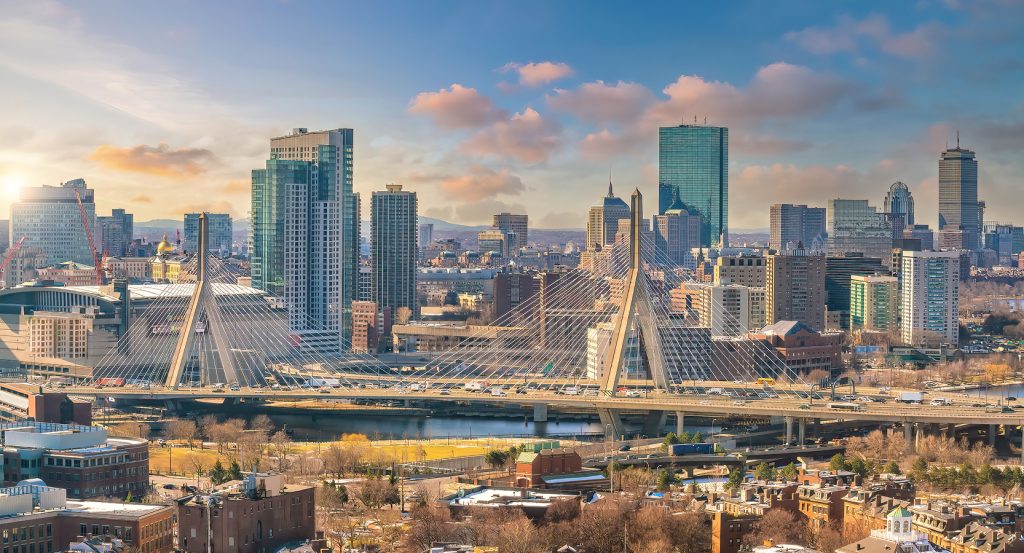
Why InterContinental Boston by IHG matters.
InterContinental Boston is a contemporary waterfront hotel where Downtown's maritime trading heritage meets Howard Elkus's ship-inspired architecture and the redevelopment of the city's former industrial waterfront into an international hospitality district.
Set along Atlantic Avenue near the Northern Avenue Bridge, opposite the Rose Kennedy Greenway and immediately west of Fort Point Channel, the hotel occupies the waterfront between the Financial District, South Station's transportation corridors, and the northern approaches to the Seaport. The 22-story building presents a curved glass façade toward the water, its horizontal divisions and reflective surfaces recalling the hull and rigging of nineteenth-century sailing vessels. The principal entrance leads into interiors finished with Italian marble and Texas limestone, establishing a substantial architectural transition from the surrounding commercial streets. On the channel-facing side, landscaped grounds and outdoor terraces create a broad separation between the building and the water. The result is a hotel whose sculptural architecture and landscaped waterfront establish a distinctive relationship between metropolitan accommodation and Boston's historic harbor geography.
What defines InterContinental Boston.
InterContinental Boston is best known for opening in September 2006 as a major component of the redevelopment of Boston's downtown waterfront following the removal of the Central Artery. Intell Management and Investment developed the property during a period when substantial public infrastructure investment was changing the relationship between the Financial District and the harbor. The undertaking formed part of a larger transformation that replaced elevated highway infrastructure with new public landscapes and encouraged private development along formerly disconnected commercial corridors. Elkus Manfredi Architects received the architectural commission, with Howard Elkus developing a building whose design drew directly from the maritime history of the surrounding waterfront. Its composition combined a curved podium with a substantial glazed tower, translating the structural forms of clipper ships into contemporary commercial architecture. The property occupied land associated with Russia Wharf, an important nineteenth-century center of international trade whose warehouses received cargo from European and Atlantic shipping routes. In 1829, the wharf handled 39 vessels carrying Russian goods and other international merchandise, demonstrating the commercial importance of this section of Boston's waterfront. The surrounding property subsequently accommodated the Russia, Graphic Arts, and Tufts buildings, including a Classical Revival commercial structure designed by Peabody and Stearns in 1891. Their development followed the gradual transformation of Boston's waterfront from maritime cargo handling into a concentration of commercial offices and industrial premises. The InterContinental undertaking represented another substantial change in land use, introducing international hospitality and private residential ownership into a district undergoing comprehensive urban reconstruction. Its architectural program incorporated hotel accommodation, upper-level private residences, and commercial premises within a unified high-rise structure. The development opened during a substantial expansion of Boston's hotel industry, coinciding with major hospitality construction associated with the city's growing convention and international business markets. Its completion established a new waterfront presence for InterContinental Hotels & Resorts, extending the company's American metropolitan portfolio into one of New England's principal financial and cultural centers. The hotel's subsequent commercial development accompanied the expansion of the Seaport and the growing importance of Boston's harborfront as a residential, business, and leisure destination. Its twentieth anniversary in 2026 marked two decades of operations within a district whose commercial geography had undergone substantial transformation since the original development.
Didier Montarou established the hotel's original culinary direction as executive chef, bringing an international hospitality career extending across more than three decades into the Boston opening. His appointment connected the property with InterContinental's established European culinary traditions, initially expressed through Miel, a restaurant developed around the cooking of Provence and southern France. The adjoining RumBa introduced a separate beverage program emphasizing rum and Caribbean drinking traditions, establishing two distinct hospitality environments within the original architectural organization. These operations served the property for almost eighteen years before a comprehensive culinary redevelopment began in 2024. The undertaking replaced both original establishments with a coordinated Italian restaurant and cocktail program, marking a substantial departure from the hotel's initial French and Caribbean culinary associations. Montarou continued as executive chef during the transition, preserving professional continuity across the property's first major restaurant transformation. Chef de cuisine Jeffrey Bianchi joined the project after substantial appointments at Davio's and Ming Tsai's Blue Ginger, contributing experience in Italian-American restaurant operations and contemporary Asian-influenced cooking. Matria developed its principal culinary direction around Piedmont and the Italian Riviera, connecting northern Italian regional cooking with an American steakhouse format. Its architectural redesign incorporated softwoods, marble detailing, and glass-and-brass chandeliers, establishing a coordinated interior treatment that extended onto the adjoining waterfront terrace. Bar Fellini replaced RumBa through a separate commission organized around Italian aperitivo culture, introducing a decorative program of sculpted arches and textured surfaces. The redevelopment also introduced the Loyall Counting Room, a smaller cocktail establishment whose design draws on the private parlors associated with Boston's eighteenth-century political culture. The three establishments developed different approaches to social dining within a coordinated hospitality program, replacing the original division between French restaurant and Caribbean bar with an Italian culinary center and a separate historically themed cocktail room. Montarou's continued leadership gives the transformation particular significance as an evolution of the hotel's original culinary organization under the chef responsible for its opening.
How InterContinental Boston fits.
InterContinental Boston works as the starting point for a waterfront outing tracing Boston's transformation from a center of colonial political resistance into a pioneer of children's education and a major institution for contemporary art.
Begin at Boston Tea Party Ships & Museum, whose historical interpretation centers on the destruction of British East India Company tea on December 16, 1773. The protest involved three merchant vessels, Dartmouth, Eleanor, and Beaver, whose cargoes were attacked by colonists opposing parliamentary taxation and the company's privileged trading position. The museum originated in 1973 and underwent substantial reconstruction following a destructive fire in 2001, reopening in June 2012 with historically reconstructed vessels and a purpose-built exhibition complex. Its reconstruction included the restoration of Beaver, a former Danish cargo vessel rebuilt at Gloucester Marine Railways, and the creation of Eleanor, establishing a physical setting for interpreting the maritime protest that preceded the American Revolution. Continue to Boston Children's Museum, founded in 1913 by teachers in Jamaica Plain who sought to develop children's scientific observation through direct engagement with collections. The institution introduced What's Inside? in 1964, establishing a pioneering approach to interactive museum exhibitions that subsequently influenced children's museums internationally. Its relocation in 1979 transformed a nineteenth-century wool warehouse into a substantial educational institution, extending the museum's public role through the adaptation of an industrial building. A $47 million expansion completed in 2007 introduced new exhibition facilities and environmentally responsible construction, earning recognition as Boston's first LEED-certified museum. Conclude at Institute of Contemporary Art, founded in 1936 as the Boston Museum of Modern Art under the leadership of architect Nathaniel Saltonstall and associated trustees. The institution developed a substantial exhibition history introducing American audiences to artists including Georges Braque, Oskar Kokoschka, and Edvard Munch, subsequently presenting early exhibitions by Andy Warhol, Robert Rauschenberg, and Roy Lichtenstein. Architects Diller Scofidio + Renfro received the commission for a permanent waterfront building in 2001, creating a 62,000-square-foot institution that opened in 2006 and introduced a permanent collection of twentieth- and twenty-first-century art. Its cantilevered architectural composition established a substantial new cultural institution on Fan Pier, extending the museum's artistic program into a building conceived specifically for contemporary exhibition and performance. The progression moves from the preservation of a foundational episode in American political resistance through the development of experimental museum education and culminates in a contemporary art institution whose architectural and curatorial ambitions helped redefine Boston's cultural waterfront.
Where your story begins.
Foresyte Travel reveals places that feel extraordinary long before you arrive.
Enjoy editorial crafted for luxury travelers.
Foresyte may earn a commission when you book.







































































































