
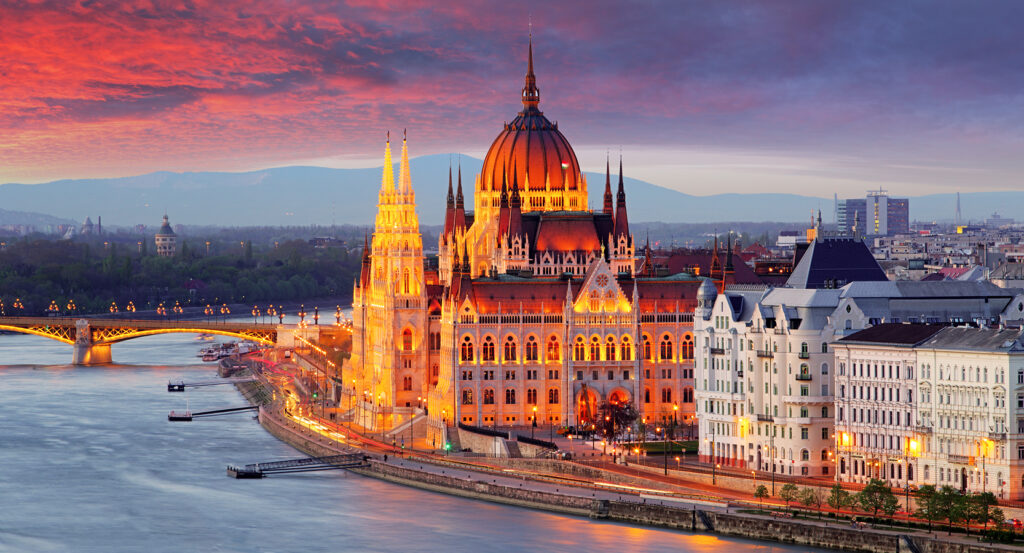
Why InterContinental Budapest matters.
InterContinental Budapest is a Danube-front hotel where József Finta's late socialist modernism meets Budapest's imperial skyline, the ceremonial scale of Buda Castle and the international culture of the riverfront.
Positioned on Apáczai Csere János utca beside the Danube, InterContinental Budapest stands between the river promenade, the Vigadó concert hall, the commercial streets of Pest and the bridges linking the city with Buda. Its river-facing rooms and public spaces look toward the Castle District, placing medieval rooftops, wooded hills and the broad Danube within the hotel's central visual field. The building occupies a prominent stretch of the Pest embankment where Budapest's nineteenth-century urban expansion meets twentieth-century hotel architecture. Floor-to-ceiling windows, elevated dining rooms and the river promenade create the primary ways to encounter the property. The result is a Budapest hotel whose character depends on its direct relationship with the Danube and the expansive cityscape assembled around it.
What defines InterContinental Budapest.
InterContinental Budapest originated as the Forum Hotel, a landmark development in Hungary's late socialist hospitality industry that opened on November 28, 1981, during the reconstruction of the capital's international tourism infrastructure. Its development formed part of a state-backed hotel construction program financed through an Austrian-Hungarian credit agreement, with Austrian construction participation supporting a new generation of international-standard properties. Construction began in July 1979 under the direction of HungarHotels, the Hungarian state hospitality enterprise responsible for the property. Architect József Finta, among the leading figures of Hungarian late modernism, designed the building through LAKÓTERV, extending an architectural career that had already transformed Budapest's hotel landscape through the Duna InterContinental. Interior designer László Király contributed to the original project, whose extensive glazed riverfront elevation introduced a striking modernist composition to the historic Danube panorama. The hotel's arrival formed part of a larger architectural transformation that included the neighboring Atrium Hyatt, creating a concentrated international hospitality district along the Pest embankment. Finta also designed the hotel's Viennese Café, whose Central European coffeehouse character became an established feature of the property until its eventual transformation during the following decades. The development proved commercially successful within Hungary's state hospitality system, with its original fifteen-year construction loan repaid during the seventh year of operation. Following the political and economic transition of 1989, the Forum entered Hungary's hotel privatization program, transferring to the state privatization agency ÁPV Rt. in 1994. A contested sale process ultimately brought the property under InterContinental ownership in November 1996, with the international hotel group acquiring a 95 percent interest before purchasing the remaining employee-held shares. The hotel adopted the InterContinental Budapest name in May 1997, beginning a substantial transformation of its physical infrastructure and international hospitality positioning. Architectural practice CMA directed a three-phase renovation completed between 1998 and September 2000, upgrading accommodations, operational facilities and public interiors before introducing a new ballroom, conference infrastructure and health club. The redevelopment established the former Forum as a five-star international hotel, strengthening its role in Budapest's expanding corporate, diplomatic and tourism economy. In June 2014, Dubai-based Al Habtoor Group acquired the property under the leadership of founder Khalaf Ahmad Al Habtoor, extending the company's European hospitality investments. The transaction joined the group's growing Hungarian portfolio, which subsequently included The Ritz-Carlton, Budapest, reinforcing the capital's importance within its international luxury hotel strategy. The hotel's evolution from a state-financed modernist development into an internationally managed luxury property reflects the transformation of Hungarian hospitality across the socialist period, post-communist privatization and contemporary international investment.
How InterContinental Budapest fits.
InterContinental Budapest works as the opening point for a daytime itinerary connecting Budapest's nineteenth-century infrastructure, medieval royal landscape and twentieth-century memorial culture along the Danube.
Begin at Széchenyi Chain Bridge, the first permanent bridge to connect Buda and Pest across the Danube and one of the engineering projects that made modern Budapest possible. Count István Széchenyi drove the political and financial effort behind the crossing, and banker György Sina arranged the capital required for construction. English engineer William Tierney Clark designed the bridge, while Scottish engineer Adam Clark supervised its local construction between 1839 and 1849. The bridge opened on 20 November 1849 after a project whose final cost reached 6.2 million forints, more than half of Hungary's annual revenue at the time. Continue to Buda Castle Quarter, where the bridge leads into the royal history that shaped the western bank. King Béla IV ordered a fortress on Castle Hill after the Mongol invasion of 1241 and 1242 destroyed settlements across Hungary. The settlement developed into a free royal town and permanent royal residence, later acquiring medieval Gothic and Baroque layers through successive periods of monarchy, Ottoman rule and reconstruction. UNESCO places the Castle Quarter within a wider World Heritage landscape that includes the Danube banks and Andrássy Avenue, recognizing the way the river, bridges, hills and urban architecture operate as one historical composition. Conclude at Shoes on the Danube Bank, the riverside memorial created by filmmaker Can Togay and sculptor Gyula Pauer in 2005. Sixty iron shoes line the embankment in memory of Jewish victims murdered by Arrow Cross militiamen in Budapest during the Second World War. The abandoned footwear transforms the river edge into a restrained memorial, linking an ordinary object with the violence of forced removal and execution. The progression moves from Széchenyi Chain Bridge's technological role in uniting Buda and Pest through Buda Castle Quarter's royal and architectural history and culminates in Shoes on the Danube Bank's confrontation with the city's twentieth-century memory.
Where your story begins.
Foresyte Travel reveals places that feel extraordinary long before you arrive.
Enjoy editorial crafted for luxury travelers.





































































































