
Why you should experience İstiklal Caddesi in Istanbul, Türkiye.
İstiklal Caddesi, or İstiklal Avenue, is Istanbul's beating pulse, a living artery that flows through the soul of modern Turkey.
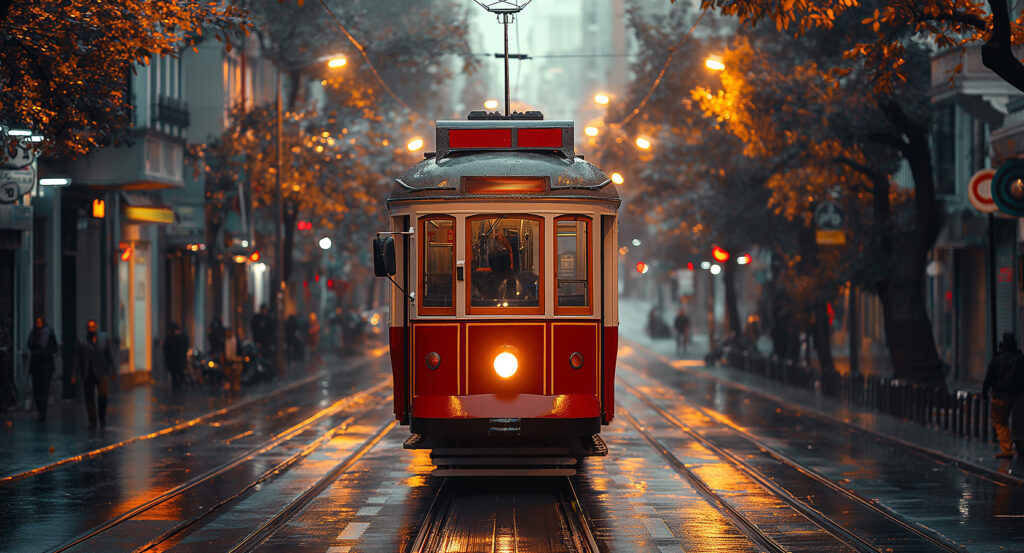
Stretching from Taksim Square to the historic Galata Tower, this grand pedestrian avenue thrums with life at every hour, a mosaic of sound, scent, and color that captures Istanbul's endless contradictions, East and West, sacred and secular, past and future. The scent of roasted chestnuts mingles with the aroma of strong Turkish coffee, while the clang of the nostalgic red tram echoes off 19th-century façades that once housed embassies and grand apartments of the Ottoman elite. Walking here is like slipping between eras: Belle Époque architecture glows beneath neon shop signs; historic cinemas and art galleries share walls with global fashion brands and kebab stalls; street musicians blend folk tunes with electric beats, weaving an ever-evolving soundtrack for the city's restless heart. As the day unfolds, the street transforms, shoppers and artists in the morning, couples and students in the afternoon, revelers and poets by night. Each step reveals another layer of Istanbul's personality: cosmopolitan, rebellious, intoxicatingly alive. The air itself feels electric, humming with conversation in a dozen languages. Above, wrought-iron balconies lean close as if listening. Below, the cobblestones remember everything, revolutions, parades, heartbreaks, and celebrations. İstiklal isn't just a street you walk down; it's a rhythm you fall into.
What you should know about İstiklal Caddesi.
Behind the glamour and commotion of İstiklal lies a story of transformation as dramatic as Istanbul itself.
The street's name, “İstiklal,” means “Independence”, a tribute to the Turkish War of Independence that shaped the nation's modern identity. Yet long before that, it was known as the Grande Rue de Péra, the heart of cosmopolitan life in late Ottoman times. French, Greek, Armenian, Italian, and Jewish merchants once filled its shops, giving the district a distinctly European air. Embassies lined its upper reaches, most still standing today as consulates, while cafés buzzed with intellectual debate and the first trams rattled past in the 19th century, symbols of progress and modernity. When the Republic was founded, the street evolved again, becoming the democratic promenade of the new Turkey. The nostalgic tram, reintroduced in the 1990s, retraces part of the original line, a bridge between memory and motion. Hidden above its storefronts are art galleries, old theaters, and the former lodgings of literary legends like Orhan Pamuk. Even more secret are the churches tucked behind inconspicuous doors, the Church of St. Anthony of Padua with its neo-Gothic red brick façade, the Greek Orthodox Church of the Holy Trinity, and small chapels that whisper of the district's multi-faith roots. Few visitors realize that İstiklal has also been the stage for pivotal moments in modern Turkish history: political marches, student demonstrations, and jubilant New Year celebrations that mirror the city's resonant extremes. Every renovation, from cobblestone restorations to tram relaunches, becomes an act of renewal, preserving the soul of a street that refuses to stand still. In a sense, İstiklal is a microcosm of Istanbul itself, layered, luminous, and alive with contradiction.
How to fold İstiklal Caddesi into your trip.
Exploring İstiklal Caddesi is not an errand, it's a ritual of immersion that begins and ends in motion.
Start at Taksim Square, the symbolic heart of modern Istanbul, and let the tram's slow bell guide you downward through a symphony of life. Stroll past the flower stalls and bookshops that have anchored the boulevard for decades. Step into the Çiçek Pasajı (Flower Passage), a glittering arcade filled with restaurants serving meze and raki under chandeliers that cast warm, nostalgic light. Stop for a Turkish coffee at Mandabatmaz, among the city's most beloved cafés, where the brew is thick enough to hold a spoon upright. Then wander off the main drag into the side streets, Galatasaray's narrow lanes, where antique stores and art studios breathe slower rhythms, or Asmalımescit, whose wine bars and jazz clubs come alive after dark. Don't miss the Pera Museum, a sanctuary of art and history that offers a quieter reflection amid the chaos. Continue your descent toward the Galata Tower, whose silhouette has watched over İstiklal's changing centuries. At sunset, climb its ancient stairs to see the street as a glowing ribbon cutting through the heart of the city. When night falls, return to İstiklal for its second act, when street performers tune their guitars, the tram clinks softly in the distance, and the crowd pulses like a living tide. Here, you feel Istanbul as it truly is, timeless yet urgent, elegant yet untamed. İstiklal Caddesi is more than a place to visit. It's a story you walk through, written in footsteps, light, and sound, and one you'll hear echoing long after you've left.
Where your story begins.
Foresyte Travel reveals places that feel extraordinary long before you arrive.
Experience premium editorial crafted for luxury travelers.





































































































