
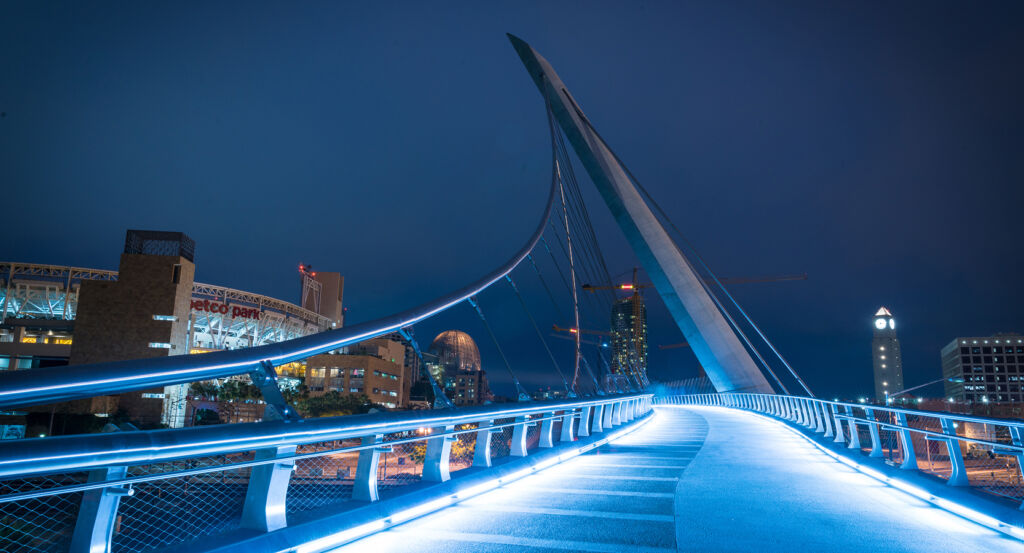
Why Ivy Street matters.
Ivy Street is a graceful corridor where Bankers Hill's architectural sophistication, hillside scenery, cultural heritage, and urban refinement converge along one of San Diego's most distinguished residential streets.
Running through Bankers Hill between Hillcrest and Little Italy, the corridor traverses elevated terrain overlooking San Diego Bay, connecting architect-designed residences, mature tree canopies, neighborhood institutions, and panoramic canyon views that collectively reflect more than a century of thoughtful urban planning. Prairie School homes, Spanish Colonial Revival residences, Mid-century Modern apartments, California sycamores, jacarandas, Moreton Bay figs, and hand-built stone retaining walls establish a streetscape where architecture remains inseparable from the surrounding topography. Throughout the corridor, exceptional craftsmanship, landscape-sensitive design, and enduring preservation reinforce an atmosphere shaped by generations of architectural stewardship. The result is an experience defined by elevated scenery, historical richness, and one of Bankers Hill's most memorable residential corridors.
What defines Ivy Street.
Ivy Street is best known for extending through Bankers Hill, whose development accelerated after 1906 with the completion of the Cabrillo Canyon Bridge, strengthening access between Downtown and the communities surrounding what became Balboa Park following the 1915 Panama-California Exposition. The corridor preserves an exceptional collection of Prairie School, Craftsman, Spanish Colonial Revival, Mission Revival, and Mid-century Modern residences distinguished by hand-troweled stucco, clinker-brick chimneys, decorative leaded-glass windows, redwood millwork, exposed rafter tails, and clay barrel roof tiles representing successive architectural movements between the early twentieth century and the postwar era. Architects including Irving Gill, William Templeton Johnson, Richard Requa, and Louis Gill contributed influential residential commissions throughout Bankers Hill, integrating terraces, retaining walls, formal gardens, and hillside siting into designs that responded directly to the area's dramatic terrain. Mature coast live oaks, California sycamores, jacarandas, Allen's hummingbirds, monarch butterflies, western scrub-jays, and drought-tolerant native vegetation continue reinforcing the corridor's established urban canopy. Together, these transportation milestones, architectural movements, influential designers, traditional building materials, and enduring ecological resources establish Ivy Street as a defining expression of Bankers Hill's historical evolution.
Hillside residential planning encouraged architects to compose homes around natural grades rather than imposing rigid street grids, allowing masonry stairways, garden courts, broad verandas, and stone retaining walls to become defining elements of the corridor's architectural identity. Original decorative wrought iron, hand-crafted wood joinery, stained art glass, fired-clay roof tile, and artisan masonry remain preserved throughout many early residences, demonstrating the exceptional craftsmanship associated with Bankers Hill's formative decades. The remarkable continuity of architect-designed homes has enabled the corridor to retain a cohesive visual narrative despite successive generations of residential investment and careful restoration. Together, these landscape-responsive design principles, enduring construction methods, and exceptionally intact architectural fabric demonstrate how Ivy Street developed within one of San Diego's finest historic hillside neighborhoods.
How Ivy Street fits.
Ivy Street works as an exploration of Bankers Hill's architecture, cultural heritage, and elevated landscapes.
Begin at Marston House Museum & Gardens, where preserved Arts and Crafts architecture introduces the residential elegance that has long distinguished Bankers Hill. Continue to Balboa Park Botanical Building, whose restored horticultural collections deepen appreciation for the artistic and landscape traditions surrounding the neighborhood. Conclude at Museum of Us, where the California Building's celebrated Spanish Colonial Revival architecture provides the historical payoff while interpreting the cultural ambitions of the 1915 Panama-California Exposition. The progression moves naturally from residential architecture through cultivated gardens before culminating in one of Balboa Park's defining cultural institutions, revealing why Ivy Street remains one of Bankers Hill's most distinguished residential corridors.
Where your story begins.
Foresyte Travel reveals places that feel extraordinary long before you arrive.
Enjoy editorial crafted for luxury travelers.
Foresyte may earn a commission when you book.





































































































