
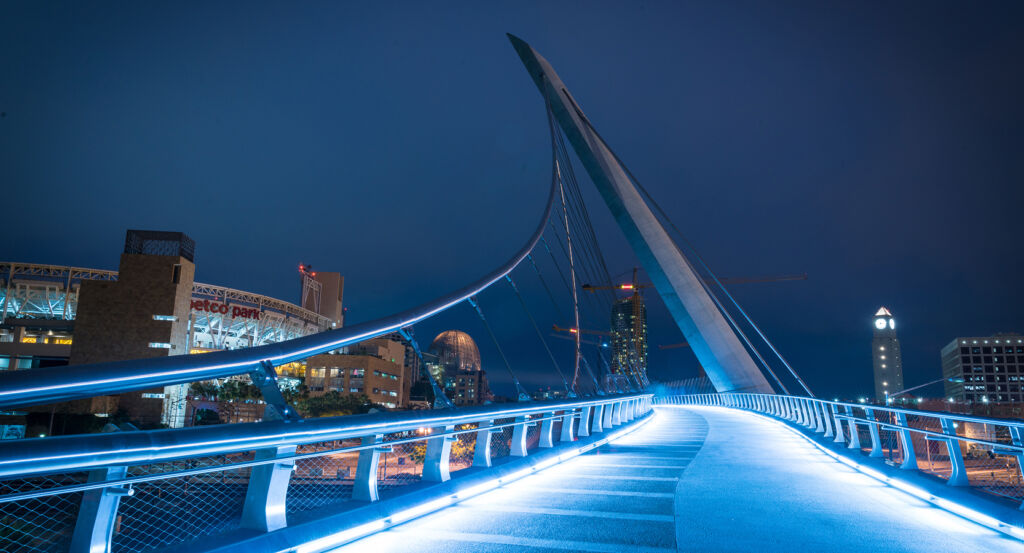
Why you should experience Kurtz Street in San Diego, California.
Kurtz Street is an enterprising corridor where Midway District's industrial heritage, military legacy, maritime economy, and entrepreneurial character converge along one of western San Diego's most enduring commercial streets.
Running through Midway District between Point Loma and Mission Hills, the corridor links long-established industrial properties, marine businesses, neighborhood services, and transportation corridors that collectively reflect more than a century of waterfront commerce and urban evolution. Mid-century industrial buildings, marine fabrication facilities, landscaped boulevards, Canary Island date palms, coast live oaks, and broad streetscapes establish an environment where commercial enterprise remains inseparable from San Diego's working harbor. Throughout the corridor, maritime industry, skilled craftsmanship, and steady reinvestment reinforce an atmosphere shaped by generations of shipbuilding, logistics, and coastal commerce. The result is an experience defined by authentic waterfront character, economic resilience, and one of San Diego's most consequential working corridors.
What you should know about Kurtz Street.
Kurtz Street is best known for extending through the Midway District, whose modern character emerged alongside the rapid expansion of Naval Training Center San Diego, San Diego Bay's maritime industries, and Lindbergh Field during the twentieth century, establishing the surrounding area as one of Southern California's principal centers for military, aviation, and harbor-related commerce. The corridor evolved within a district transformed by former tidelands reclaimed during the early twentieth century, creating new industrial acreage that supported marine manufacturing, ship repair, warehousing, transportation firms, and businesses serving the expanding United States Navy presence along the waterfront. Industrial buildings surrounding Kurtz Street introduced reinforced-concrete framing, structural steel construction, sawtooth roof profiles, clerestory glazing, and expansive loading bays designed to accommodate marine fabrication, freight handling, and commercial distribution throughout successive decades of growth. California fan palms, coast live oaks, eucalyptus, Anna's hummingbirds, western gulls, double-crested cormorants, and drought-tolerant coastal vegetation continue contributing to the corridor's resilient urban landscape. Together, these military milestones, engineering traditions, industrial architecture, maritime enterprises, and ecological resources establish Kurtz Street as a defining expression of the Midway District's historical evolution.
Marine engineering became the corridor's defining economic thread as ship repair specialists, metal fabricators, rigging companies, and precision manufacturers supplied vessels operating throughout San Diego Bay, reinforcing the area's reputation for highly specialized waterfront industries. Durable reinforced concrete, exposed structural steel, overhead crane systems, heavy timber roof framing, and original steel sash windows remain visible across many surviving industrial buildings, preserving construction techniques specifically adapted to demanding maritime production. The continued presence of marine-oriented businesses has allowed the corridor to retain a tangible connection to San Diego's working harbor while successive reinvestment has preserved much of its industrial character. Together, these specialized industries, enduring engineering materials, and preserved industrial architecture demonstrate how Kurtz Street developed within a corridor whose significance is inseparable from San Diego's maritime economy.
How to fold Kurtz Street into your trip.
Kurtz Street works as an exploration of San Diego's naval heritage, waterfront industry, and maritime history.
Begin at Liberty Station, where preserved Spanish Colonial Revival buildings introduce the former Naval Training Center and the military history that shaped the surrounding district. Continue to Spanish Landing Park, whose shoreline pathways and panoramic harbor views deepen appreciation for the working waterfront that continues defining the Midway District. Conclude at Maritime Museum of San Diego, where one of the world's foremost collections of historic vessels provides the historical payoff by illustrating the centuries of shipbuilding, navigation, and Pacific seafaring that continue influencing San Diego's harbor. The progression moves naturally from preserved naval architecture through active waterfront landscapes before culminating in one of California's premier maritime collections, revealing why Kurtz Street remains a defining commercial corridor within the Midway District.
Where your story begins.
Foresyte Travel reveals places that feel extraordinary long before you arrive.
Experience premium editorial crafted for luxury travelers.





































































































