
Why Liberty Station matters.
Liberty Station is a historic waterfront district where Point Loma's maritime character meets Spanish Colonial Revival architecture, expansive public grounds and the reinvention of a former United States Navy training complex.
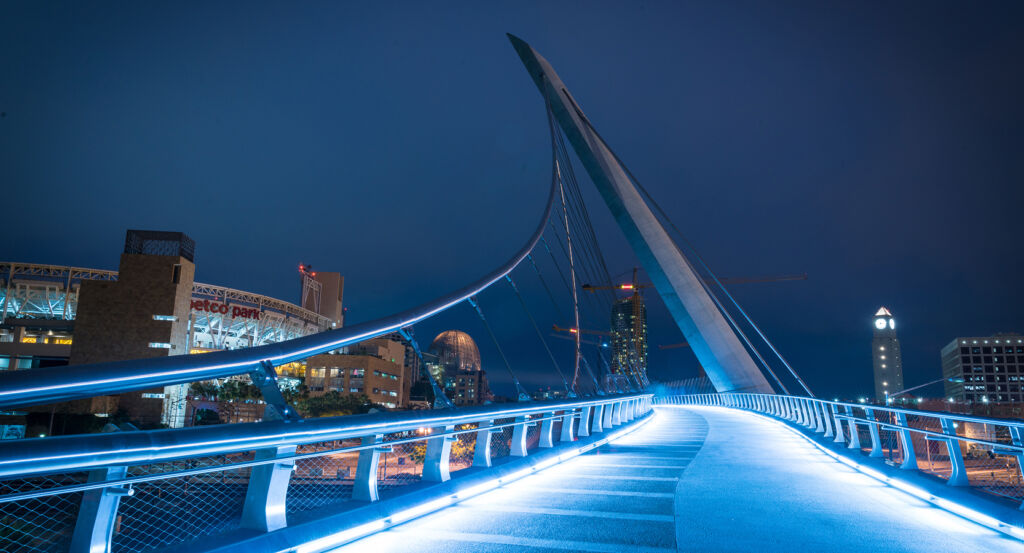
Set along Historic Decatur Road near Rosecrans Street and just steps from Spanish Landing Park, the district occupies 361 acres at the northern edge of San Diego Bay, where former military grounds extend between a sheltered boat channel, residential Point Loma and the airport corridor across the water. A cruciform landscape organizes the historic core through long axial greens, symmetrical courtyards, parallel walkways and rows of mature trees framed by low stucco buildings with tiled roofs and arcaded elevations. Broad lawns and pedestrian passages carry movement through the former base at a scale inherited from military assembly, opening repeated sightlines between building groups and landscaped courts. The eastern edge changes character again as the ordered architectural core gives way to waterfront parkland and an esplanade running beside the channel. The result is a former naval campus whose axial planning, Spanish Colonial Revival architecture, immense lawns and bayfront geography preserve the spatial coherence of a military institution within contemporary San Diego.
What defines Liberty Station.
Liberty Station is best known for occupying the former Naval Training Center San Diego, whose origins grew from the city's campaign to secure a permanent Navy training facility on Point Loma. Congressman William Kettner championed San Diego's military development in Washington, and Franklin D. Roosevelt examined the area as a prospective training site during his tenure as assistant secretary of the Navy. Congress authorized the center in 1919, construction began in 1921 and the Naval Training Station was commissioned in 1923 on an original 235-acre property. Architect Lincoln Rogers shaped the first architectural phase under the influence of Bertram Goodhue's work for the 1915 Panama-California Exposition, giving the station its defining Spanish Colonial Revival character. The base expanded rapidly during World War II, tripling in size and reaching a wartime peak population of 33,000 personnel in 1942. Women arrived for training in May 1943, and the secretary of the Navy changed the installation's name to Naval Training Center in 1944 as specialized schools assumed a larger role. Expansion eventually carried the installation to 550 acres and more than 300 buildings containing close to three million square feet. Across its operating history, 1.75 million recruits and another one million sailors attending advanced schools graduated from the center, making the property a major component of San Diego's twentieth-century relationship with the Navy.
The 1993 Base Realignment and Closure process initiated a radically different chapter for the property, and active military use ended on April 30, 1997. San Diego had already entered a master lease with the Navy in 1995, allowing buildings to accommodate nonprofit organizations, film companies, municipal departments and small businesses during the transition. A June 2000 deed transferred the former training center to the city, and the Corky McMillin Companies became master developer as rehabilitation advanced across the former base. The NTC Foundation formed that year with a cultural mission centered on 26 historic buildings, eventually developing a 100-acre arts campus from a portion of the former military complex. The historic district entered the National Register of Historic Places in 2001, recognizing architecture and military history spanning the station's formative decades. Arts District Liberty Station opened its first building in 2006, followed by successive rehabilitation phases that placed studios, galleries, cultural organizations and educational programs inside former Navy structures. Liberty Public Market opened in 2016 inside the former mess hall and commissary, carrying another surviving military building into a public food hall. The conversion received a California Governor's Historic Preservation Award in 2021, marking the former training center's rehabilitation as one of the state's significant preservation projects.
How Liberty Station fits.
Liberty Station works as the anchor for a Point Loma outing connecting early twentieth-century women's civic philanthropy, the peninsula's military history and the sixteenth-century voyage that placed San Diego Bay within European maritime exploration.
Begin at The Thursday Club, an organization formed in 1921 when four San Diego women created a club combining social activity with civic and charitable work. John Mills of the Pantages-Mills-Shreve Company granted the organization land in the Sunset Cliffs area in 1927, allowing the group to create a permanent clubhouse overlooking the Pacific; the organization subsequently developed a century-long philanthropic history that includes its annual rummage sale supporting San Diego charitable causes. Continue south along the peninsula to Fort Rosecrans National Cemetery, whose origins reach to a military post cemetery created in 1882 on ground associated with San Diego's earliest American coastal defenses. Fort Rosecrans received the name of Civil War general William Starke Rosecrans in 1899, and the cemetery became the burial place for sailors killed when a boiler exploded aboard USS Bennington on July 21, 1905, killing 60 crewmen. Thirty-five remain together beneath a granite obelisk erected by the Pacific Squadron, and the cemetery now holds more than 120,000 interments extending back to people who died in 1846. Conclude at Cabrillo National Monument, where the southern crest of Point Loma overlooks the entrance to San Diego Bay associated with Juan Rodríguez Cabrillo's arrival on September 28, 1542. Cabrillo sailed north from Navidad commanding three vessels and entered the harbor he named Puerto de San Miguel, marking the first European expedition to reach the bay and initiating contact with the Kumeyaay people already occupying the region. President Woodrow Wilson designated a half-acre at Point Loma as Cabrillo National Monument in 1913, and a later statue by Portuguese sculptor João Chartes Almeida replaced an earlier work damaged by the marine environment. The surrounding headland subsequently became integral to San Diego's coastal defenses during both world wars, when gun batteries, searchlights, bunkers and fire-control stations guarded the harbor approaches. The progression moves from The Thursday Club's century of Point Loma civic philanthropy through Fort Rosecrans' military burials and culminates at Cabrillo National Monument, carrying the peninsula from twentieth-century community life through American coastal defense to the maritime encounter of 1542.
Where your story begins.
Foresyte Travel reveals places that feel extraordinary long before you arrive.
Enjoy editorial crafted for luxury travelers.
Foresyte may earn a commission when you book.





































































































