
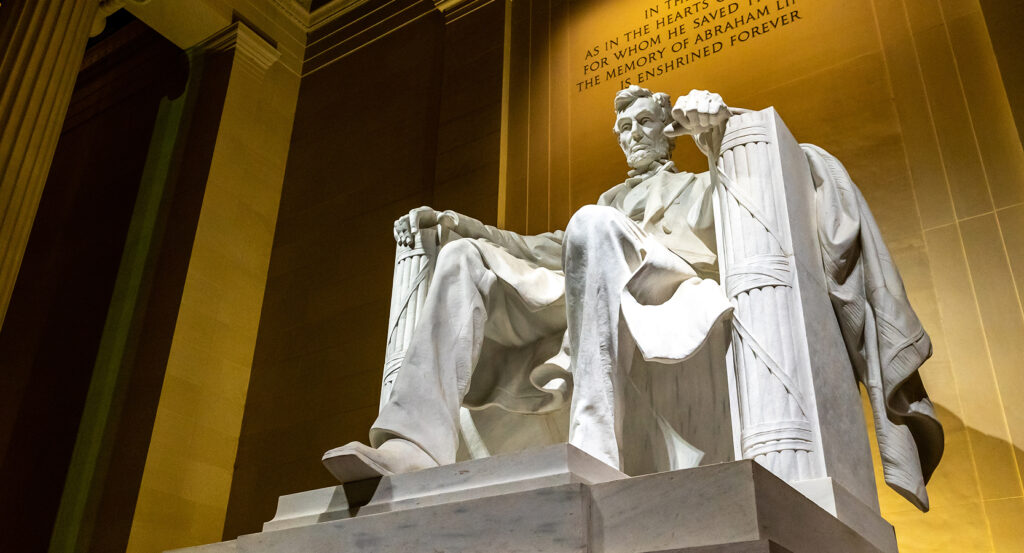
Why you should experience Freedman's Memorial in Washington, D.C.
The Emancipation Inscription Wall within the Lincoln Memorial captures the soul of a nation in transition, from division to renewal, from war to moral clarity.
Etched into the north chamber wall, the full text of Abraham Lincoln's Second Inaugural Address stands in solemn balance opposite the Gettysburg Address Inscription Wall. It's here that Lincoln reflects not on victory, but on the price of freedom, his words resonating through the marble with haunting grace: “With malice toward none, with charity for all…” Standing before the inscription, you can almost feel the tension of a country emerging from war, its leader seeking forgiveness. The wall's sheer size draws the eye upward, the text cascading like scripture down pale stone. As the light from the open chamber filters across the engraved words, they seem to glow faintly, a visual echo of the compassion that guided Lincoln's hand. Few places in Washington radiate such quiet dignity; this wall transforms history into prayer.
What you should know about Freedman's Memorial.
The Emancipation Inscription Wall, bearing the Second Inaugural Address, was carved into the Lincoln Memorial in 1922, the same year the monument was dedicated.
Its placement was no accident. Architect Henry Bacon designed the memorial so that the Gettysburg Address would represent the sacrifice of war, while the Second Inaugural, often called Lincoln's sermon on reconciliation, would embody the moral aftermath. The wall's inscription contains 701 words precisely, each chiseled by the Piccirilli Brothers, who also sculpted Lincoln's statue. Unlike the other inscriptions, this wall includes visible signs of hand-carving, left intentionally imperfect to emphasize the human struggle behind Lincoln's message. The text references slavery with an unflinching honesty rarely found in 19th-century oratory, acknowledging divine justice and national accountability in equal measure. Over time, this inscription has become a touchstone for civil rights leaders and visitors alike, serving as a reminder that emancipation was not merely a policy but a moral awakening, one still unfolding in the conscience of the nation.
How to fold Freedman's Memorial into your trip.
When visiting the Lincoln Memorial, approach the Emancipation Inscription Wall slowly, from the statue's left side, the light and shadow along the text reveal its depth and texture best in the late afternoon.
Read the speech aloud if you can; its rhythm and rhetoric carry the cadence of a sermon, not a speech. The words take on special gravity when contrasted with the Gettysburg Address across the hall, together, they form Lincoln's moral bookends: one promising rebirth, the other offering redemption. For photographers, the soft interior glow after sunset gives the inscriptions an ethereal, candlelit effect, perfect for capturing their quiet authority. Afterward, step outside to the memorial steps and look east across the Reflecting Pool, it's a natural continuation of the wall's message, a symbol of reflection in both word and water. The Emancipation Inscription Wall reminds every visitor that freedom's story is not finished, it's written, like these words, one enduring line at a time.
Where your story begins.
Foresyte Travel reveals places that feel extraordinary long before you arrive.
Experience premium editorial crafted for luxury travelers.







































































































