
Why Los Angeles Zoo matters.
Los Angeles Zoo is an expansive zoological institution where Griffith Park's chaparral-covered terrain meets global wildlife conservation, botanical collections and animal habitats distributed across 133 acres.
Set along Zoo Drive near Western Heritage Way and just across from the Autry Museum of the American West, the zoo occupies a broad basin at Griffith Park's northern edge beneath the surrounding Santa Monica Mountains foothills. Winding paths climb and descend through mature vegetation and geographically organized habitat zones, using the site's changing elevations to separate animal areas and create long internal sightlines across the campus. More than 1,700 mammals, birds, amphibians, fish and reptiles representing over 270 species inhabit the grounds, giving the zoological landscape substantial biological breadth. Botanical collections add more than 800 plant species and 7,000 individual plants, including cycads, Chilean wine palms, bald cypress, California natives and arid-climate specimens that also provide browse, shade and habitat structure. The result is a large zoological landscape where hillside topography, extensive planting, hundreds of animal species and specialized habitat zones distribute the institution across one of Griffith Park's broadest developed areas.
What defines Los Angeles Zoo.
Los Angeles Zoo is best known for developing from a municipal zoological collection into a major conservation institution with an unusually deep history of captive breeding, veterinary innovation and species recovery. The present zoo opened on November 28, 1966 after relocating from the Griffith Park Zoo, with Mayor Sam Yorty, the United States Army color guard and Los Angeles Symphonic Band participating in the opening ceremonies. Harpy eagle work began that same year with the arrival of a male from Parque las Leyendas in Peru, followed by a female from Ecuador in 1970 and the first harpy eagle chicks hatched in the United States. A captive hatching of the dog-toothed cat snake earned the institution its first Association of Zoos and Aquariums Edward H. Bean Award in 1971, followed in 1977 by two striking zoological achievements: Caesar became the first gorilla successfully delivered by Cesarean section, and a mountain tapir became the first of its species born in a zoo. Los Angeles had already produced successful births among Brazilian, Malayan and Baird's tapirs, making the institution the first zoo to breed all four recognized tapir species. Eight Arabian oryx were transported to Israel's Hai-Bar Reserve in 1978, contributing to an international reintroduction campaign for a species that had disappeared from the wild six years earlier. A dedicated research department followed in 1981, making Los Angeles only the eleventh American zoo with such a unit, and the North Hollywood High School Zoo Magnet established during the same year joined secondary science education directly with zoological resources. A consortium involving Los Angeles Zoo and the Duke Lemur Center later helped form the Madagascar Fauna Group, and the zoo produced the first successful Coquerel's sifaka birth outside Madagascar in 1992.
California condor recovery forms another consequential chapter in the institution's scientific history. The wild population had fallen to 22 birds by 1982, and the last free-ranging condor entered human care in 1987 as the U.S. Fish and Wildlife Service, Los Angeles Zoo, San Diego Zoo and other partners pursued intensive breeding and reintroduction. Los Angeles specialists developed techniques including double brooding to increase chick production, combining reproductive management with rehabilitation, partner training and preparation of birds for release. Releases began in 1992, eventually returning condors to portions of California, Arizona, Utah and Baja California as the total population climbed above 500. The zoo had contributed 250 condors to the recovery program by 2024, making its breeding work a substantial component of one of North America's most prominent endangered-species interventions. Topatopa, a male brought to Los Angeles as a malnourished fledgling, became the world's oldest known California condor when he reached 50 in 2016, tying an individual animal's life directly to the species' recovery from near extinction. Veterinary capacity expanded on another front with the 50,000-square-foot animal health facility opened in 2002 and later named the Gottlieb Animal Health and Conservation Center, incorporating surgery, intensive care, multiple animal wards and quarantine infrastructure into a dedicated medical complex. The condor program and veterinary center place reproductive science, medical care and reintroduction at the center of the zoo's conservation work.
How Los Angeles Zoo fits.
Los Angeles Zoo works as the anchor for a Griffith Park outing connecting preserved railroad technology, early twentieth-century amusement design and Los Angeles astronomy.
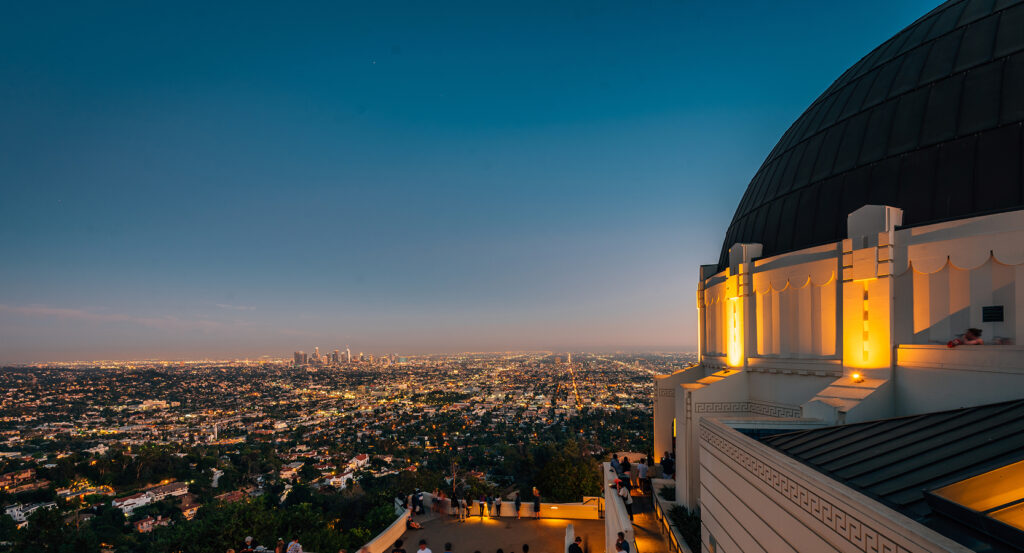
Begin at Travel Town Museum, whose origins reach to Recreation and Parks employee Charley Atkins and fellow rail enthusiasts seeking a retired steam locomotive for Griffith Park during the closing years of the steam era. Two Los Angeles Harbor Department engines destined for scrap expanded that idea into a collection, and Atkins secured further donations from California railroads with support from George Hjelte and William Frederickson. Travel Town was dedicated on December 14, 1952 as a transportation-oriented recreation center where children had direct access to retired machinery. Its surviving collection spans locomotives, passenger cars, freight equipment and cabooses, including Union Pacific Caboose 2117 from 1881 and Western Pacific locomotive 26, built by American Locomotive Company's Schenectady Works in 1909. Continue to Griffith Park Merry-Go-Round, built by Spillman Engineering Company in 1926 and relocated to Griffith Park in 1937. Its 68 carved horses are all jumpers, embellished with jeweled bridles, draped blankets, sunflowers and lion heads, preserving the elaborate decorative craft of large American carousels. A Stinson 165 Military Band Organ accompanies the machine with a repertoire exceeding 1,500 marches and waltzes. The carousel arrived during a period when Depression-era public investment reshaped Griffith Park through trails, recreation areas and federally supported construction, placing the attraction within a much larger expansion of Los Angeles public recreation. Conclude at Griffith Observatory, completed in 1935 during the same major period of park development and conceived as a public institution devoted to astronomy. Griffith J. Griffith had donated the surrounding parkland to Los Angeles in 1896 and later funded an observatory intended to make astronomical observation accessible to the public, establishing a scientific institution on Mount Hollywood that joined telescopic observation with exhibitions and planetarium programming. The building's commanding position above the Los Angeles basin connected public astronomy with direct observation of the city and sky, giving Griffith Park a scientific institution whose reach extended far beyond conventional park recreation. The progression moves from Atkins's preservation of disappearing railroad machinery through Spillman Engineering Company's elaborate carousel craft and culminates in a hilltop institution devoted to public astronomy, tracing three distinct forms of education and recreation across Griffith Park.
Where your story begins.
Foresyte Travel reveals places that feel extraordinary long before you arrive.
Enjoy editorial crafted for luxury travelers.
Foresyte may earn a commission when you book.





































































































