
Why Zoo Drive matters.
Zoo Drive is a wooded corridor where Griffith Park's urban-wilderness character meets broad foothill scenery, animal-focused institutions and a northern park edge shaped by the Santa Monica Mountains and Los Angeles River.
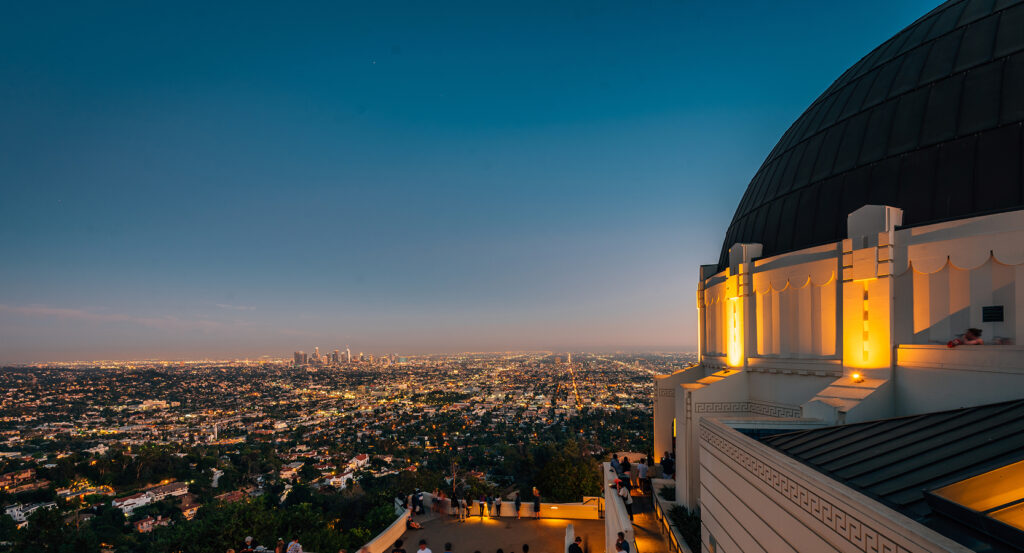
Running through Griffith Park between Los Feliz and Burbank, the parkland corridor curves across the northern floor of the park from Crystal Springs Drive toward Forest Lawn Drive, passing beneath slopes that rise into the eastern Santa Monica Mountains as the Los Angeles River follows the park's outer edge. Broad lawns, mature trees and open hillsides give the roadway a spacious physical character, with the enclosing terrain shifting between planted parkland and dry chaparral-covered ridges. Movement westward carries the road away from the Golden State and Ventura freeways into a quieter interior where long curves follow the base of the hills and mountain landforms increasingly define the view. Changes in elevation remain gentle along the roadway itself, leaving the steeper topography to rise immediately beyond the corridor and creating an unusually broad transition between metropolitan infrastructure and Griffith Park's interior landscape. The result is a Los Angeles corridor whose open terrain, mountain backdrop, river-edge geography and sustained parkland setting compress the northern reaches of Griffith Park into a remarkably legible cross-section of the city's largest urban wilderness.
What defines Zoo Drive.
Zoo Drive is best known for becoming the northern approach to a new generation of Griffith Park institutions during the immense postwar expansion of Los Angeles. The roadway itself predates that transformation, appearing with Griffith Park Drive on topographic maps from 1926 and 1928 before freeways reshaped the park's northern and eastern boundaries. Interstate 5 reached the eastern edge of Griffith Park in 1957, separating the park from its historic relationship with the Los Angeles River, and State Route 134 followed along the northern boundary during the 1960s. Those transportation projects placed Zoo Drive beside one of Southern California's major freeway junctions just as Los Angeles pursued a replacement for the aging Griffith Park Zoo. Voters approved a $6.6 million bond in 1956 for a new zoological complex, reviving an effort that had included Cornell & Shearer's examination of replacement sites in 1939 before World War II interrupted development. The resulting Los Angeles Zoo occupied 133 acres in the northeastern park and cost $10 million by the time its gates opened on November 28, 1966. Mayor Sam Yorty joined a United States Army color guard and the Los Angeles Symphonic Band for the opening ceremonies, marking the transfer of the city's zoological center two miles north from its earlier Griffith Park location. Zoo Drive became inseparable from the postwar remaking of northern Griffith Park, where freeway construction and a substantially larger zoological complex changed a prewar park road into the principal approach to a major metropolitan institution.
Another major chapter arrived in 1988 as the corridor gained a museum devoted to the history and cultural representation of the American West. Jackie and Gene Autry joined Joanne and Monte Hale in founding the institution, placing a new cultural destination across from the zoological complex on the roadway segment now named Western Heritage Way. Walt Disney Imagineers designed seven inaugural exhibitions titled around Opportunity, Conquest, Community, Cowboy, Discovery, Romance and Imagination, organizing the opening galleries across historical objects, art and artifacts connected with Western popular culture. The institution expanded far beyond its founding collection through a 2003 merger joining the Autry Museum of Western Heritage, Southwest Museum of the American Indian and Women of the West Museum. That consolidation brought the Southwest Museum's extensive Native American holdings into an institution whose collection has grown beyond 600,000 works of art, objects and cultural holdings. The museum's development shifted the eastern end of Zoo Drive beyond its zoological role, giving the corridor another institution concerned with the histories and cultural representations of the American West.
How Zoo Drive fits.
Zoo Drive works as the anchor for a Griffith Park sequence tracing Southern California railroading from preserved full-scale equipment through model engineering and into Walt Disney's personal railroad workshop.
Begin at Travel Town Museum, whose origins reach to a 1947 idea by recreation superintendent William Frederickson Jr. to give Los Angeles children direct access to transportation equipment. Recreation and Parks employee Charley Atkins subsequently solicited obsolete railroad equipment as steam power disappeared from commercial service, and Southern Pacific responded with locomotive 3025, a 115-ton passenger engine built by American Locomotive Company in 1904. Belyea Truck Company hauled the locomotive from Glendale in October 1952, beginning a collection that quickly gained a Los Angeles Transit Lines streetcar, Union Pacific caboose, Pacific Electric Sierra Vista waiting station and other transportation artifacts. Travel Town Museum received its formal dedication on December 14, 1952, turning a flat section of Griffith Park into a permanent home for machinery spanning several eras of western transportation. Continue to Los Angeles Live Steamers Railroad Museum, formed in 1956 after Southern California model railroaders gathered at Travel Town on September 9 to discuss creating a Los Angeles club. 35 members joined later that month, beginning a volunteer-built railroad devoted to live steam, gas-mechanical and electric technology. Member construction became central to the institution, with locomotives and much of the surrounding railroad infrastructure built by the hobbyists themselves. The resulting miniature railway preserved the engineering culture of live steam beside the full-scale equipment assembled next door, turning this section of Griffith Park into an unusual concentration of operating and preserved railroad technology. Conclude at Walt Disney's Carolwood Barn, the surviving workshop from the Holmby Hills estate where Disney built and maintained equipment for his one-eighth-scale Carolwood Pacific Railroad. Disney constructed the railroad in 1950 and modeled the red barn after a building on the Disney family farm in Marceline, Missouri, using the workshop for model trains and miniature fabrication during the years immediately preceding Disneyland. Disney became a founding member of Los Angeles Live Steamers, binding his private railroad interests to the model-engineering culture already developing in Griffith Park. His family moved the barn to the railroad museum grounds in 1999, where Disney's handmade workbenches, tools and railroad objects preserve the working environment behind his miniature railway. The progression moves from Travel Town Museum's preservation of retired full-scale transportation through Los Angeles Live Steamers Railroad Museum's member-built engineering and culminates inside Walt Disney's Carolwood Barn, connecting three successive expressions of Southern California railroad culture along the western reaches of Zoo Drive.
Where your story begins.
Foresyte Travel reveals places that feel extraordinary long before you arrive.
Enjoy editorial crafted for luxury travelers.
Foresyte may earn a commission when you book.





































































































