
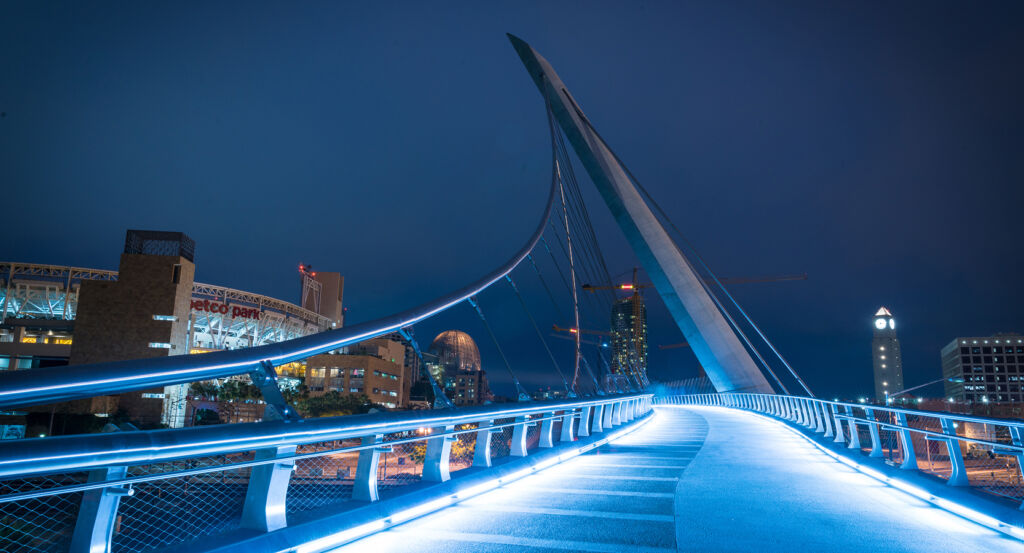
Why you should experience Louisiana Street in San Diego, California.
Louisiana Street is a leafy corridor where North Park's architectural heritage, creative identity, neighborhood continuity, and streetcar-era character converge along one of Central San Diego's most enduring residential streets.
Running through North Park between University Heights and South Park, the corridor follows gently rising terrain lined with historic residences, neighborhood businesses, mature tree canopies, and walkable streets that collectively reflect more than a century of thoughtful urban development. Craftsman bungalows, Spanish Colonial Revival homes, California cottages, jacarandas, coast live oaks, California pepper trees, and broad landscaped parkways establish a streetscape where architecture and neighborhood life remain inseparable. Throughout the corridor, preservation, artistic energy, and residential stewardship reinforce an atmosphere shaped by generations of investment in one of San Diego's most distinctive urban communities. The result is an experience defined by architectural warmth, cultural vitality, and one of North Park's most memorable neighborhood corridors.
What you should know about Louisiana Street.
Louisiana Street is best known for extending through North Park, whose transformation accelerated after developer James Monroe Hartley acquired and subdivided extensive acreage during the 1890s, establishing the structure for one of San Diego's earliest streetcar suburbs. Residential construction surrounding the corridor expanded rapidly following the arrival of the San Diego Electric Railway, producing an exceptional concentration of Craftsman, California Bungalow, Spanish Colonial Revival, Mission Revival, and Prairie School residences distinguished by hand-troweled stucco, exposed rafter tails, clinker-brick chimneys, decorative leaded-glass windows, and finely crafted redwood millwork. Architect Richard Requa and other influential Southern California designers contributed to the architectural style that defined North Park during its principal era of growth, while commercial expansion centered around the neighborhood's early twentieth-century business district reinforced the surrounding residential fabric. Mature coast live oaks, jacarandas, California sycamores, Allen's hummingbirds, monarch butterflies, western scrub-jays, and native drought-tolerant vegetation continue enriching the corridor's established urban landscape. Together, these founding milestones, transportation advances, architectural movements, influential designers, traditional building materials, and ecological features establish Louisiana Street as a defining expression of North Park's historical evolution.
Early residential commissions introduced deep front porches, river-rock foundations, artisan wood joinery, decorative art-glass windows, and hand-laid masonry that reflected the craftsmanship associated with Southern California's finest neighborhood development during the first decades of the twentieth century. North Park's emergence as one of San Diego's leading centers for independent galleries, performing arts, and creative enterprise strengthened the corridor's cultural character while complementing rather than displacing its historic residential character. Careful preservation of original construction materials, mature streetscapes, and architecturally cohesive blocks has allowed successive generations to retain the physical character established during the corridor's formative years. Together, these enduring construction traditions, evolving cultural institutions, and remarkably intact architectural fabric demonstrate how Louisiana Street developed within a corridor whose historic character continues to shape contemporary North Park.
How to fold Louisiana Street into your trip.
Louisiana Street works as an exploration of North Park's architectural heritage, creative culture, and neighborhood character.
Begin at North Park Community Park, where mature landscaping and open gathering spaces introduce the neighborhood's relaxed residential atmosphere before exploring the surrounding streets. Continue to Observatory North Park, whose beautifully restored 1929 theater deepens appreciation for the architectural and cultural traditions that continue defining the district. Conclude at Ray Street Arts District, where galleries, studios, and public art provide the historical and cultural payoff by celebrating the creative character that has become inseparable from modern North Park. The progression moves naturally from neighborhood landscapes through preserved architectural heritage before culminating in one of San Diego's most celebrated arts destinations, revealing why Louisiana Street remains a defining corridor within North Park.
Where your story begins.
Foresyte Travel reveals places that feel extraordinary long before you arrive.
Experience premium editorial crafted for luxury travelers.





































































































