
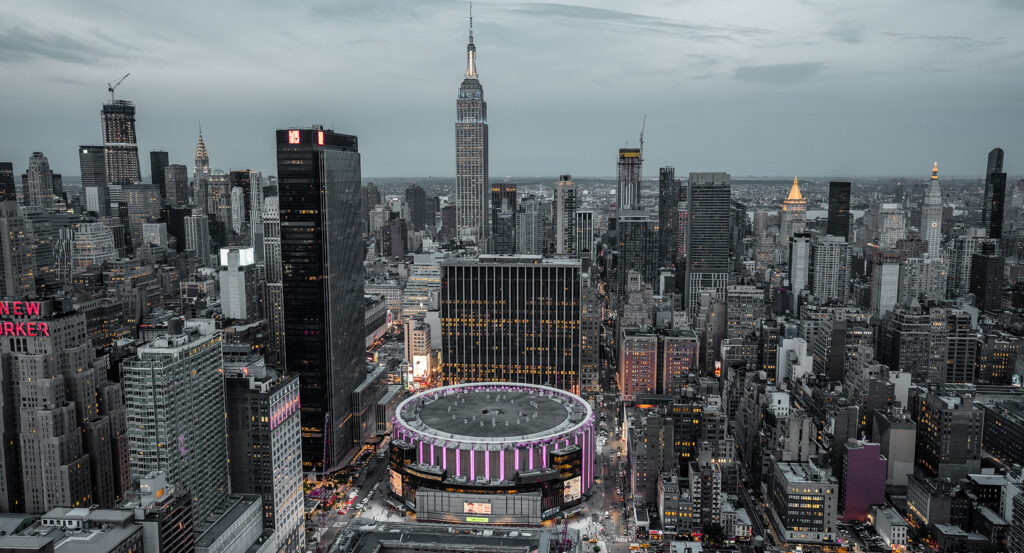
Why Madison Square Garden matters.
Madison Square Garden is a storied circular arena where Midtown South's dense transportation core meets cable-roof engineering, championship sports and a performance history spanning generations of major artists.
Set between Seventh and Eighth avenues near West 33rd Street and just steps from the James A. Farley Building, the arena occupies a full-block superstructure directly above the active tracks and platforms of Penn Station. Charles Luckman Associates shaped the 1968 complex around a cylindrical exterior and a vast interior bowl, concentrating its principal volume above a rail network that severely constrained the placement of structural supports. Severud Associates designed a 404-foot-diameter roof rising 150 feet, with 48 steel cables radiating between a central tension connector and an exterior compression ring to eliminate columns across the arena floor. Existing station columns were reinforced for additional loads, and new supports were threaded between active tracks, allowing the building to rise. The result is a massive arena whose circular shell, cable-supported roof and structural accommodation of Penn Station place entertainment architecture directly above one of the busiest transportation sites in Manhattan.
What defines Madison Square Garden.
Madison Square Garden is best known for concentrating more than half a century of championship sports, major concerts and nationally consequential public events inside the fourth New York building to carry the Garden name. The present arena opened on February 11, 1968 with a USO salute hosted by Bob Hope and Bing Crosby, establishing a new home for the New York Knicks and New York Rangers after the demolition of the previous Garden on 8th Avenue. The Knicks captured the 1970 NBA championship there, defeating the Los Angeles Lakers in Game 7 after Willis Reed emerged from the tunnel despite a severe thigh injury and scored the opening baskets before Walt Frazier produced 36 points and 19 assists. Muhammad Ali and Joe Frazier entered the arena undefeated on March 8, 1971 for the Fight of the Century, with Frazier retaining the heavyweight championship through a unanimous decision after knocking Ali down in the fifteenth round. George Harrison and Ravi Shankar organized the Concert for Bangladesh later that year, assembling Bob Dylan, Eric Clapton, Ringo Starr, Billy Preston and Leon Russell for two benefit performances that became an important precursor to subsequent large-scale musical fundraising events. Frank Sinatra staged his televised Main Event concert there in 1974, and Pope John Paul II celebrated Mass inside the arena during his 1979 visit to New York. The Rangers ended a 54-year Stanley Cup drought on June 14, 1994, defeating the Vancouver Canucks in Game 7 and adding another championship episode to the building's sporting history. The Concert for New York City assembled Paul McCartney, The Who, David Bowie, Elton John, Billy Joel and other performers in October 2001 to support people affected by the September 11 attacks. Billy Joel began a monthly residency in January 2014 after decades of appearances at the arena, extending a musical association that had begun with his first Garden concert in 1978.
A three-year rebuilding campaign between 2011 and 2013 created a separate architectural chapter inside the existing exterior shell. Brisbin Brook Beynon Architects led the architectural work, Severud Associates handled structural engineering and Turner Construction served as general contractor for a project approaching $1 billion. Engineers demolished and rebuilt the seating bowls, raised portions of the roof structure, expanded the 7th Avenue entrance and suspended two new viewing bridges from the existing cable roof. Reworking the upper bowl required temporary bracing for perimeter mast columns before crews removed the old seating structure, installed a new roof frame above the existing one and transferred decades of accumulated axial loading into the raised assembly. More than 50 steel raker beams measuring between 40 and 90 feet supported over 500 precast seating components in the reconstructed upper bowl. The first construction phase debuted in 2011 with a rebuilt lower bowl and expanded sixth-floor concourse; subsequent phases added upper-level openings, new seating zones and hospitality areas. The final 2013 phase added the two suspended bridges, an enlarged 7th Avenue entrance, a center-hung GardenVision display and 18 reconstructed ninth-floor suites, alongside restoration work on the original ceiling. Completing the work demanded 2.6 million labor hours and generated 3,700 union construction jobs, turning the renovation into a major engineering intervention within a building that remained constrained by railroad infrastructure below and its original tension-roof system above.
How Madison Square Garden fits.
Madison Square Garden works as the anchor for a Midtown South outing connecting American fashion scholarship, graphic communication and the private collecting culture of the Gilded Age.
Begin at The Museum at FIT, founded by the Fashion Institute of Technology in 1969 as the Design Laboratory to support the college's teaching program. Early exhibitions drew on a long-term loan from the Brooklyn Museum, before the institution assembled a collection now exceeding 50,000 garments and accessories from the eighteenth century onward. Robert Riley organized a 1971 presentation devoted to Hollywood designer Gilbert Adrian, prompting MGM to donate costumes Adrian created for Greta Garbo and Joan Crawford. Richard Martin and Harold Koda later developed influential exhibitions including Fashion and Surrealism and Jocks and Nerds, expanding scholarly treatment of dress through tightly argued curatorial projects. Continue to Poster House, founded in 2015 and opened in 2019 as the first museum in the United States devoted specifically to posters. LTL Architects converted 15,000 square feet inside a circa-1901 building erected for the National Cloak Company, retaining exposed brick, barrel vaults and cast-iron columns across two floors. The institution examines posters through mass communication, persuasion, art and commerce, supported by a growing collection exceeding 15,000 examples. Conclude at The Morgan Library & Museum, where financier Pierpont Morgan commissioned Charles Follen McKim in 1902 to build a private library beside his Madison Avenue residence. Completed in 1906, the Italian Renaissance-inspired building housed Morgan's expanding assemblage of manuscripts, early printed books, drawings and prints. Morgan's son Jack converted the library into a public institution in 1924; Benjamin Wistar Morris designed the 1928 Annex, and Renzo Piano later unified the historic buildings through a steel-and-glass expansion completed in 2006. The progression moves from FIT's development of fashion scholarship through Poster House's examination of graphic communication and culminates in Morgan's private library becoming a public center for rare books, manuscripts and works on paper.
Where your story begins.
Foresyte Travel reveals places that feel extraordinary long before you arrive.
Enjoy editorial crafted for luxury travelers.
Foresyte may earn a commission when you book.







































































































