
Why Mandarin Oriental matters.
Mandarin Oriental is where refined cosmopolitan luxury meets the intellectual heartbeat of one of America's most storied cities, a sanctuary that feels both beautifully composed and deeply in conversation with its surroundings.
Set in the heart of Back Bay overlooking the Public Garden, Mandarin Oriental occupies a position of quiet authority, a place where elegance is neither ostentatious nor subdued but meaningful in every detail. From the moment you arrive, the hotel communicates intention: a façade that bridges contemporary clarity with a respect for architectural lineage, inviting you into an experience defined by poise. Enter the lobby and you feel a cultivated calm, luminous surfaces, subtle textures, and sightlines that draw you inward while anchoring you in place. Here, design functions as a form of hospitality: warm woods, refined materials, and curated art that feels thoughtful. There is a sense of spatial intelligence at work, a coherence between rooms that feels composed. Guest rooms continue this narrative with breadth and restraint. Expect generous layouts, king beds wrapped in impeccably tailored linens, and expansive windows that frame views of the Public Garden's verdant sweep, the Back Bay's geometric grace, or the city skyline beyond. Interiors blend contemporary refinement with timeless comfort, soft neutral palettes warmed by deep accents, upholstery and surfaces that feel tactile rather than fashionable, and lighting designed to flatter without performance. Bathrooms are luminous retreats: natural stone, deep soaking tubs, walk-in rain showers, double vanities, and amenities that elevate daily rituals into moments of contemplative ease. What distinguishes the Mandarin Oriental experience here is its harmony of depth and delicacy, spaces that feel deeply considered without ever feeling precious, luxury that supports clarity rather than distraction. Downstairs, dining and social spaces unfold with the same balanced confidence: restaurants and lounges that feel lively yet composed, where each meal becomes a moment of savoring. Service throughout the hotel is polished, intelligent, and warm, delivered with precision that feels personal. Staff move with an intuitive awareness of place and rhythm, offering guidance rooted in local insight and genuine care. Step outside and Boston's cultural corridors, the Public Garden, Copley Square, Newbury Street's boutiques, and the Museum of Fine Arts, are all within effortless reach, inviting exploration. Mandarin Oriental is ideal for travelers who want luxury that is thoughtful rather than theatrical, place that is inhabited rather than staged, and a stay that feels both quietly expansive and richly textured.
What defines Mandarin Oriental.
Mandarin Oriental occupies a site defined by layers of civic intent, cultural aspiration, and urban reinvention, a place where Boston's architectural ambition and public life have coalesced over centuries.
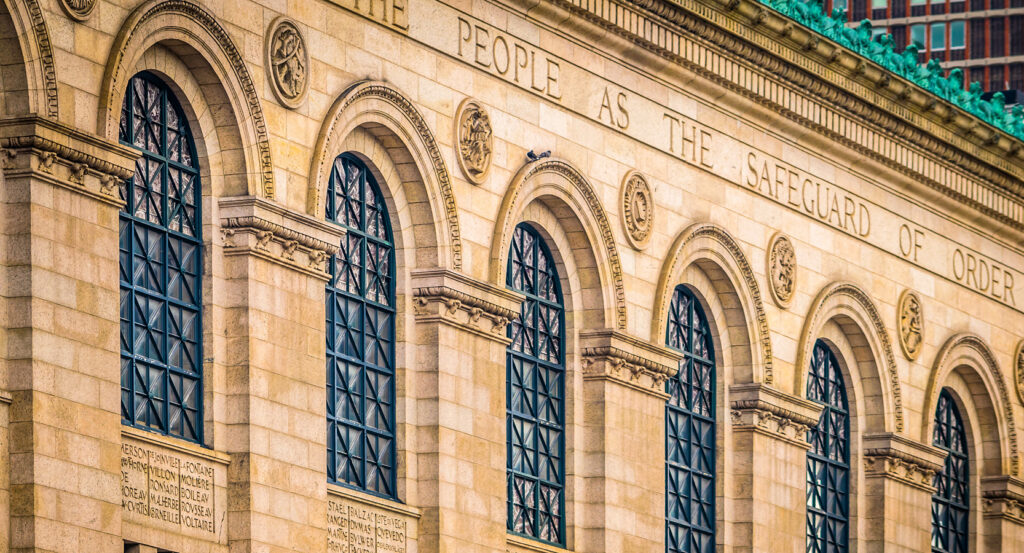
Today's Back Bay, once tidal marshland filled in during the 19th century, stands as one of the most remarkable examples of planned urban expansion in North America. Its ordered streets, uniform façades, and boulevards were conceived as a canvas for a new kind of American city, one where continuity of design met the practical needs of growing civic life. Within this fabric, the parcel that became Mandarin Oriental has always been more than real estate; it has been a node of connection. Near Copley Square, the Boston Public Library, Trinity Church, and Commonwealth Avenue, this ground has long been where architecture articulates civic identity, creativity, and communal presence. When the hotel was conceived, its designers embraced this lineage not through imitation but through a deliberate conversation with context: generous sightlines toward historic landmarks, materials chosen to complement rather than mimic, and an architectural language that bridges eras rather than collide with them. A lesser-known detail is how the hotel's façade and structural articulation respond to the city's historic geometry. The building's composition pays homage to the city's classical proportions while asserting a fluid modernity, a visual negotiation that allows it to stand confidently alongside venerable neighbors. Inside, public spaces carry this character forward. The Mandarin Bar + Lounge, for example, is more than a place to drink; it is a social room where light, proportion, and conversation converge in a way that feels like an extension of the neighborhood's cultural life. The hotel's wellness spaces, too, reflect a philosophy that situates care as architecture, generous volume, natural materials, refined lighting, and sightlines that mitigate the boundary between inside and out. In this way, the hotel does not simply occupy space; it participates in Boston's ongoing discussion between history and innovation. Staying here places you not in a standalone luxury experience but within a continuum of civic ambition and cultural texture. The Mandarin Oriental's presence in Back Bay is neither imposition nor echo; it is a calibrated addition to a city that has always prized both heritage and experience.
How Mandarin Oriental fits.
Mandarin Oriental becomes most enriching when you let the city's depth shape your days and the hotel serve as your reflective counterpoint, a place to rest, recalibrate, and absorb.
Begin your mornings with a quiet stroll into the Public Garden before breakfast, letting the light move across ponds, paths, and sculpted greenery before the city fully awakens. Step outward into Copley Square and cross into the Boston Public Library to feel history, architecture, and civic life converge in grand rooms and quiet corners. Midday, walk toward Newbury Street's boutiques and cafés, letting the city's elegant streetspace inform your pace. Return to the hotel for a pause, a shower, a quiet moment in your room, or a leisurely lunch in a dining space that feels formed by context. In the afternoon, venture toward the Museum of Fine Arts or the Isabella Stewart Gardner Museum, letting art and architecture shape your sense of place before returning. As evening arrives, let the Mandarin's culinary venues or nearby acclaimed restaurants become your staging ground for dinner, allowing conversation and light to mingle. Afterward, take one last walk through illuminated boulevards, watching historic façades soften in night light before returning to calm sanctuary. On your final morning, linger longer over breakfast or tea, appreciating how the hotel's design and service supported both your outward exploration and interior repose.
Where your story begins.
Foresyte Travel reveals places that feel extraordinary long before you arrive.
Enjoy editorial crafted for luxury travelers.
Foresyte may earn a commission when you book.







































































































