
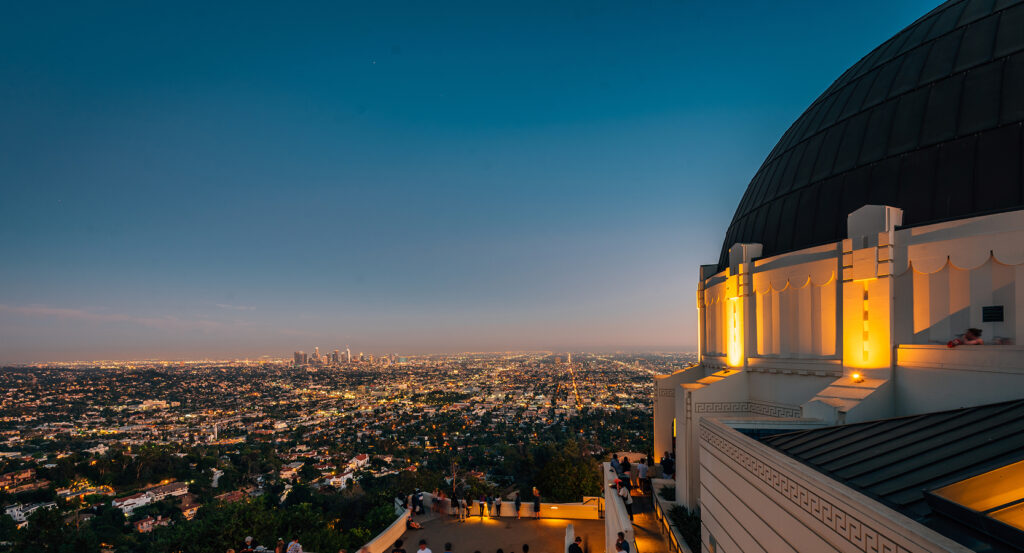
Why Memorial Park matters.
Memorial Park is a spirited public park where Pico's community-rooted character meets more than a century of baseball, recreation and civic remembrance on grounds shaped by successive generations of Santa Monica life.
Set along Olympic Boulevard near 14th Street and just steps from Santa Monica College Center for Media and Design, the park occupies a broad recreational tract extending north toward Colorado Avenue beside the former rail corridor that once carried Pacific Electric passenger service across this part of Santa Monica. Baseball diamonds define the open center, giving the park an unusually field-driven physical composition amid the tighter residential and commercial blocks surrounding Olympic Boulevard. Long sightlines across the diamonds make organized sport the primary encounter, with fences, backstops and playing surfaces dividing the grounds into overlapping zones of activity. The northern edge changes that spatial character beside the E Line corridor, placing contemporary rail movement against a recreational landscape whose boundaries developed across successive phases of Santa Monica growth. The result is a public park whose scale, athletic focus and position beside an old transportation corridor preserve a distinct inland chapter of Santa Monica far beyond the city's coastal image.
What defines Memorial Park.
Memorial Park is best known for occupying ground where Pete Garcia created a practice field for his semiprofessional Santa Monica Tigers in 1923, beginning a baseball lineage that preceded the park itself by nearly three decades. Santa Monica pursued federal labor support in 1934 for a municipal stadium on the site, linking the emerging sports ground to the New Deal era. Delays prevented the Los Angeles Angels from using the completed stadium for their intended spring training, yet the Angels played their 1934 season opener against the Chicago White Sox there. Baseball soon shared the grounds with a striking range of public spectacles. A rodeo arrived in 1936, and a square track carried midget automobiles and motorcycles around the stadium during subsequent years. Pacific Coast League and California Winter League baseball also brought professional competition onto the field during the 1930s. Santa Monica began remaking the property after World War II, acquiring eight parcels between the stadium and Olympic Boulevard in 1949 before removing the grandstands and adjoining structures. The enlarged grounds were rebuilt around baseball diamonds for Santa Monica's new Little League organization and formally dedicated as Memorial Park in 1951, converting a semiprofessional practice ground and municipal event stadium into a permanent center for youth recreation.
Architect James Mount gave Memorial Park its next substantial built chapter when a new gymnasium replaced the original recreation building in 1971. Mount brought a substantial Santa Monica portfolio to the commission after designing the city's American Red Cross building and other local projects during a career that followed architectural study at the University of Southern California and Marine Corps service during World War II. A Cultural Arts Building followed in 1976, broadening the park's institutional role beyond the athletic fields that had driven its postwar creation. The Police Activities League added another dedicated center in 1992, and its $1 million facility opened the following year after PAL relocated from Virginia Park. The Cove skatepark arrived in 2005, carrying the grounds into another generation of Southern California recreation more than eight decades after Garcia first secured the original practice field. Mount's gymnasium, the Cultural Arts Building, the PAL center and The Cove mark a sustained expansion of Memorial Park from diamond sports into a broader collection of athletic and youth institutions without displacing baseball from the grounds that gave the property its earliest public purpose.
How Memorial Park fits.
Memorial Park works as the anchor for a daytime sequence through Woodlawn Cemetery, 18th Street Arts Center and Bergamot Station, connecting Santa Monica's early civic formation with experimental art and the industrial rail history that shaped the inland city.
Begin at Woodlawn Cemetery, whose origins reach the 1870s when the burial ground was known as Ballona Township Cemetery on land associated with Rancho La Ballona and Arcadia Bandini de Stearns Baker, the Californio landowner closely connected with Santa Monica's early development. Bandini de Stearns Baker transferred the property to her nephew Juan Carrillo in 1884, and Carrillo later conveyed it without payment to Santa Monica in 1897, placing a nineteenth-century burial ground containing generations of civic figures, artists and performers under municipal stewardship. Continue to 18th Street Arts Center, where Judy Chicago used a studio on the future campus beginning in 1974 during creation of The Dinner Party, placing a major work of feminist art into the site's prehistory. Linda Frye Burnham launched High Performance magazine in 1977, Sue Dakin purchased the Santa Monica campus in 1988, and the organization subsequently accommodated Highways Performance Space, Electronic Café International, Cornerstone Theater and other groups that made the property a durable base for experimental artistic practice. Conclude at Bergamot Station, where a rail stop operating from 1875 until 1953 passed through the Los Angeles and Independence Railroad and Santa Monica Air Line eras before the warehouse property moved through celery packing, ice production and water-heater manufacturing. Santa Monica later acquired the abandoned tract, and gallery owner Wayne Blank converted the industrial buildings into an arts complex that opened in 1994; passenger trains returned beside the property in 2016 with the arrival of the Expo Line, reconnecting contemporary Santa Monica with a transportation corridor whose history stretches into the nineteenth century. The progression moves from a burial ground rooted in Rancho La Ballona through a campus central to feminist and performance art into a former railroad and industrial property recast around galleries, revealing how inland Santa Monica repeatedly converted older civic, creative and transportation sites into institutions with new cultural purposes.
Where your story begins.
Foresyte Travel reveals places that feel extraordinary long before you arrive.
Enjoy editorial crafted for luxury travelers.
Foresyte may earn a commission when you book.





































































































