
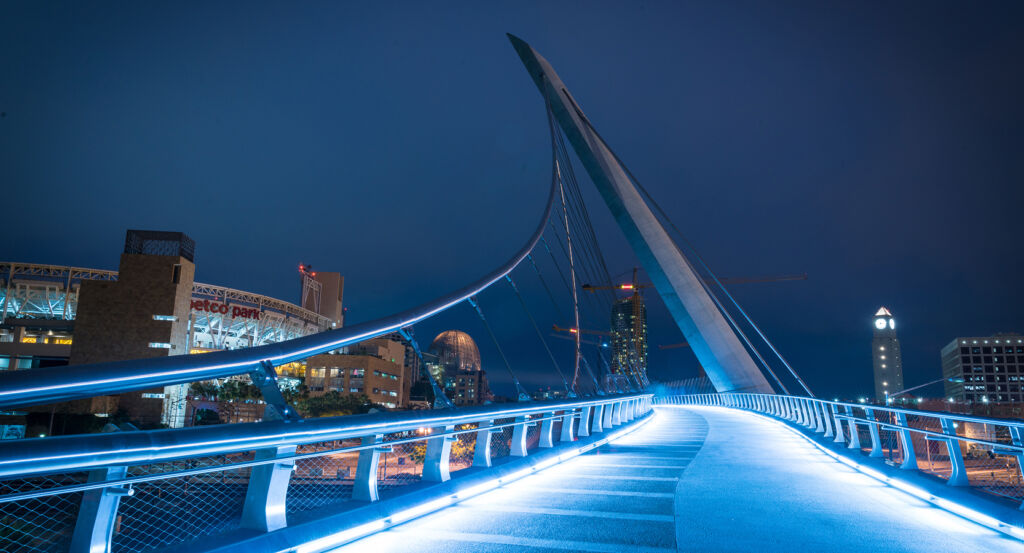
Why you should experience Napier Street in San Diego, California.
Napier Street is a tranquil corridor where Midway District's waterfront legacy, aviation heritage, evolving urban character, and harborfront setting converge along one of western San Diego's quietly distinctive streets.
Running through Midway District between Point Loma and Mission Hills, the corridor connects established residential enclaves, aviation-era landmarks, commercial destinations, and broad views toward San Diego Bay that collectively reflect the area's transformation from tidal flats to one of the city's principal western gateways. Mature Canary Island date palms, coast live oaks, contemporary residences, low-rise commercial architecture, and expansive skies shaped by nearby airfields establish a streetscape where maritime influence remains inseparable from twentieth-century urban development. Throughout the corridor, harbor history, transportation heritage, and steady neighborhood renewal reinforce an atmosphere shaped by San Diego's long relationship with the waterfront. The result is an experience defined by coastal accessibility, understated character, and one of western San Diego's most approachable neighborhood corridors.
What you should know about Napier Street.
Napier Street is best known for extending through the Midway District, whose twentieth-century growth was shaped by the expansion of Lindbergh Field, the rise of nearby military installations, and the increasing importance of San Diego Bay as a center for aviation, commerce, and naval activity. Much of the surrounding landscape occupied former tidelands that were gradually filled and redeveloped during the early and mid-twentieth century, creating new opportunities for residential neighborhoods, transportation corridors, and commercial investment west of downtown. The corridor developed alongside an area whose character became closely associated with aviation industries, maritime commerce, and regional mobility, reflecting decades of economic growth driven by the city's expanding Pacific presence. Coast live oaks, eucalyptus, jacarandas, Anna's hummingbirds, western gulls, and red-tailed hawks contribute to an urban landscape that continues balancing dense development with resilient coastal vegetation. Together, these geographic transformations, transportation milestones, economic forces, and natural features establish Napier Street as a defining expression of the Midway District's modern evolution.
Harbor-oriented industries encouraged architects and builders to introduce practical mid-century residential designs that emphasized durable stucco exteriors, low-pitched rooflines, steel-framed windows, and shaded outdoor living suited to San Diego's coastal climate. Nearby Dutch Flats, among the city's earliest nineteenth-century settlements outside Old Town, preserves an important historical connection to the agricultural communities that occupied the area before large-scale waterfront expansion reshaped the surrounding landscape. The continued coexistence of early settlement history, mid-century architectural traditions, and the enduring influence of San Diego Bay gives the corridor a layered character that extends well beyond its modern streetscape. Together, these surviving historical connections, characteristic building materials, and successive phases of urban development demonstrate how Napier Street reflects the broader transformation of San Diego's western waterfront while retaining a distinct neighborhood character.
How to fold Napier Street into your trip.
Napier Street works as an exploration of San Diego's waterfront history, aviation legacy, and harbor scenery.
Begin at Liberty Station, where preserved Spanish Colonial Revival buildings introduce the military heritage that shaped much of the surrounding area. Continue to Spanish Landing Park, where harborfront pathways and panoramic views deepen appreciation for the relationship between the Midway District and San Diego Bay. Conclude at Maritime Museum of San Diego, where one of the world's finest collections of historic vessels provides the historical payoff through centuries of Pacific maritime history and seafaring innovation. The progression moves naturally from preserved military architecture through the living waterfront before culminating in San Diego's maritime legacy, creating an experience that fully reflects the character of Napier Street.
Where your story begins.
Foresyte Travel reveals places that feel extraordinary long before you arrive.
Experience premium editorial crafted for luxury travelers.





































































































