
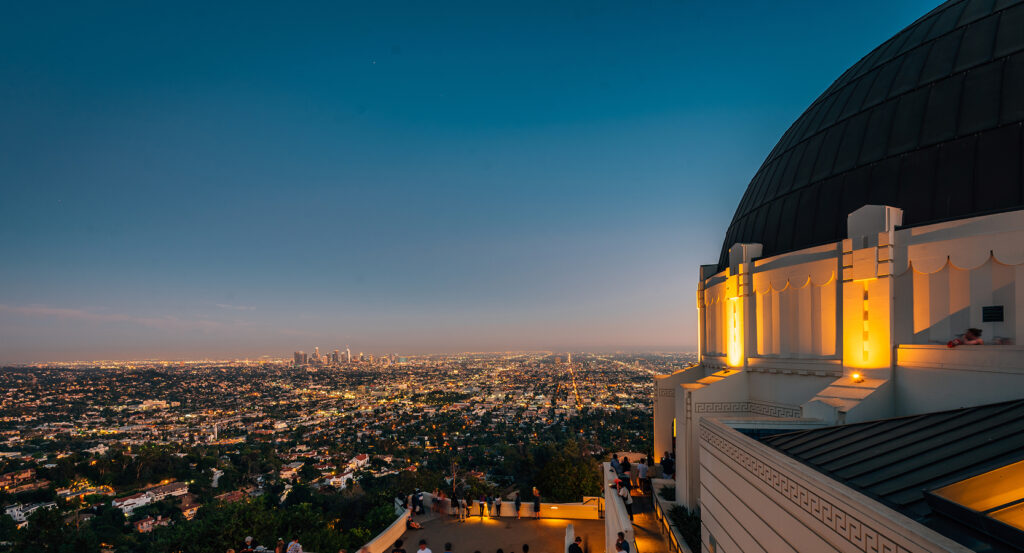
Why Rosemead matters.
Rosemead is a layered enclave where the western San Gabriel Valley's suburban character meets nineteenth-century ranch settlement, postwar residential expansion and commercial corridors reshaped by successive Asian and Latino communities.
Positioned between San Gabriel, Temple City, and South San Gabriel, the neighborhood occupies low, nearly level ground near the western reaches of the San Gabriel Valley, with the San Bernardino Freeway crossing its northern half and the Pomona Freeway defining a second metropolitan corridor farther south. Single-family houses from the principal postwar building decades spread across compact blocks behind commercial strips, with older parcels, remnant agricultural lot patterns and later apartment buildings producing subtle changes in scale across an otherwise low-rise landscape. Valley Boulevard supplies the primary encounter through the northern half, where dense concentrations of restaurants, markets and small commercial centers extend the transnational business geography shared with neighboring San Gabriel and Monterey Park. Garvey Avenue creates a secondary east-west passage through southern Rosemead, carrying a finer-grained mixture of storefronts, restaurants, automotive properties and older roadside buildings toward El Monte. The result is a neighborhood whose modest physical scale contains several distinct eras of San Gabriel Valley development, preserving traces of ranch country beneath a suburban landscape subsequently transformed by metropolitan growth and international migration.
What defines Rosemead.
Rosemead is best known for developing from nineteenth-century ranches and agricultural holdings into one of the western San Gabriel Valley's densely settled suburban communities. John and Harriet Guess reached the valley from Arkansas in 1852 and settled three years later on a 100-acre property they called Savannah, establishing an early American foothold in the area that became Rosemead. Frank Frost followed among the settlers, and Leonard John Rose acquired between 500 and 700 acres for a ranch devoted substantially to breeding and training horses. Rose called the property Rose's Meadow, a name subsequently compressed into Rosemead and transferred from a private estate to the surrounding community. Hayfields, truck gardens, orchards, dairies, chicken farms and rabbit ranches spread across the district after Rose's era, sustaining an agricultural economy on land capable of producing fruit, vegetables, grain and animal feed. J. W. Robinson, founder of the Robinson's department-store enterprise, owned the 33-acre Edgemont Park horse ranch within this landscape, adding another substantial private holding to the area before suburban subdivision accelerated. Commercial development remained limited enough that the 1922 opening of a grocery store with a single gasoline pump at Valley and Rosemead boulevards encountered opposition from 365 residents, yet additional merchants soon followed it. Rosemead incorporated on August 4, 1959 after years of cityhood efforts, formalizing a community whose agricultural acreage was already giving way to houses, businesses and industry. Southern California Edison added a major corporate presence in 1973 when it transferred its headquarters and thousands of employees from Downtown to Rosemead, completing a striking transition from horse ranches and truck farms to a fully metropolitan San Gabriel Valley city.
Large-scale immigration produced another consequential transformation during the closing decades of the twentieth century as Chinese and Vietnamese households expanded eastward through the western San Gabriel Valley. Chinese settlement had accelerated in neighboring Monterey Park during the 1970s, and subsequent housing pressure and commercial expansion carried newcomers into Rosemead, Alhambra, San Gabriel and communities farther east. Rosemead's Asian population grew sharply during the 1980s and early 1990s, joining an established Latino population and changing a community whose principal housing stock had been built during the 1940s and 1950s. Garvey Avenue became one of the clearest physical expressions of that shift, with Vietnamese pho restaurants, Chinese markets, bakeries and other immigrant businesses joining older motels, automotive properties and surviving roadside commerce. An indoor commercial center at Garvey Avenue and San Gabriel Boulevard converted a former Builder's Square property into an Asian market and food complex, showing how existing suburban retail structures acquired new cultural functions. The corridor simultaneously retained traces of an earlier population associated with Wilmar, an unincorporated settlement whose Arkansas-born residents had named their community after Wilmar, Arkansas before much of the territory entered Rosemead. By the opening twenty-first century, Chinese and Vietnamese commerce had become integral to Rosemead's place within the wider Asian American geography extending across Monterey Park, San Gabriel, Alhambra and the Central San Gabriel Valley. Rosemead carries two migrations across the same streets: nineteenth-century settlers established ranches and farms on open valley ground, and late twentieth-century immigrant communities converted the resulting suburb into part of one of North America's most consequential Asian American population centers.
How Rosemead fits.
Rosemead works as the anchor for an outing connecting the Spanish mission from which the surrounding valley took its name, a purpose-built theater created for an immense California historical pageant and a midcentury sculpture playground fashioned from a former landfill.
Begin at Mission San Gabriel Arcángel, founded on September 8, 1771 by Franciscan friars Pedro Benito Cambón and Ángel Fernández de la Somera under Junípero Serra's presidency as the fourth Spanish mission established in Alta California. Construction of the surviving church began late in the eighteenth century, producing thick masonry walls, massive exterior buttresses and a distinctive belfry wall; the church reached completion 1800 and remains among Southern California's earliest surviving stone buildings. The mission became an agricultural and religious center whose extensive holdings preceded the modern communities of the San Gabriel Valley, and the 1781 expedition that founded the pueblo of Los Angeles departed from San Gabriel for the final nine-mile approach west. Continue to San Gabriel Mission Playhouse, constructed in 1927 specifically for John Steven McGroarty's Mission Play, a production first staged in San Gabriel in 1912 and devoted to the California missions. Arthur B. Benton and Dodd & Richards shaped the Mission Revival theater around a façade recalling Mission San Antonio de Padua, with Spanish, Mexican and Native American influences extending through the interior; King Alfonso XIII of Spain supplied ten tapestries depicting Spanish provinces for its opening. The production accumulated 3,198 performances before ending after the 1932 season, and San Gabriel purchased the building in 1945 before restoration of the Mission Playhouse name in 2007. Conclude at La Laguna de San Gabriel, where Mexican-born artist Benjamin Dominguez created a fantastical concrete playground inside Vincent Lugo Park in 1965. Lugo, then San Gabriel's parks supervisor, had helped convert ground containing concrete and rubble left from San Bernardino Freeway construction into a nine-acre park, and Dominguez filled its children's area with climbable sea creatures including a whale, octopus, starfish and serpentine forms. The surviving ensemble belongs to a once broader postwar tradition of sculptural playground design and remains one of the few substantially intact examples of Dominguez's work. The progression moves from the eighteenth-century institution that gave the San Gabriel Valley its enduring geographic name through a theatrical monument to California's mission mythology and culminates in Dominguez's vivacious midcentury public sculpture, spanning three radically different chapters of cultural creation immediately west of Rosemead.
Where your story begins.
Foresyte Travel reveals places that feel extraordinary long before you arrive.
Enjoy editorial crafted for luxury travelers.
Foresyte may earn a commission when you book.





































































































