
Why Silver Lake matters.
Silver Lake is a topographic enclave where Central Los Angeles's dense urban fabric meets steep residential hills, curving canyon streets and a pair of open water bodies that give the district an unusual geographic center.
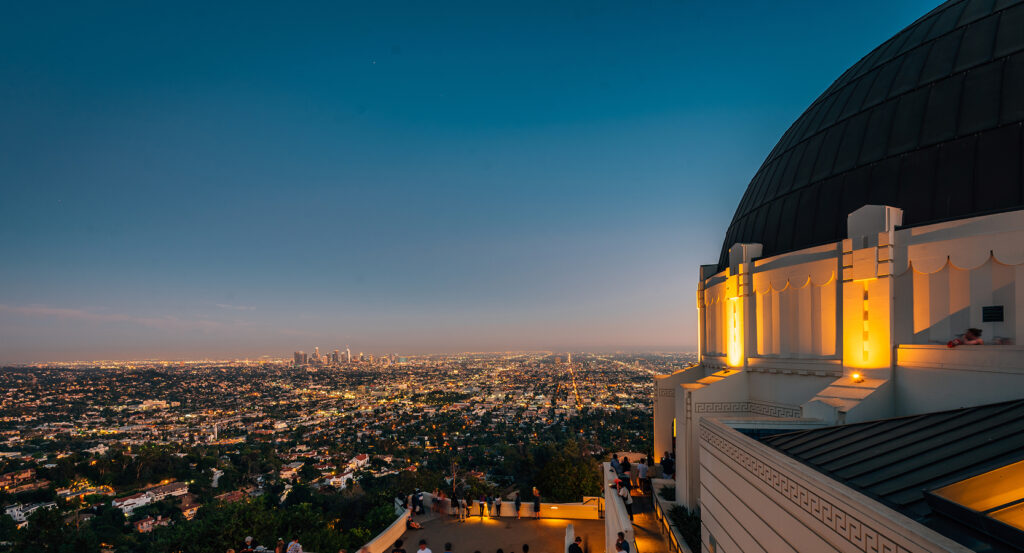
Positioned between Los Feliz, Echo Park, and East Hollywood, the neighborhood occupies sharply folded terrain northwest of Downtown, where ridges descend toward Sunset Boulevard and Glendale Boulevard across a compact network of slopes, hollows and elevated residential streets. Houses climb above narrow roadways on terraced parcels, stairways cut between elevation changes and mature vegetation partially conceals buildings whose foundations adjust repeatedly to difficult ground. Sunset Boulevard supplies the primary encounter through a diagonal commercial spine whose continuous storefronts contrast sharply with residential streets rising almost immediately from either side. Silver Lake Boulevard creates a secondary passage through quieter interior terrain, bending with the contours as open water, hillside development and descending side streets repeatedly alter the scale of the surrounding landscape. The result is a neighborhood whose combination of metropolitan density and severe topography created an unusually intricate piece of Central Los Angeles, with commercial corridors and residential hills compressed into immediate physical contact.
What defines Silver Lake.
Silver Lake is best known for developing into one of Los Angeles's richest concentrations of twentieth-century residential design after interwar subdivision opened its difficult hillsides to sustained construction. Daisy Canfield, wife of silent-film actor Antonio Moreno, subdivided a substantial portion of the western hills in 1924 and 1925, then expanded the tract with Moreno the following year. Their development became Moreno Highlands, carved from ground associated with the couple's estate and equipped with curving streets, landscaping, underground utilities and ornamental street lamps intended to attract homebuyers. The tract opened in 1926, and 193 homes had risen there by 1930 despite the engineering challenges presented by steep parcels. Another 120 houses followed between 1936 and 1938, with 85 more completed by 1940 as construction continued across previously vacant ground. The wider residential district eventually encompassed six contiguous tracts whose earliest substantial building phase favored Period Revival houses before postwar construction filled remaining parcels. Difficult lots encouraged architects to devise structures capable of occupying slopes once dismissed as impractical building sites. Rudolph Schindler, Gregory Ain, Raphael Soriano, Harwell Hamilton Harris, J. R. Davidson, Richard Neutra and John Lautner all produced houses in the area, placing radically different approaches to modern domestic design within close geographic proximity. Schindler's How House appeared in 1925, Soriano's Lipetz House followed in 1935, Neutra completed the Koblick House in 1937, and Ain added the Tierman House near the close of that decade. The resulting concentration joined the district's interwar subdivision history to a sustained architectural culture in which demanding terrain became an active catalyst for experimentation.
Edendale had already made the southeastern reaches of present-day Silver Lake part of Los Angeles motion-picture history before those residential tracts reached maturity. Selig Polyscope relocated to permanent quarters in Edendale in August 1909, followed that year by the New York Picture Corporation and in 1910 by Biograph and Kalem. Adam Kessel and Charles Baumann financed another consequential arrival when Mack Sennett established Keystone Studios at 1712 Alessandro Street, the present Glendale Boulevard, on ground previously occupied by Bison Pictures. Keystone became deeply associated with Sennett's fast-paced screen comedy and performers whose careers passed through the company included Mabel Normand, Ben Turpin, Gloria Swanson, Carole Lombard and Charlie Chaplin. Sennett joined D. W. Griffith and Thomas Ince in 1915 when their production interests combined within Triangle Pictures Corporation, connecting the Edendale operation with three major figures in early American cinema. Walt Disney later established his first substantial studio in the wider Silver Lake area, extending the district's connection with screen production beyond the silent era. Film workers also settled nearby, and performers including Stan Laurel, Oliver Hardy and Antonio Moreno occupied the surrounding residential landscape. Silver Lake's later association with artists and architects followed an earlier creative concentration rooted in Edendale, where independent production companies helped shift American filmmaking toward Los Angeles during the industry's formative decades.
How Silver Lake fits.
Silver Lake works as the anchor for an outing connecting Los Angeles's earliest preserved Victorian suburb, Frank Lloyd Wright's first Los Angeles commission and the largest of his four Southern California textile-block houses.
Begin at Angelino Heights, planned during the late nineteenth century as an upper-middle-class residential suburb on elevated ground northwest of Downtown. The district retains Victorian houses alongside later Craftsman and Mission Revival buildings, and the 1300 block of Carroll Avenue contains the city's highest concentration of surviving nineteenth-century Victorian residences. Los Angeles created its first Historic Preservation Overlay Zone there in 1983, giving the neighborhood an institutional role in the emergence of local architectural preservation alongside its much older place in the city's suburban expansion. Continue to Hollyhock House, commissioned by oil heiress and theater producer Aline Barnsdall after she acquired 36 acres on Olive Hill in 1919 for an ambitious cultural compound. Frank Lloyd Wright completed the residence between 1919 and 1921 as his first Los Angeles commission, carrying Barnsdall's favored hollyhock through ornamental art stone, furniture, textiles and art glass and bringing younger architects Rudolph Schindler and Richard Neutra into the project's orbit. Barnsdall gave the house and twelve surrounding acres to Los Angeles in 1927, converting part of her unrealized private arts complex into public ground. UNESCO inscribed Hollyhock House in 2019 as one of eight buildings comprising The 20th-Century Architecture of Frank Lloyd Wright, making it Los Angeles's first World Heritage Site. Conclude at Ennis House, designed by Wright for retailer Charles Ennis and his wife Mabel and constructed by Lloyd Wright between 1924 and 1926. The residence and chauffeur's quarters extend beyond 6,000 square feet and contain more than 27,000 hand-made concrete blocks incorporating decomposed granite extracted from the site, making the complex the largest of Wright's four Los Angeles textile-block houses. John Nesbitt later commissioned Wright to alter the property in 1940, with Lloyd Wright converting basement storage into a billiard room and designing a swimming pool for the north terrace. Earthquake damage, deterioration and heavy rains pushed the house into severe physical distress by 2005; stabilization and restoration began the following year, and the project received a Los Angeles Conservancy Preservation Award in 2008. The progression moves from nineteenth-century Victorian suburbanization through Wright's early attempt to construct a new California architecture and culminates in the immense concrete-block residence where his Los Angeles experimentation reached its most imposing domestic scale.
Where your story begins.
Foresyte Travel reveals places that feel extraordinary long before you arrive.
Enjoy editorial crafted for luxury travelers.
Foresyte may earn a commission when you book.





































































































