
Why Getty Center matters.
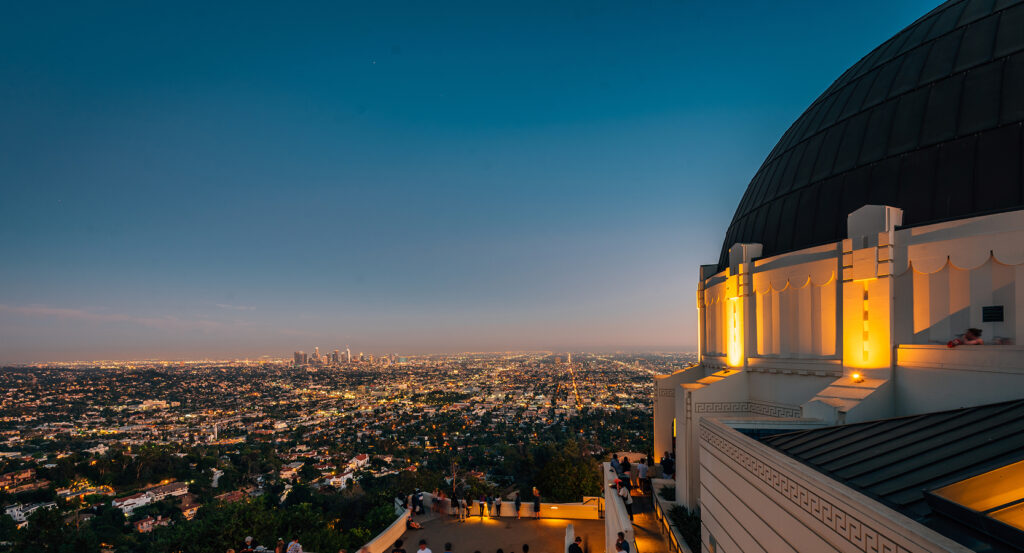
Getty Center is a commanding arts campus where Brentwood's Santa Monica Mountains setting meets Richard Meier's geometric architecture, expansive museum galleries and Robert Irwin's sculpted garden above the Los Angeles basin.
Set atop a ridge above the Sepulveda Pass near Interstate 405 and just north of the residential streets of Brentwood, the complex occupies a 24-acre campus within a 110-acre hilltop property overlooking the Pacific Ocean, city grid and San Gabriel Mountains. Six principal buildings organize the summit through plazas, courtyards and terraces clad with 1.2 million square feet of Italian travertine, whose split surfaces expose fossilized leaves, feathers and branches within stone quarried near Tivoli. Curving walls interrupt Meier's rectilinear composition, and exterior glass carries Southern California daylight into interiors regulated through computer-assisted louvers and shades. Robert Irwin's 134,000-square-foot Central Garden descends beside a stream toward bougainvillea bowers, a stone waterfall and an azalea maze set within a circular pool, with more than 500 plant varieties changing the composition across the seasons. The result is a hilltop ensemble in which stone, glass, gardens, water and long metropolitan sightlines turn the movement between art buildings into an architectural composition extending across the summit.
What defines The Getty.
Getty Center is best known for realizing the J. Paul Getty Trust's ambition to bring its expanding museum, research, conservation and philanthropic programs together on a purpose-built Los Angeles campus. The Trust purchased its Sepulveda Pass hilltop in 1982 and invited 33 architects to submit qualifications for the undertaking. Richard Meier received the commission in 1984, beginning a design process that extended across more than a decade as the institution and architect resolved the demands of a major museum, scholarly facilities and public spaces on a steep site. Construction began in 1989, and the January 1994 Northridge earthquake temporarily halted work during the long building campaign. The project eventually encompassed about one million square feet of building area and 71 galleries, 22 illuminated through skylights. Getty Center opened on December 16, 1997 after 15 years of planning, design and construction, bringing an institution previously dispersed around Los Angeles into its new Brentwood home. Initial public demand became substantial enough that advance parking reservations remained necessary during the first several years. Meier's commission became the architectural culmination of an institutional expansion that had begun long before construction, joining museum display, scholarship, conservation and philanthropy within a single purpose-built center.
J. Paul Getty's fortune supplied the financial foundation for that expansion, yet the institutional structure occupying the Center emerged primarily after his death. Getty had created the J. Paul Getty Museum Trust in 1953 and opened part of his Pacific Palisades ranch house to the public the following year, then left $700 million to the Trust when he died in 1976. Resolution of litigation delayed transfer of the bequest until 1982, by which point its market value had risen to $1.2 billion; the subsequent sale of Getty Oil to Texaco substantially increased the resources available to the institution. Harold M. Williams, appointed the Trust's first president in 1981, worked with program-planning director Nancy Englander to determine how those resources should address needs across the visual arts. Their plan expanded the former museum trust into an interdisciplinary institution spanning scholarly research, conservation science, arts education, grants, publications and significantly enlarged museum collections. The Getty Research Institute originated in 1982, the Getty Foundation followed in 1984 and the Getty Conservation Institute began in 1985, with the latter undertaking scientific and field projects across architecture, archaeological sites, photographs, modern paints, plastics, outdoor sculpture and other areas of cultural heritage. Four operating programs now carry forward the Trust's mandate: the J. Paul Getty Museum, Getty Research Institute, Getty Conservation Institute and Getty Foundation. The Center represents far more than the expansion of a private collection, housing the institutional network created when Getty's immense bequest was redirected toward collecting, scholarship, scientific conservation and international support for the visual arts.
How The Getty fits.
Getty Center works as the anchor for a West Los Angeles outing connecting American Jewish cultural institution-building, twentieth-century collecting and a Roman-inspired museum devoted to Mediterranean antiquity.
Begin at Skirball Cultural Center, whose origins reach to the early 1980s, when scholar and rabbi Uri D. Herscher began developing a cultural institution with initial funding from Jack and Audrey Skirball. Herscher selected a 15-acre site at the base of the Santa Monica Mountains and engaged Moshe Safdie, who designed all four construction phases of the campus, his first cultural project in the United States. Safdie responded to the steep terrain with clustered buildings, courtyards, arcades and landscaped ravines, using pink Tadoussac granite, recessed glazing and stainless-steel vaulted roofs across a complex that opened in April 1996. Herscher led the institution until 2020, overseeing successive expansions that made the Skirball the nation's largest Jewish cultural institution. Continue to Hammer Museum, founded by industrialist and collector Armand Hammer and opened in November 1990 beside Occidental Petroleum's Westwood headquarters. Edward Larrabee Barnes designed the museum for Hammer's holdings of Old Master and nineteenth-century European paintings and drawings, alongside his extensive Daumier collection and galleries for temporary exhibitions. Hammer died three weeks after the opening with portions of the building unfinished, and negotiations beginning in 1992 led UCLA to assume management of the institution. That university relationship subsequently repositioned the museum within Los Angeles contemporary-art culture while retaining the collections assembled by its founder. Conclude at Getty Villa, where J. Paul Getty created an archaeological setting modeled on the Villa dei Papiri at Herculaneum, the Roman residence buried by Vesuvius in AD 79 and rediscovered during the eighteenth century. Langdon and Wilson constructed the museum during the early 1970s with architectural consultant Norman Neuerburg working closely with Getty; the design drew additional details from ancient houses at Pompeii, Herculaneum and Stabiae where archaeological knowledge of the Villa dei Papiri remained incomplete. Rodolfo Machado and Jorge Silvetti later directed a major renovation that added an entry pavilion, parking structure and 450-seat outdoor theater before the Villa reopened in 2006 as a center devoted to Greek, Roman and Etruscan antiquities, with a collection numbering 44,000 works. The progression moves from Herscher and Safdie's institution for Jewish culture through Hammer's collector-founded museum and culminates in Getty's archaeological reconstruction of an ancient Roman country house, connecting three distinct models of cultural patronage across Los Angeles.
Where your story begins.
Foresyte Travel reveals places that feel extraordinary long before you arrive.
Enjoy editorial crafted for luxury travelers.
Foresyte may earn a commission when you book.





































































































