
Why Getty Research Institute matters.
Getty Research Institute is an intellectually ambitious cultural institution where Brentwood's Getty Center meets art-historical scholarship, vast library holdings and exhibitions drawn from rare archival collections.
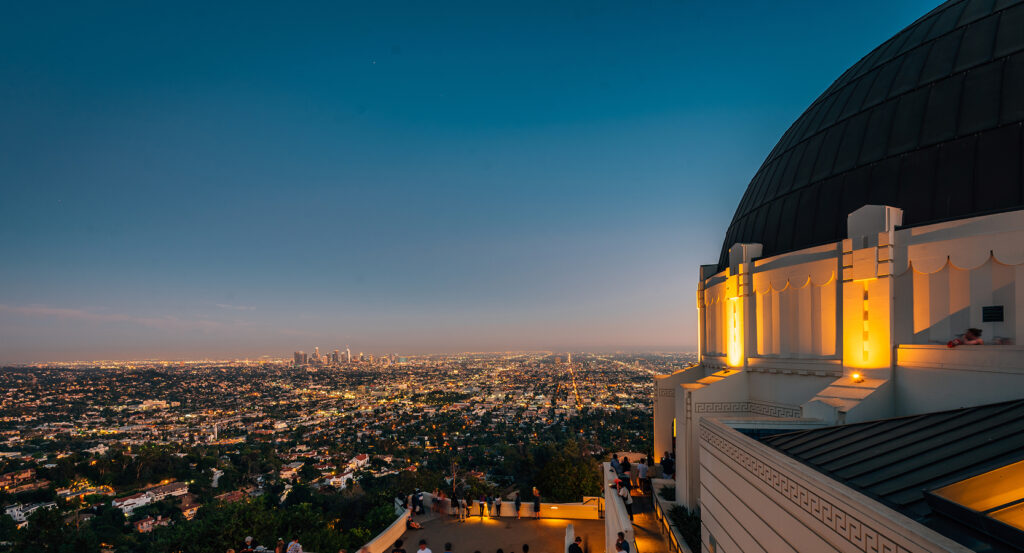
Set on the western side of the Getty Center campus near the Museum Courtyard and just steps from the Fran and Ray Stark Sculpture Terrace, the institute occupies a circular building overlooking the Los Angeles basin from the Santa Monica Mountains. Richard Meier organized the structure around concentric forms, with curved ramps and corridors wrapping an interior court and reinforcing the building's role as the scholarly counterpoint to the rectilinear museum pavilions across the plaza. A skylight carries natural illumination into the reading room on the lowest level, where the circular geometry continues through book stacks and study areas surrounding the central void. Plaza-level galleries bring rare books, photographs, prints and archival holdings into public exhibition spaces, linking the institute's scholarly functions with the larger Getty campus. The result is a circular research building whose ramps, central court, subterranean reading room and public galleries translate the institute's academic purpose into one of Richard Meier's most distinctive architectural components at the Getty Center.
What defines Getty Research Institute.
Getty Research Institute is best known for building one of the world's most extensive art-historical libraries and special collections while supporting international scholarship across art, architecture and visual culture. The J. Paul Getty Trust created the institute during its early-1980s expansion beyond the museum, when Getty's posthumous bequest gave the organization resources to develop programs devoted to scholarship, conservation, education and philanthropy. Originally known as the Getty Center for the History of Art and the Humanities, the institute developed a collecting program encompassing rare books, manuscripts, photographs, artists' papers, architectural archives, correspondence and ephemera. The Getty Library now holds more than 1.5 million volumes of books, journals and sales catalogues, adds 24,000 volumes annually and preserves 15 miles of archives, manuscripts and architectural drawings. Its readership extends across more than 70 countries, placing a collection built in Los Angeles within an international community of art historians, archaeologists, architects, curators and scholars from adjacent disciplines. The Getty Scholars Program began in 1985 and has since brought residential scholars and artists from around the world to Los Angeles for sustained work with Getty holdings and colleagues. One of the institute's largest acquisitions arrived with the Harald Szeemann Archive and Library, preserving the working world of the Swiss curator whose exhibitions helped shape postwar understandings of conceptualism, performance, installation art, Dada, surrealism and other twentieth-century movements. The Szeemann archive alone extends across 1,500 linear feet of files, correspondence, prints, drawings, floor plans, date books, videotapes and photographs, accompanied by another 1,500 linear feet of rare monographs, artists' books and limited editions.
The Digital Florentine Codex gives the institute a separate chapter in multilingual scholarship and digital access centered on one of the foundational manuscripts of early colonial Mexico. Bernardino de Sahagún worked with Nahua elders, authors and artists to create the Florentine Codex at the Imperial Colegio de la Santa Cruz in Tlatelolco, completing its twelve illuminated books in 1577 before the manuscript entered the Medici library in Florence. Its 2,446 pages place Nahuatl and Spanish in parallel columns and contain 2,500 hand-painted images addressing subjects extending from religion, medicine and astronomy to merchants, rulers, animals and the Spanish invasion of Mexico. Getty began the digital initiative in 2016 under a team led by Kim N. Richter, with Jeanette Favrot Peterson, Diana Magaloni and Kevin Terraciano serving as project co-heads and Alicia Maria Houtrouw managing the undertaking. Digirati built the digital edition using a bespoke Canvas Panel viewer based on International Image Interoperability Forum standards. The edition launched on October 26, 2023 with searchable images and texts, Nahuatl and Spanish transcriptions, and English and Spanish translations, allowing individual people, plants, animals, objects and concepts to be traced across the manuscript's twelve books. Getty's treatment of the codex joins Indigenous authorship, sixteenth-century manuscript culture, multilingual translation and contemporary digital infrastructure within a single long-term scholarly undertaking.
How Getty Research Institute fits.
Getty Research Institute works as the anchor for a Getty Center outing connecting European art collecting, Robert Irwin's landscape art and a major twentieth-century sculpture collection.
Begin at J. Paul Getty Museum, whose holdings at the Getty Center extend across European paintings, drawings, sculpture, illuminated manuscripts, decorative arts and international photography. The paintings collection spans more than six centuries from 1250 to 1920, with Peter Paul Rubens, Rembrandt, Édouard Manet, Claude Monet and Vincent van Gogh represented among its major artists. Getty's collecting scope expanded substantially after J. Paul Getty's death: drawings became a dedicated collecting field in 1981, the acquisition of Peter and Irene Ludwig's group of illuminated manuscripts formed the foundation of a new department in 1983, and several major private collections launched the Department of Photographs in 1984. Continue to Central Garden, commissioned from Southern California artist Robert Irwin in 1992 and opened with the Getty Center in 1997. Irwin conceived the 134,000-square-foot garden as an evolving artwork, directing a tree-lined path across a stream before it descends toward bougainvillea arbors, a stone waterfall and a pool containing a floating azalea maze. More than 500 plant varieties entered the original conception, and Irwin treated seasonal change as an integral component of the work, giving the Getty Center an artwork whose composition changes through growth, pruning and flowering cycles. Conclude at Fran and Ray Stark Sculpture Garden, part of a 28-work modern sculpture collection donated from the estate of film producer Ray Stark and his wife, Fran. The gift brought works by Alexander Calder, Alberto Giacometti, Barbara Hepworth, Ellsworth Kelly, Roy Lichtenstein, Joan Miró, Henry Moore and Isamu Noguchi into outdoor locations across the Getty Center. The garden near the lower tram station concentrates works including Elisabeth Frink's Horse and Running Man, Moore's Bronze Form and Draped Reclining Mother and Baby, Noguchi's Tent of Holofernes and Miró's Figure. Installation began after the collection entered the Museum in 2005, and its long-term care generated a dedicated Getty program examining coatings, patinas, structural concerns and the preservation demands of sculpture exposed to Southern California weather. The progression moves from centuries of European art and global photography through Irwin's changing garden and culminates in the Starks' twentieth-century sculpture collection, connecting collecting, site-specific art and outdoor conservation across the Getty Center campus.
Where your story begins.
Foresyte Travel reveals places that feel extraordinary long before you arrive.
Enjoy editorial crafted for luxury travelers.
Foresyte may earn a commission when you book.





































































































