
Why Wall Street matters.
Wall Street is a consequential financial corridor where the Financial District's compressed colonial street grid meets the institutions, skyscrapers and capital markets that transformed a seventeenth-century defensive boundary into a global synonym for American finance.
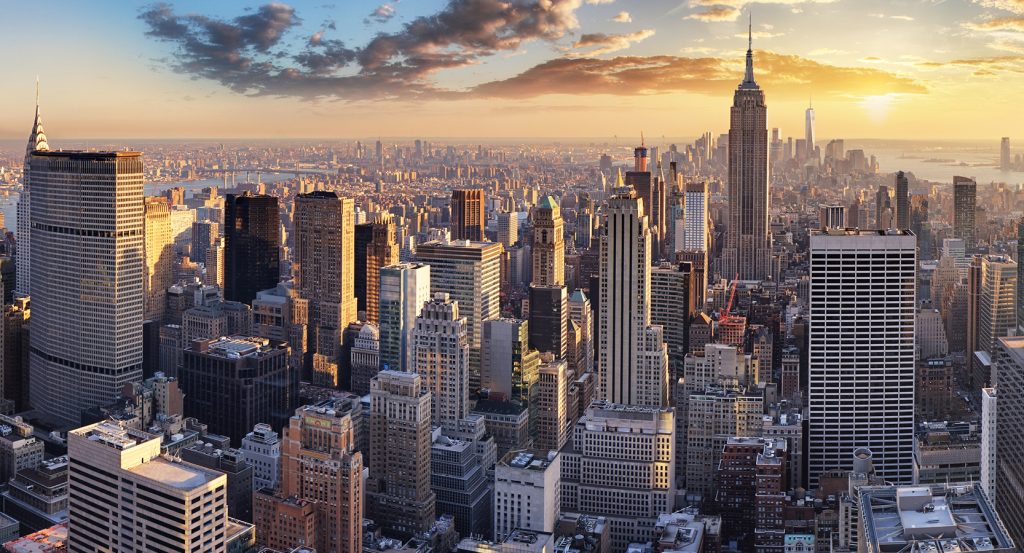
Set along Wall Street near William Street and just steps from Exchange Place, the corridor runs east from Broadway through Lower Manhattan's dense masonry canyons toward Pearl Street, crossing Nassau and Broad streets within a street plan whose narrow dimensions sharply contain views between successive towers. Buildings rise almost directly from the sidewalk, producing steep vertical enclosures whose limestone, granite, brick, bronze and glass surfaces compress the pedestrian realm beneath the skyline. Lower stories carry expansive columns, deeply recessed entrances and sculptural banking facades before upper floors recede through setbacks imposed on an exceptionally tight urban footprint. One Wall Street contributes a sweeping Art Deco termination at Broadway, with Ralph Walker's curved limestone mass rising beside the western entrance to the corridor. The result is a short street whose narrow colonial geometry and immense twentieth-century building mass make the physical concentration of American finance visible at pedestrian scale.
What defines Wall Street.
Wall Street is best known for becoming the geographic shorthand for American securities markets after centuries of commercial and institutional development on a street whose name predates the United States itself. Dutch colonists founded New Amsterdam at Manhattan's southern end in 1624, and a defensive stockade later crossed the settlement near the route that became Wall Street. Commerce persisted after English control replaced Dutch rule, and the street's proximity to the harbor placed merchants, insurers and brokers inside an increasingly important Atlantic trading city. Alexander Hamilton's federal fiscal program after independence strengthened New York's financial position through federal assumption of Revolutionary War debt, government bonds and the creation of a national bank. Twenty-four brokers and merchants signed the Buttonwood Agreement on May 17, 1792, establishing rules for securities transactions and creating the institutional ancestry of the New York Stock Exchange. Trading initially remained tied to informal gathering places and coffeehouses before brokers adopted a constitution on March 8, 1817 and formed the New York Stock & Exchange Board. The organization rented quarters at 40 Wall Street, where members assembled twice daily and traded a list of 30 stocks and bonds through an auction process directed by the exchange president. Expansion of railroads, industrial corporations, banking and national securities markets during the nineteenth century increased the district's financial concentration, turning physical proximity among exchanges, banks and brokerage houses into an economic advantage. Twentieth-century construction then translated that institutional power into architecture as corporations competed for prominent sites within Lower Manhattan's constrained blocks. One Wall Street joined that transformation in 1931 as Ralph Walker's Art Deco headquarters for Irving Trust Company, later passing to the Bank of New York before its conversion from offices into 566 residences with ground-floor retail. Wall Street compresses several stages of New York's economic development into a few blocks: colonial defense, mercantile exchange, federal finance, organized securities trading and corporate skyscraper building.
Hildreth Meière's mosaics inside One Wall Street provide an unusually concentrated expression of the way financial institutions used architecture to communicate permanence during periods of economic uncertainty. Ralph Walker commissioned Meière for Irving Trust's banking room, completed in 1931 after the 1929 market collapse had intensified pressure on banks to project stability. Curved walls follow the building's exterior geometry, enclosing a room in which tile moves through deep reds and oranges beneath gilded web-like patterns. Meière treated wall, ceiling and columns as a continuous decorative field, allowing thousands of individual pieces to dissolve the conventional distinction between mural and architecture. Perry Coke Smith joined Walker and Meière among the designers credited for the interior, embedding decorative authorship within a building created for one of New York's major banking institutions. The commission also marked the first of several collaborations between Walker and Meière, whose later work extended into major religious, communications and entertainment buildings across the city. Irving Trust's banking room differed sharply from the classically derived stone halls long associated with American banking, using Art Deco abstraction and saturated mosaic to communicate wealth through surface, light and geometry. Restoration recovered the room as the building underwent its enormous office-to-residential conversion, including the use of surviving original tiles discovered during the project. New York City designated the banking room an interior landmark in June 2024, protecting its historic surfaces, columns, lighting, metalwork and attached decorative components. Wall Street's architectural power emerges through this fusion of institutional ambition and highly authored design, where financial organizations turned constrained Manhattan parcels into buildings engineered to communicate scale, security and permanence.
How Wall Street fits.
Wall Street works as the central axis for a Lower Manhattan route connecting the birthplace of the federal government, an Episcopal parish that has occupied Broadway since the seventeenth century and a colonial tavern that became a stage for Revolutionary politics and the early national government.
Begin at Federal Hall National Memorial, where New York's City Hall stood by the opening years of the eighteenth century and John Peter Zenger faced his celebrated 1735 libel trial. The Stamp Act Congress assembled on the site in 1765, and the Continental Congress later adopted the Northwest Ordinance there in 1787. Pierre L'Enfant remodeled the building after ratification of the Constitution, and George Washington took the presidential oath on its second-floor balcony on April 30, 1789. The First Congress subsequently developed the Bill of Rights there before the national capital moved to Philadelphia. The original structure disappeared in 1812; the Greek Revival building standing on the site opened as a United States Customs House in 1842 and later became the Sub-Treasury, whose vaults held federal gold and silver. Continue to Trinity Church NYC, where the parish's long Broadway presence places ecclesiastical history at the western edge of the financial district and its churchyard preserves burials extending deep into New York's colonial and early national periods. The surviving church belongs to the parish's third major sanctuary on the site and dates from the nineteenth century, giving the Broadway terminus a Gothic counterweight to the commercial towers surrounding it. Conclude at Fraunces Tavern Museum, whose principal building began as the De Lancey family residence in 1719 before Samuel Fraunces converted it into the Queen's Head Tavern in 1762. The New York Chamber of Commerce was founded there in 1768, Patriot groups used its rooms during the revolutionary era and a British cannonball struck the building in 1775. The Birch Trials of 1783 became part of the evacuation process for thousands of Black Loyalists, and Washington later bade farewell to his officers in the Long Room on December 4 of that year. Departments of Foreign Affairs and War and offices of the Board of Treasury subsequently occupied the building during the Confederation period, temporarily turning a tavern into federal administrative space. The progression moves from the creation of constitutional government through a centuries-old religious institution and culminates in a surviving tavern where commerce, revolution, emancipation, diplomacy and early federal administration converged.
Where your story begins.
Foresyte Travel reveals places that feel extraordinary long before you arrive.
Enjoy editorial crafted for luxury travelers.
Foresyte may earn a commission when you book.







































































































