
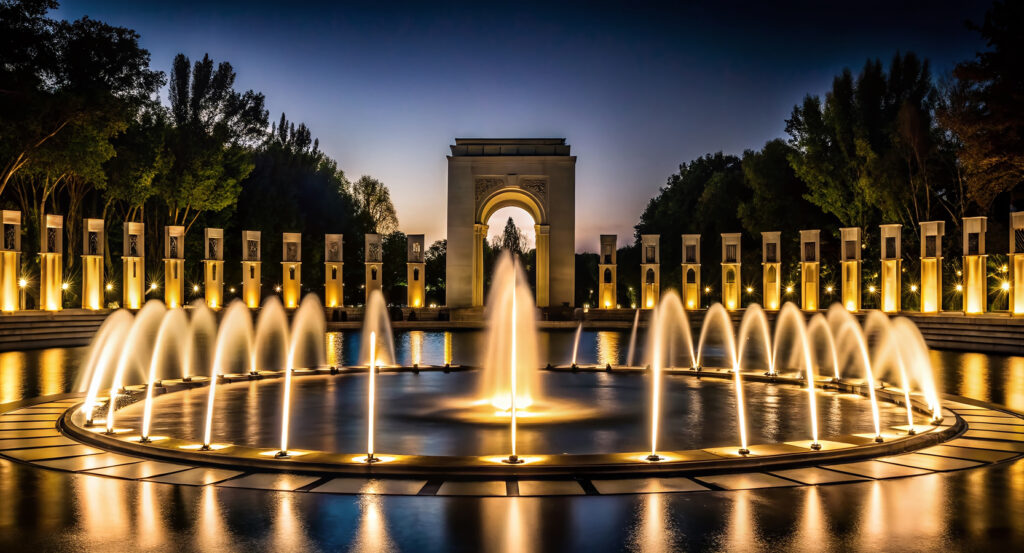
Why you should experience Pacific Pavilion at World War II Memorial in Washington, D.C.
The Pacific Pavilion, or Pacific Arch, at World War II Memorial honors the courage, endurance, and unity of those who served in the vast Pacific Theater, from the coral atolls of the South Pacific to the volcanic slopes of Iwo Jima.
Standing directly opposite its twin, the Atlantic Arch, it forms one half of the memorial's powerful symmetry, a balance between east and west, sea and sky, conflict and peace. Crafted from pale white granite, the arch rises nearly 43 feet high, commanding yet graceful, with the word “PACIFIC” carved in bold relief. Overhead, two bronze eagles grasp a laurel wreath, symbolizing victory and the eternal bond between allies. The structure's open vault captures sunlight like a beacon, casting shifting patterns of gold and shadow across the plaza below. Standing beneath it, you feel the enormity of distance and the strength of human resolve that defined the Pacific campaign. It's a place where history feels immediate, where the salt air of distant islands and the roar of naval fleets seem to echo faintly in the wind.
What you should know about Pacific Pavilion at World War II Memorial.
The Pacific Arch represents not just a military victory, but a grand human effort carried out across the world's largest ocean.
Designed by architect Friedrich St. Florian, its sculptural bronze elements were created by Ray Kaskey, who intended the arch's eagles and wreath to embody both the fragility and the strength of peace. Every detail is symbolic, the 28 pillars surrounding it represent the states and territories that contributed to the Pacific effort, while the intertwined ropes between them signify the unity that carried the nation through hardship. Beneath the arch are bronze campaign medallions commemorating key battles and turning points, Midway, Guadalcanal, Leyte Gulf, Iwo Jima, and others that shifted the tide of war. The wreaths carved into the granite panels recall the Navy's victory pennants, while the arch's orientation toward the Lincoln Memorial connects the memory of sacrifice to the enduring ideals of freedom and equality. Despite its grandeur, the Pacific Arch was designed to feel human, open, inviting, and grounded in the idea of shared service.
How to fold Pacific Pavilion at World War II Memorial into your trip.
When visiting the World War II Memorial, approach the Pacific Arch from the western end of the plaza, ideally near sunset when the light catches the bronze eagles in a warm golden glow.
Stand beneath the arch and look upward, the symmetry of the eagles and their wreath draws your gaze skyward, echoing the hope that rose from the war's devastation. From here, follow the line of state pillars circling the memorial; each represents a community whose sons and daughters helped bring peace to the Pacific. Pause at the Rainbow Pool, where reflections of both the Atlantic and Pacific arches shimmer side by side, symbolizing the unity of purpose that bound the nation together. If you're visiting with family, share the story of how an entire generation mobilized across continents and oceans, not for conquest, but for liberation. As evening falls and the fountains illuminate, the Pacific Arch takes on a quiet majesty, its soaring form a reminder that even across the vastness of the Pacific, the spirit of freedom always found its way home.
Where your story begins.
Foresyte Travel reveals places that feel extraordinary long before you arrive.
Experience premium editorial crafted for luxury travelers.







































































































