Why 9th Avenue matters.
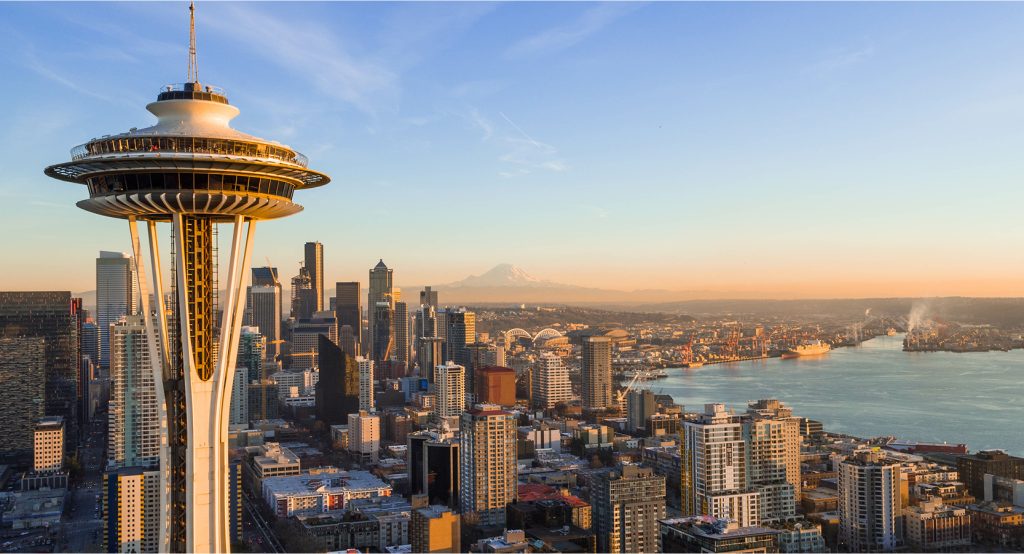
9th Avenue is a scholarly corridor where South Lake Union's scientific innovation, institutional legacy, urban ambition, and architectural evolution define one of Seattle's most influential city streets.
Running through South Lake Union between Denny Triangle and Eastlake, the corridor links biomedical campuses, research institutions, historic commercial buildings, modern office towers, and established residential blocks that collectively reflect more than a century of continuous urban transformation. Early twentieth-century brick commercial buildings, reinforced-concrete institutional structures, contemporary glass laboratories, steel-framed office buildings, broad sidewalks, London plane trees, vine maples, and Pacific Northwest landscaping establish a streetscape where research, commerce, and city life reinforce one another. Throughout the corridor, generations of scientific discovery, entrepreneurship, healthcare, and private investment have cultivated an atmosphere defined by intellectual curiosity and purposeful growth. The result is an experience distinguished by institutional significance, architectural diversity, and one of Seattle's most influential urban corridors.
What you should know 9th Avenue.
9th Avenue is best known for traversing South Lake Union, whose twentieth-century transformation accelerated after the completion of the Lake Washington Ship Canal in 1917, strengthening the district's industrial economy before its later emergence as one of the Pacific Northwest's foremost centers for biomedical research and technology. Construction surrounding the corridor expanded throughout the 1910s, 1920s, and 1930s, producing warehouses, commercial buildings, laboratories, manufacturing facilities, and institutional structures distinguished by reinforced-concrete framing, structural steel, brick masonry, heavy timber roof systems, industrial steel sash windows, and carefully detailed terra-cotta ornamentation. The corridor matured alongside marine engineering firms, manufacturing companies, biomedical organizations, research laboratories, and technology enterprises that collectively reshaped South Lake Union into a globally recognized innovation district. Great blue herons, osprey, bald eagles, harbor seals, Chinook salmon, Douglas fir, western red cedar, and Pacific madrone continue reflecting the ecological character of the nearby Lake Union shoreline. Together, these engineering achievements, commercial enterprises, institutional investments, architectural traditions, and ecological influences establish 9th Avenue as a defining expression of South Lake Union's historical evolution.
Physician William F. Hutchinson established the Pacific Northwest Research Foundation in 1956, helping lay the groundwork for the biomedical research ecosystem that transformed South Lake Union during the second half of the twentieth century. Architect NBBJ, founded in 1943 in Seattle, contributed numerous research, healthcare, and commercial buildings that helped define the district's contemporary architectural identity. Buildings lining 9th Avenue continue displaying exposed structural steel, brick pilasters, curtain-wall glazing, reinforced-concrete framing, aluminum sunshades, and precision-fabricated metal panel systems that demonstrate the corridor's transition from industrial production to scientific research. Together, these pioneering institutions, influential designers, and evolving construction methods demonstrate how 9th Avenue became one of Seattle's principal corridors for innovation and discovery.
How 9th Avenue fits.
9th Avenue works as an exploration of Seattle's scientific leadership, urban design, and lakeside culture.
Begin at Museum of History & Industry, where Seattle's maritime artifacts, industrial collections, and regional exhibitions introduce the historical foundations that shaped South Lake Union before establishing an ideal beginning for the experience. Continue to Amazon Spheres, whose immersive botanical environment, ambitious engineering, and contemporary workplace design deepen appreciation for the district's culture of innovation before naturally guiding the outing toward its concluding destination. Conclude at Lake Union Park, where restored historic vessels, sweeping waterfront views, and interpretive exhibits provide the maritime payoff by reconnecting the neighborhood's research-driven present with the working lake that shaped its earliest identity. The progression moves naturally from regional history through contemporary innovation before concluding beside the shoreline that explains South Lake Union's enduring evolution.
Where your story begins.
Foresyte Travel reveals places that feel extraordinary long before you arrive.
Enjoy editorial crafted for luxury travelers.
Foresyte may earn a commission when you book.