
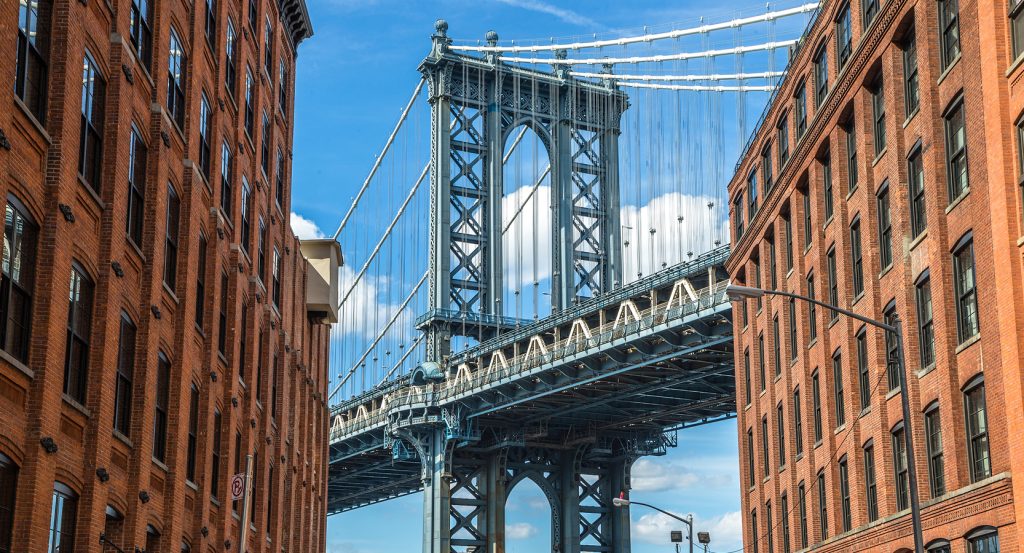
Why you should experience McGuinness Boulevard in New York, NY.
McGuinness Boulevard is a defining Greenpoint corridor where industrial achievement, transportation infrastructure, and neighborhood evolution converge along one of North Brooklyn's most significant thoroughfares.
Running north-south through Greenpoint between the Pulaski Bridge and Williamsburg, this prominent boulevard connects historic factory buildings, neighborhood businesses, residential blocks, industrial campuses, civic institutions, and major transportation links that reflect Brooklyn's remarkable manufacturing legacy. Monumental brick warehouses, adaptive reuse lofts, classic commercial storefronts, mature street trees, and architecturally significant industrial buildings create a streetscape where engineering ambition and neighborhood life remain closely intertwined. Originally developed as Oakland Street before its mid-twentieth-century transformation, McGuinness Boulevard became a principal transportation spine serving Greenpoint's shipyards, refineries, glassworks, and manufacturing districts while continuing to anchor one of Brooklyn's most distinctive neighborhoods. To the south, Williamsburg extends this industrial landscape through interconnected commercial corridors and historic waterfront districts that reinforce the boulevard's enduring significance. The result is a corridor defined by transportation prominence, industrial heritage, and urban continuity.
What you should know about McGuinness Boulevard.
McGuinness Boulevard is best known for being renamed in 1954 to honor Peter J. McGuinness, Brooklyn's first Borough President of Irish descent, who served from 1909 to 1921 and championed major public works and civic improvements throughout the borough.
Originally known as Oakland Street, the boulevard was renamed to recognize McGuinness's lasting influence on Brooklyn's infrastructure, public institutions, and municipal development during the early twentieth century. His administration helped oversee significant civic investments that supported Brooklyn's rapid growth as one of the nation's largest cities. The boulevard remains one of the borough's most visible tributes to a public official whose leadership helped shape modern Brooklyn.
How to fold McGuinness Boulevard into your trip.
McGuinness Boulevard works as an exploration of Greenpoint's industrial heritage, waterfront revival, and neighborhood character.
Begin at WNYC Transmitter Park, where sweeping East River views immediately establish the boulevard's defining relationship with Greenpoint's historic waterfront. Continue toward The Greenpoint Historic District, whose beautifully preserved nineteenth-century architecture reveals the residential prosperity that accompanied the neighborhood's industrial ascent. From there, make your way to Newtown Creek Nature Walk, where innovative landscape design provides remarkable insight into one of New York City's most historically significant industrial waterways. Along the route, you'll encounter converted warehouses, neighborhood cafés, independent boutiques, architecturally significant industrial buildings, historic churches, and energetic public spaces that reveal the boulevard's exceptional breadth. The progression moves naturally from waterfront park to celebrated historic district to industrial landscape, demonstrating how McGuinness Boulevard connects civic history, manufacturing heritage, and neighborhood evolution within one of Brooklyn's most distinctive corridors. McGuinness Boulevard remains one of the borough's most compelling avenues, preserving a distinctive balance between historical significance, industrial authenticity, and community identity.
Where your story begins.
Foresyte Travel reveals places that feel extraordinary long before you arrive.
Experience premium editorial crafted for luxury travelers.







































































































