
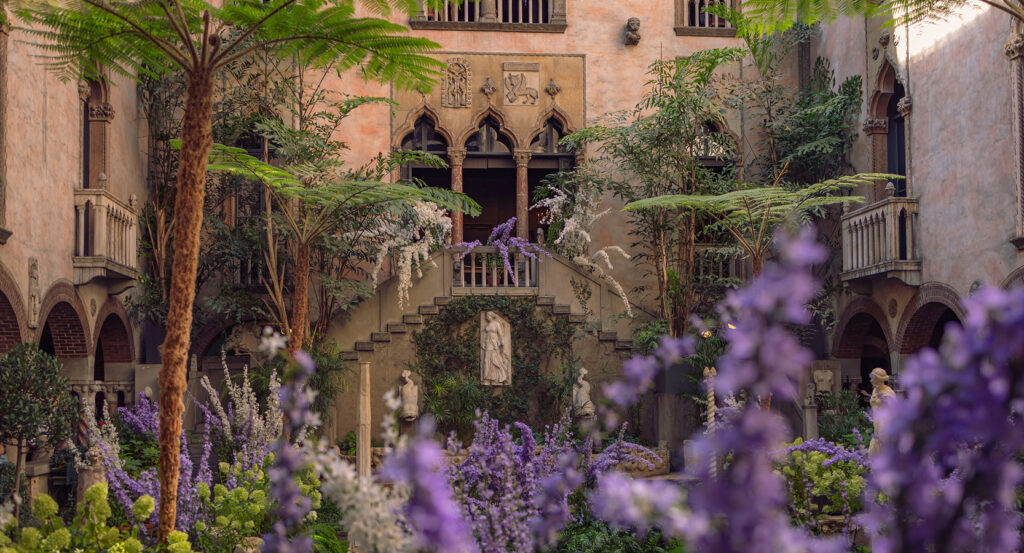
Why you should experience Titian Room at Isabella Stewart Gardner Museum in Boston, Massachusetts.
Titian Room at Isabella Stewart Gardner Museum is a grand Renaissance gallery where Fenway-Kenmore's artistic legacy, Venetian culture, museum craftsmanship, and Isabella Stewart Gardner's visionary collecting create one of America's most celebrated museum interiors.
Set on the second floor of the Isabella Stewart Gardner Museum near the Veronese Room and just steps from the Long Gallery, this opulent gallery surrounds visitors with Venetian masterpieces, richly layered Baroque textiles, carved furnishings, gilded frames, and carefully orchestrated architectural details that recreate the atmosphere of an aristocratic Italian palace. Deep crimson silks, elaborate Rococo furniture, historic sculpture, and subdued natural light frame one of the greatest Renaissance paintings in the United States while preserving Gardner's immersive vision of art experienced within its historical setting. Every object contributes to a carefully balanced composition where architecture, decoration, and painting function as a unified artistic whole. The result is a gallery defined by curatorial brilliance, Venetian elegance, and one of the finest museum rooms in North America.
What you should know about Titian Room at Isabella Stewart Gardner Museum.
Titian Room at Isabella Stewart Gardner Museum is best known for being conceived around Titian's grand masterpiece The Rape of Europa, acquired by Isabella Stewart Gardner in 1896 for £20,000, then the highest price ever paid by an American collector for an Old Master painting and the first major work by Titian to enter the United States. Encouraged by her close friend and advisor Bernard Berenson, Gardner immediately recognized the painting as the crown jewel of her collection, inspiring the creation of an entire gallery bearing Titian's name when the museum opened in 1903. Designed as one of the museum's grandest interiors, the room combines The Rape of Europa with Venetian masterpieces, Habsburg portraits, Renaissance sculpture, carved walnut furnishings, bronze objects, historic tapestries, and richly patterned Italian textiles that evoke the artistic atmosphere of sixteenth-century Venice, a city Gardner visited repeatedly throughout her life. Rather than arranging paintings chronologically, Gardner curated the gallery as an immersive architectural composition in which every object reinforced the significance of Titian's masterpiece and its mythological subject derived from Ovid's Metamorphoses. Between 2019 and 2021, the museum undertook one of the most ambitious gallery conservation projects in its history, restoring the Titian Room from floor to ceiling through the conservation of paintings, furniture, sculpture, frames, and decorative objects while recreating Gardner's original layered silk wall coverings from surviving historic fragments and archival photographs. During the project, The Rape of Europa underwent its first comprehensive conservation treatment in more than ninety years, revealing Titian's extraordinary color, brushwork, and glazing techniques while preserving one of the world's finest Venetian Renaissance paintings for future generations. The restored gallery now presents Gardner's original vision with remarkable fidelity, allowing visitors to experience the room much as she intended more than a century ago while reaffirming its status as one of America's greatest museum interiors.
The architectural composition exemplifies Gardner's revolutionary philosophy that paintings, sculpture, textiles, furniture, and architecture should function together as a complete artistic environment. Rich crimson silks, Venetian furnishings, grand gilded frames, and carefully calibrated natural light create an atmosphere that heightens the resonant impact of Titian's masterpiece while reinforcing the gallery's strong Venetian identity. The painstaking restoration reintroduced historically accurate textiles, conserved decorative arts, stabilized original finishes, and returned countless subtle details that had gradually disappeared over the previous century. Every element demonstrates how visionary collecting, architectural design, conservation science, and curatorial scholarship have combined to preserve one of the most extraordinary Renaissance galleries in the United States.
How to fold Titian Room at Isabella Stewart Gardner Museum into your trip.
The Titian Room works as the Venetian Renaissance centerpiece of an exploration through the Isabella Stewart Gardner Museum's extraordinary collections.
Begin in the Veronese Room, where grand Venetian painting establishes the artistic traditions that culminate in the Titian Room. Continue through the Long Gallery, whose remarkable sequence of European paintings, sculpture, and decorative arts naturally extends Gardner's carefully choreographed curatorial vision. Conclude in the Courtyard, where the museum's Venetian-inspired architecture, seasonal gardens, and tranquil atmosphere provide a memorable finale celebrating Isabella Stewart Gardner's extraordinary synthesis of art, architecture, and landscape. The progression moves naturally from Venetian painting to the museum's greatest Renaissance gallery before concluding within its iconic central courtyard, revealing why the Titian Room remains among America's defining museum interiors.
Where your story begins.
Foresyte Travel reveals places that feel extraordinary long before you arrive.
Experience premium editorial crafted for luxury travelers.







































































































