
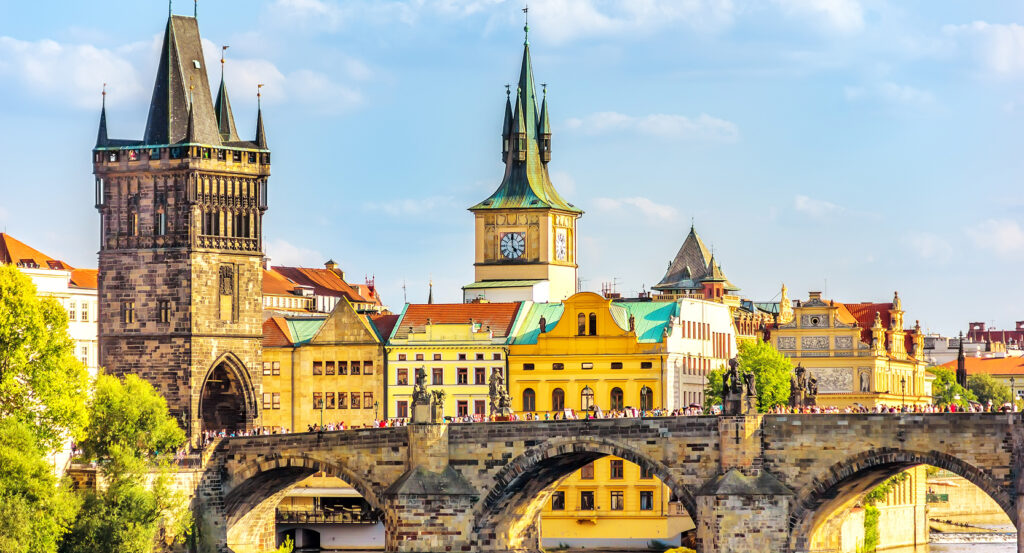
Why you should experience Charles Bridge Viewpoints in Prague, Czech Republic.
The Charles Bridge Viewpoints aren't just places to look, they're places to feel.
Each one offers a slightly different heartbeat of Prague: the golden reflection of the castle in morning light, the soft blue haze over the Vltava at dusk, the rhythmic pattern of spires and statues lining the bridge like sentinels of time. From these viewpoints, the city reveals itself in layers, Gothic towers, Renaissance domes, Baroque silhouettes, and the quiet pulse of the water below. Lean against the stone balustrade, and the sound of musicians drifts by, violins, accordions, and voices echoing between arches. Watch boats slide beneath the bridge's reflections, the river turning to liquid glass. What makes these viewpoints extraordinary isn't their height or grandeur, it's their humanity. Every photo, every sigh, every pause here becomes part of the bridge's living memory. To stand at one of these edges is to understand Prague not as a city, but as a feeling, melancholy, magnificent, and endlessly alive.
What you should know about Charles Bridge Viewpoints.
The bridge's viewpoints were never formally designed, they emerged naturally, shaped by light, perspective, and centuries of observation.
Architect Peter Parler built subtle asymmetries into the structure, allowing certain arches and angles to align perfectly with the rising and setting sun. The viewpoints at either end, beneath the Old Town Bridge Tower and the Lesser Town Tower, were intended to frame the royal route, creating a visual corridor that led directly to Prague Castle. From the midpoint, however, the alignment changes, the statues form a rhythmic pattern that draws the eye westward, toward the castle's divine elevation, symbolizing the soul's ascent. In the 18th century, Baroque sculptors even considered light in their compositions: Saint John of Nepomuk's halo was positioned to catch dawn's first rays, while the statue of Saint Luthgard glows most vividly at sunset. Beneath the bridge, the Vltava itself adds to the illusion, the current bends slightly along the east bank, creating mirrored doubles of the arches that shimmer with motion. Few realize that during the Austro-Hungarian era, artists and poets gathered secretly at these spots to paint or write about freedom, the viewpoints became sanctuaries of perspective long before photography existed. Even today, the bridge's viewpoints hold a quiet democracy: everyone, regardless of faith or language, stops here to watch the same light move across the same stones.
How to fold Charles Bridge Viewpoints into your trip.
The best way to experience the viewpoints is to chase the day through them.
Start at dawn on the Old Town side, standing just before the tower's archway. From here, the bridge leads your eyes directly toward Prague Castle as the first sunlight touches its spires, a composition as deliberate as it is eternal. Walk slowly across, stopping at the midpoint beside the Saint John of Nepomuk statue; this is the bridge's soul, where mist hangs low and the river reflects the sky in muted gold. Around sunset, shift to the Lesser Town side and stand by the final balustrade near the tower, from here, the castle burns orange and pink as church bells ripple through the air. For a quieter, more intimate view, descend to the riverbank beneath Kampa Island or the archways near Na Kampě Street, the bridge rises above you like a cathedral of stone. If you return at night, lanterns turn the statues into silhouettes, and the reflections on the water look almost painted. The Charles Bridge Viewpoints aren't just scenes to admire, they're rituals to live through, a discussion between light and stone that continues long after you've left.
Where your story begins.
Foresyte Travel reveals places that feel extraordinary long before you arrive.
Experience premium editorial crafted for luxury travelers.





































































































