
Why Adams Hill matters.
Adams Hill is a bohemian enclave where Glendale's foothill character meets steep residential streets, architectural experimentation and a hillside setting shaped by successive waves of Southern California domestic design.
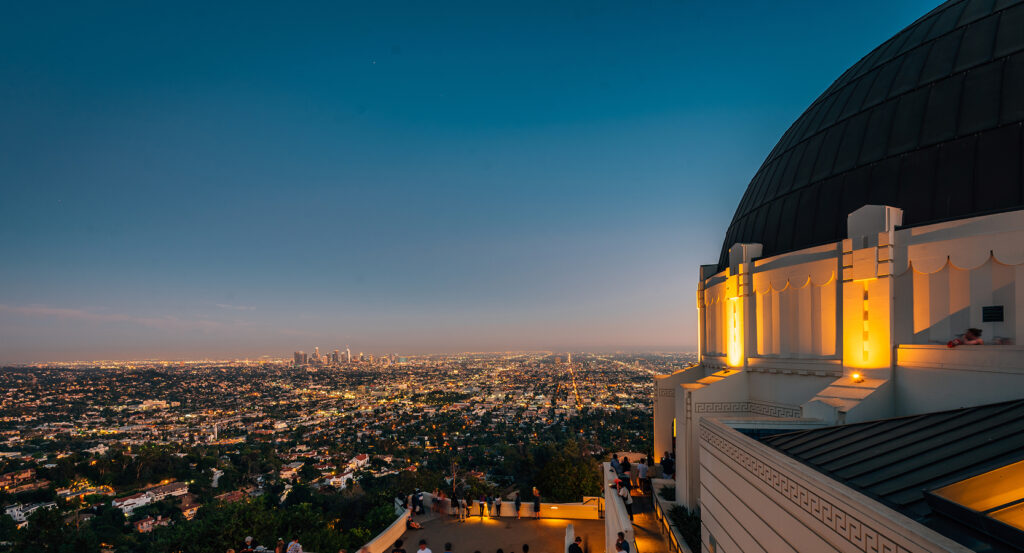
Positioned between Somerset-Mariposa, Forest Lawn, and Glassell Park, the neighborhood occupies Glendale's southern hills above the Los Angeles boundary, where tightly packed lower blocks climb into narrow streets curling across increasingly steep terrain. Detached houses step across irregular parcels with Spanish tile roofs, Tudor gables, compact cottages and postwar modern forms creating pronounced architectural variation from one slope to the next. Movement uphill follows streets such as Columbia Drive, Berkeley Drive and Marion Drive as straight approaches give way to bends, abrupt grades and houses positioned above or below pavement level. Upper elevations deepen that physical character through retaining walls, hillside vegetation, cantilevered construction and long outward views across the Los Angeles basin, turning changes in elevation into a persistent part of the streetscape. The result is a neighborhood whose compressed lots, climbing roads, architectural variety and dramatic topography produce one of southern Glendale's most distinctive residential landscapes.
What defines Adams Hill.
Adams Hill is best known for developing from land within Rancho San Rafael into part of the former city of Tropico and subsequently into Acacia Hills, the 1924 foothill tract that supplied much of the neighborhood's present street pattern. José María Verdugo received Rancho San Rafael in 1784, and his son Julio inherited the portion encompassing present-day Glendale before living on the hill between 1860 and his death in 1876. Subdivision of the rancho later placed much of the hill within W.C.R. Richardson's Santa Eulalia Ranch, linking the property to the breakup of the vast nineteenth-century holding that preceded suburban Glendale. Southern Pacific applied the name Tropico to the settlement south of early Glendale, and the hill belonged to the independent municipality from 1911 until its union with Glendale in 1918. Hope-Hardin-Weldon Realty Company opened Acacia Hills in 1924, cutting curving streets and irregular parcels into the foothills and marking the western entrance with a wood lattice gateway. Large hillside letters spelling ACACIA HILLS advertised the development across the surrounding basin, accompanied by ornate double-globe Gothic streetlamps that strengthened the tract's deliberately theatrical presentation. Tudor Revival and Spanish Colonial Revival houses spread across the slopes through the decade, yet the 1929 crash arrived with only one-third of Acacia Hills developed. Residential construction resumed in 1946, reached the eastern hill by 1950 and filled the remaining parcels by 1970, leaving architecture accumulated across several distinct periods of twentieth-century construction.
Irv Robbins opened Snowbird Ice Cream at Adams Street and Palmer Avenue on December 1, 1945, establishing a separate commercial legacy at the base of the hill. The son of a dairyman, Robbins had spent his youth working in his family's Tacoma ice-cream store before serving in the Army and using $6,000 from an insurance policy to finance his Glendale venture. Snowbird specialized exclusively in ice cream and began with 21 flavors, an unusual retail model during a period when ice-cream counters commonly shared premises with bakeries, sandwich shops and other food businesses. Robbins's brother-in-law Burt Baskin opened Burton's Ice Cream in Pasadena in 1946, and their businesses had grown to five Snowbird shops and three Burton's shops by 1948, when the operations joined into a single enterprise and introduced Chocolate Mint as their thirty-first flavor. The partners began selling stores to their managers, creating the franchise structure that accelerated expansion beyond the founders' ability to supervise individual locations. Baskin-Robbins became the company name in 1953, with the order of the surnames decided by a coin toss, and the chain reached more than 2,000 stores worldwide by Robbins's 1978 retirement. A neighborhood storefront financed by a returning serviceman became the origin point for one of Southern California's most internationally recognizable food businesses.
How Adams Hill fits.
Adams Hill works as the anchor for an outing connecting an English-themed residential experiment, Southern California's preservation of electric-sign art and a purpose-built hall containing two colossal paintings.
Begin at Cottage Grove Historic District, a single block of fourteen houses at the foot of the hill whose surviving architecture compresses Glendale's early twentieth-century transition from agricultural property into residential tracts. Helene Ungerland owned the 1901 Folk Victorian farmhouse that predates the surrounding development and later subdivided the land from which the Fox Brothers tract emerged. Harry, Preston S. and John C. Fox pursued an English-themed village in 1924, commissioning architects R.H. Paul and C.B. Martin for the first cottage and completing four Tudor Revival houses by January 1925. Subsequent construction added Spanish Colonial Revival houses, leaving the block as a concentrated sequence of farmhouse and Period Revival architecture. Continue to Museum of Neon Art, founded in Downtown in 1981 by artists Lili Lakich and Richard Jenkins as an institution devoted to historic neon signs and electric and kinetic art. Its work joined fine-art exhibitions with preservation of commercial signcraft at a moment when neon sign shops were disappearing and illuminated signs were being discarded across Los Angeles. The institution subsequently operated from several Los Angeles locations before establishing its permanent home on Brand Boulevard in Glendale, extending a collection and exhibition program spanning historic signage and luminous art. Four decades after its founding, the museum marked its anniversary with sixteen artists working across sculptural, kinetic and light-based forms, connecting contemporary practice to the neon-art resurgence that began during the 1970s. Conclude at Hall of Crucifixion-Resurrection, constructed at Forest Lawn specifically to house Jan Styka's immense Crucifixion after Hubert Eaton and his colleagues located the long-displaced canvas in storage belonging to the Chicago Civic Opera Company. Styka painted the 195-foot-long, 45-foot-high panorama between 1894 and 1896 and transported it to St. Louis for the 1904 World's Fair, where its immense dimensions prevented its intended display. Forest Lawn acquired the work after World War II, Adam and Wanda Styka carried out conservation, and the dedicated hall opened on Good Friday in 1951. A 25-year search for a companion painting later produced Robert Clark's 70-by-51-foot Resurrection, completed in 1965 and installed on a track in front of Styka's panorama. The progression moves from Cottage Grove's concentrated experiment in Period Revival residential design through the Museum of Neon Art's stewardship of Southern California signcraft and culminates inside a hall conceived around paintings of immense physical scale, connecting three highly specific expressions of Glendale's architectural and artistic development.
Where your story begins.
Foresyte Travel reveals places that feel extraordinary long before you arrive.
Enjoy editorial crafted for luxury travelers.
Foresyte may earn a commission when you book.





































































































