Why Beacon Grand matters.
Beacon Grand, A Union Square Hotel, San Francisco is a grand hotel where Union Square's metropolitan energy meets San Francisco's Jazz Age ambition through Weeks & Day architecture, opulent Renaissance interiors and a 2022 reinvention that preserved the building's defining historic craftsmanship.
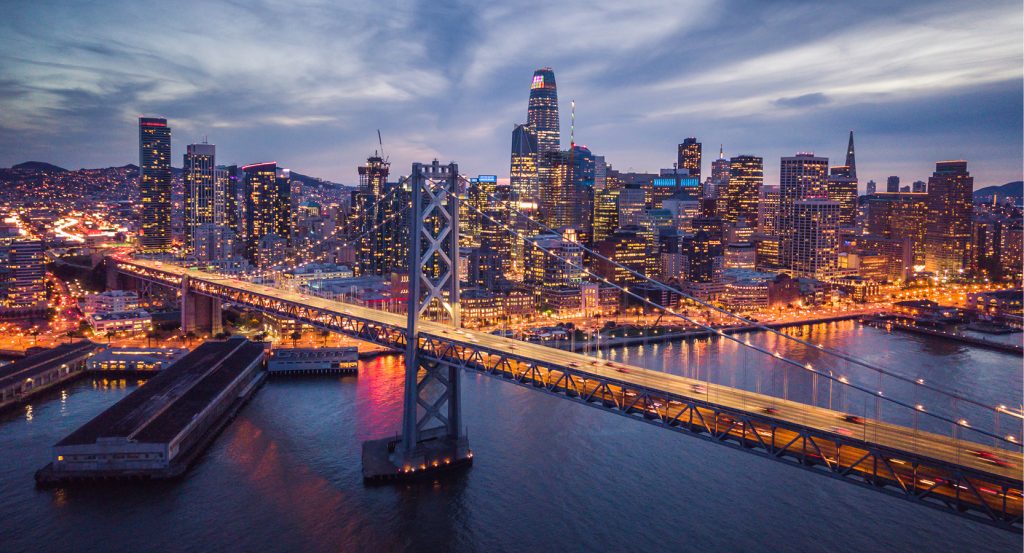
Set along Powell Street near Sutter Street and just steps from Union Square, the hotel occupies the district's northern edge between the Powell cable-car corridor, Stockton Street's approach to Chinatown and the dense retail and theater blocks extending south toward Market Street and Yerba Buena. The high-rise exterior rises through a vertical composition of masonry, repetitive windows and ornamental upper levels above the compact downtown intersection. French and Italian marble, oak flooring, vaulted ceilings, chandeliers and an elaborate staircase give the principal public spaces a scale established during the building's first hospitality chapter. Contemporary furnishings introduce deep blues, bronze finishes and leather against those preserved architectural elements. The result is a hotel whose Jazz Age architecture and renewed interiors preserve the grandeur of prewar Union Square within a contemporary independent hospitality identity.
What defines Beacon Grand.
Beacon Grand, A Union Square Hotel, San Francisco is best known for preserving and reinventing the former Sir Francis Drake Hotel, a $5 million Jazz Age project whose architectural ambition captured San Francisco's extraordinary late-1920s building boom. Midwestern hoteliers Leon W. Huckins and John A. Newcomb developed the property as an elaborate metropolitan hotel conceived to compete at the highest level of West Coast hospitality. San Francisco architects and engineers Weeks & Day translated that ambition into a high-rise composition drawing heavily from European Renaissance architecture. Michel & Pfeffer Iron Works executed extensive ornamental iron, bronze, aluminum, stair and steel-window work, placing the hotel within the same extraordinary period of San Francisco construction that produced Weeks & Day's 450 Sutter building and the nearby Mark Hopkins Hotel. A. F. Marten Company supervised much of the interior decoration, with imported marble, monolithic pilasters, Florentine ceiling work, Italian decorative references and walnut paneling establishing an unusually elaborate sequence of public rooms. The grand debut on October 23, 1928 drew 10,000 people across a two-day open house attended by San Francisco Mayor James Rolph Jr. and California Governor C. C. Young. Technological features reinforced the building's modernity through radios, ice water taps and the Servidor, a corridor-access cabinet permitting discreet deliveries into private quarters. An indoor golf course added another unusual element to the original program. Kimpton acquired the hotel in 1994 and sustained the Sir Francis Drake character through another quarter century of Union Square hospitality. Northview Hotel Group purchased the property from Pebblebrook Hotel Trust for $156.7 million in April 2021 after the pandemic closure created an opportunity for comprehensive redevelopment. The new ownership retired the Sir Francis Drake name amid reassessment of Francis Drake's involvement in the slave trade and selected Beacon Grand as a character centered on San Francisco itself. A major renovation drew from 30 historical photographs published when the hotel debuted, using original visual evidence to guide restoration of its principal architectural character. The property returned in 2022 under the Beacon Grand name, preserving the expansive staircase, ornate ceilings and historic decorative fabric within a substantially renewed hotel.
Starlite gives the hotel a separate cultural lineage through the 21st-floor drinking room that evolved across decades into one of Union Square's best-known nightlife addresses. Harry Denton became the figure most closely associated with the earlier Starlight Room, turning the elevated lounge into a destination for San Francisco nightlife during the 1990s and 2000s. Herb Caen and Allen Ginsberg belonged to the prominent local figures associated with the room across its long social history. The pandemic closure interrupted that chapter for nearly four years before Northview Hotel Group rebuilt the concept as Starlite. Alice Crumeyrolle of Maison A. redesigned the interior through emerald and gold tones, velvet banquettes and glass chandeliers drawing from Art Deco references. Scott Baird, co-founder of Trick Dog, developed the cocktail program around San Francisco imagery and flavors. Cable Car Redux reworks the Sidecar through spiced rum and blood orange, translating one of the city's defining transportation symbols into the drinks program. MICHELIN-recognized chef Johnny Spero created the accompanying food menu after building his reputation through Washington, D.C.'s Reverie. Hot Fried Chicken Bun combines Szechuan spices and pickled daikon with a steamed bun after Spero's exploration of Chinatown. Baked Oysters use cider, egg, brown butter, herbs and breadcrumbs as a culinary reference to San Francisco Bay. Music director Nina Tarr developed the nightly all-vinyl program across funk, glam, Afrobeat, boogie, hip hop, new wave, post-punk, disco and soul. Starlite returned on February 2, 2024, restoring nightlife to the top floor through a creative team spanning cocktails, MICHELIN-recognized cooking, interior design and vinyl culture. Juanita MORE! extended that social chapter in 2026 through Floor 21 Happy Hours and Pride programming, reconnecting the historic rooftop with San Francisco's drag culture. Starlite transforms the hotel's elevated nightlife heritage into a contemporary collaboration whose drinks, food, design and music remain grounded in San Francisco creative culture.
How Beacon Grand fits.
Beacon Grand, A Union Square Hotel, San Francisco works as an anchor for an outing connecting the mechanical ingenuity of San Francisco's cable railway, the city's Chinese American historical record and North America's only museum devoted specifically to bookbinding.
Begin at Cable Car Museum, housed within the Washington and Mason powerhouse at the mechanical center of San Francisco's surviving cable railway. Andrew Smith Hallidie successfully tested the world's first cable car on August 2, 1873 after developing a transportation system suited to the city's severe grades. The operating powerhouse places the museum directly around the winding machinery that pulls underground cables through the street network. Historic cars and mechanical exhibits trace the engineering progression from Hallidie's first Clay Street line into the surviving Powell and California routes. The building joins museum interpretation with machinery that continues moving cable cars through surrounding neighborhoods. Continue to Chinese Historical Society of America Museum, rooted in an organization founded in 1963 to preserve and interpret Chinese American history. The society developed one of the country's most substantial collections devoted to Chinese American life, migration and community formation. Its museum occupies the former Chinatown YWCA designed by Julia Morgan, connecting the collection with a building created by one of California's most consequential architects. Exhibitions examine subjects spanning exclusion, immigration, family history, civil rights and the development of Chinese American communities across the United States. Conclude at American Bookbinders Museum, founded by Bay Area bookbinder Tim James to preserve the tools, machinery and craftsmanship that transformed book production. The institution is the only museum in North America dedicated specifically to the art and history of bookbinding. Working equipment traces the transition from hand binding through the mechanization that reshaped the trade during the nineteenth century. Tools associated with sixteenth-century hand production stand alongside machines developed during the Industrial Revolution, turning changes in physical book construction into a tangible history of American manufacturing and publishing. The progression moves from Cable Car Museum's operating nineteenth-century transportation machinery through Chinese Historical Society of America Museum's preservation of Chinese American history and culminates in American Bookbinders Museum's specialized record of the craftsmanship and industrial technology that transformed the physical book.
Where your story begins.
Foresyte Travel reveals places that feel extraordinary long before you arrive.
Enjoy editorial crafted for luxury travelers.
Foresyte may earn a commission when you book.