
Why Bel Air matters.
Bel Air is a secluded hillside enclave where the Westside's residential character meets canyon topography, architect-designed estates and the enduring imprint of Los Angeles's early twentieth-century expansion into the Santa Monica Mountains.
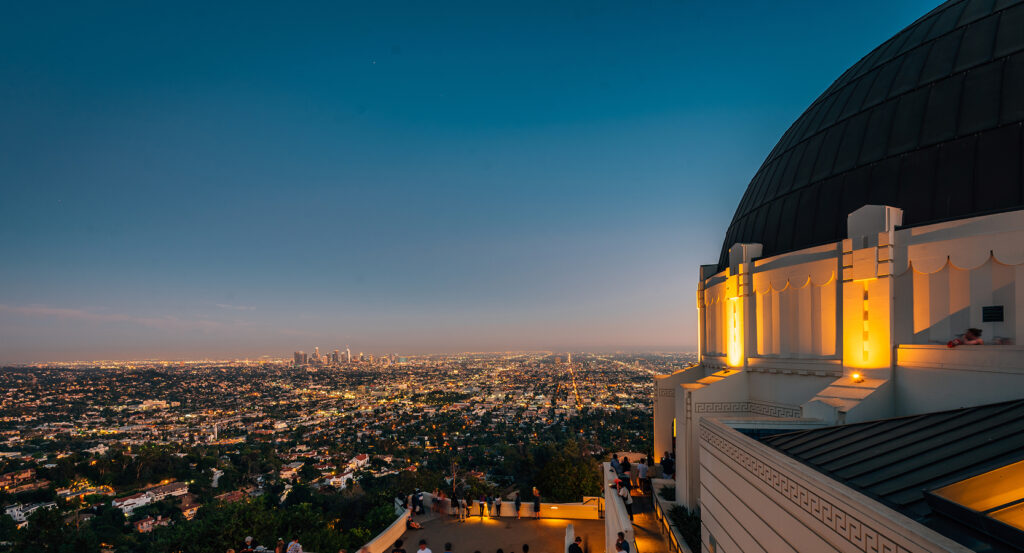
Set along Sunset Boulevard near Beverly Glen Boulevard and just steps from UCLA, the neighborhood rises into the southern Santa Monica Mountains between Brentwood and Beverly Crest, where winding roads climb from the Los Angeles Basin through narrow canyons toward Mulholland Drive and elevated ridges command long sightlines across Westwood, Century City and the coastal plain toward Santa Monica Bay. Stone entrance gates mark the transition from the boulevard into a street network shaped by the folds of the mountains, with roads repeatedly curving around slopes and drainage courses as they gain elevation. Estate parcels occupy irregular hillside ground behind mature vegetation, retaining walls and long driveways, producing a built environment governed more strongly by terrain than by the rectilinear street grid below Sunset Boulevard. Higher roads open intermittently toward the basin and distant Pacific before returning behind ridges, giving the neighborhood a sequence of enclosed canyon passages and exposed mountain edges. The result is a residential landscape whose gates, serpentine roads, steep slopes and dispersed estates translate the Santa Monica Mountains directly into the urban geography of western Los Angeles.
What defines Bel Air.
Bel Air is best known for Alphonzo E. Bell Sr.'s conversion of former rancho land into an estate subdivision whose street plan, architecture and development controls established one of Los Angeles's defining hillside residential districts. Much of the area had belonged to Rancho San José de Buenos Ayres, granted to Máximo Alanís by Mexican governor Manuel Micheltorena in 1843. Bell entered the property's modern history after striking oil at Santa Fe Springs and purchasing the Danziger family estate in 1922, giving him 1,700 acres from which to begin his subdivision. Lot sales and construction started late that year, and the first tract filed in 1923 contained 128 residential lots. Bell placed utilities underground to protect views across the mountainous site and developed roads around the existing canyon terrain, creating a residential pattern substantially removed from the orthogonal subdivisions spreading elsewhere across Los Angeles. Early marketing presented the project as “Gentleman's Estates,” with purchasers subject to approval and minimum residential investments ranging from $15,000 to $25,000. Bell expanded the community through a second tract in 1925 and commissioned infrastructure intended to reinforce its estate character, including entrance gates, bridle trails, stables and landscaped improvements. His wife supplied many streets with European names including Bellagio, Nimes, St. Pierre, Cuesta and Capello, embedding the development's cultivated aspirations into its geography. Residential construction attracted architects including Paul R. Williams, Wallace Neff, Roland E. Coate, Sumner Spaulding, Gerard Colcord, Gordon B. Kaufmann and John Byers, producing houses across Mediterranean, Spanish Colonial Revival, Georgian and later Hollywood Regency traditions. The 1929 stock-market crash interrupted Bell's expansion as declining oil revenue and collapsing land sales placed severe pressure on his real-estate ventures, bringing the subdivision's first development era to a close.
Charles B. Hopper assumed sales responsibilities during the early 1930s and redirected the struggling subdivision through a different development strategy. Bell had retired from active control by 1931 after financial and personal difficulties, leaving Hopper to confront a Depression-era market incapable of sustaining the original concentration of immense estates. Hopper relaxed several restrictions on prospective purchasers and opened additional roads into lateral canyons, creating smaller tracts that broadened the range of available properties. Land sales began recovering by 1933, and the expanded street network pushed residential construction farther into the mountainous interior. Postwar development accelerated again after Alphonzo Bell Jr. assumed control of the family corporation and sold remaining undeveloped western acreage to builders seeking opportunities during Southern California's housing boom. Houses from this period occupied smaller lots and adopted architectural approaches distinct from the large revival-style residences of the 1920s, extending the neighborhood through Mid-Century Modern and other postwar forms. Paul R. Williams's 1936 residence at 914 North Stradella Road had already demonstrated the arrival of Hollywood Regency architecture in Bel Air before the war, joining a wider body of Westside commissions associated with Williams, Wallace Neff, Douglas Honnold and Roland Coate. Continued rebuilding across subsequent decades replaced numerous early houses and weakened the architectural uniformity of the original subdivision, yet the underlying mountain road system and general estate scale survived. More than 2,000 properties now extend between Sunset Boulevard, Mulholland Drive, Beverly Glen Boulevard and Sepulveda Boulevard, preserving the geographic reach created through successive phases of Bell-era subdivision, Depression-era adaptation and postwar expansion.
How Bel Air fits.
Bel Air works as the anchor for a daytime outing connecting a hilltop arts campus, a Jewish cultural institution built across the Sepulveda Pass and a 1920s oil fortune translated into one of Southern California's great residential estates.
Begin at Getty Center, whose creation followed the J. Paul Getty Trust's 1982 purchase of a 110-acre hilltop site above the Sepulveda Pass. Thirty-three architects entered the initial selection process before Richard Meier received the commission in 1984, and construction began in 1989 after years of planning. The complex opened in December 1997 after bringing the Getty Museum, Research Institute, Conservation Institute, Foundation and administrative operations onto one campus. Approximately 300,000 cream-colored travertine blocks quarried near Rome clad Meier's buildings, and Robert Irwin developed the 134,000-square-foot Central Garden after receiving his commission in 1992. Continue to Skirball Cultural Center, conceived by Rabbi Uri D. Herscher with support from philanthropist Jack H. Skirball and opened to the public in April 1996. Herscher selected a 15-acre mountainside site and engaged Moshe Safdie, whose design organized the institution as a village of pavilions, courtyards and gardens constructed through four phases. Its museum collection reaches back to Hebrew Union College's nineteenth-century collecting, the establishment of the Union Museum in Cincinnati in 1913 and the collection's relocation to Los Angeles in 1972. More than 30,000 objects now trace Jewish life, art, religion and history across a collection whose institutional roots substantially predate the Los Angeles campus. Conclude at Greystone Mansion & Gardens, where oil magnate Edward L. Doheny gave his son Ned a 12.58-acre hillside parcel in 1926 and commissioned Gordon B. Kaufmann to design an immense residence overlooking the Los Angeles Basin. Construction began in February 1927, and the estate ultimately cost $3,166,578.12, with the mansion alone accounting for $1,238,378.76. Its 46,054 square feet contained 55 habitable rooms, and Paul G. Thiene developed the surrounding landscape. Beverly Hills acquired the surviving 18.3-acre property in 1965, dedicated it as a public park in 1971 and secured National Register recognition in 1976. The progression moves from the Getty Trust's creation of a mountaintop cultural campus through Uri Herscher and Moshe Safdie's development of a Jewish institution across the Sepulveda Pass and culminates in Greystone Mansion & Gardens, where petroleum wealth produced an architectural estate later preserved for public use.
Where your story begins.
Foresyte Travel reveals places that feel extraordinary long before you arrive.
Enjoy editorial crafted for luxury travelers.
Foresyte may earn a commission when you book.





































































































