
Why Belvedere Castle matters.
Belvedere Castle is a scenic architectural folly where Central Park's pastoral character meets rugged Manhattan schist, elevated terraces and commanding views across the park's interior landscapes.
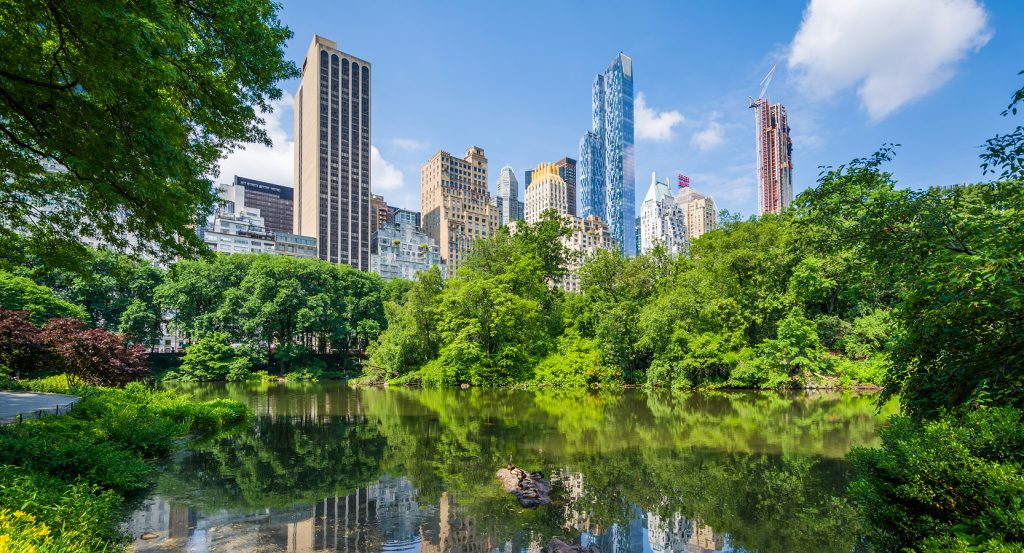
Set atop Vista Rock near the 79th Street Transverse and just steps from Turtle Pond, the castle occupies the second-highest natural point in Central Park above a steep transition between the Ramble and Great Lawn. Manhattan schist visually joins the structure to its rocky perch, with turrets, parapets, stairs and adjoining terraces creating a compact composition that seems to rise directly from the outcrop. The upper levels open broad northern views across Turtle Pond and Great Lawn, with the metropolitan skyline appearing beyond the park's tree canopy. Southern outlooks descend toward the densely wooded Ramble, creating a sharp visual change from open lawn and water to irregular rock, paths and forested slopes. The result is an elevated architectural composition whose stone construction, terraces, vertical lookout points and contrasting north-south views make Central Park's varied topography unusually legible from a single site.
What defines Belvedere Castle.
Belvedere Castle is best known for transforming Vista Rock into an architectural lookout conceived within Frederick Law Olmsted and Calvert Vaux's evolving design for Central Park. Olmsted and Vaux developed the Belvedere concept during the 1860s after the park itself had already entered construction, designing a terrace, pavilions and miniature castle near the old Receiving Reservoir. Vaux worked with architect Jacob Wrey Mould on the complex, extending a partnership that produced numerous architectural features across Central Park. Construction began in 1867, and the completed complex entered park life during the early 1870s as a folly devoted to outlooks across the surrounding landscape. The site replaced an old reservoir bell tower that critic Clarence Cook had condemned as an eyesore, turning an unattractive utilitarian structure into a deliberately scenic destination. Belvedere, Italian for “beautiful view,” expressed the purpose directly: the structure initially had neither doors nor windows and functioned as an open-air lookout. Period guidebooks and postcards soon promoted the panoramic outlook, and nineteenth-century imagery also referred to the site as “The Observatory,” showing how quickly the architectural addition became associated with viewing Central Park from above.
Meteorology gave the castle a radically different institutional role during the twentieth century. The U.S. Weather Bureau had operated New York observations from the Arsenal since 1868, but taller surrounding buildings increasingly interfered with readings, leading the Bureau to recommend Belvedere as a replacement site by 1913. Comparative observations followed in 1918, and preparations during 1919 placed a temperature shelter on exposed rock south of the castle, precipitation gauges closer to ground level and wind equipment on the roof. Doors and windows enclosed the formerly open structure for Weather Bureau personnel, and the official Central Park observing site transferred there on January 1, 1920. Automation eventually emptied the castle itself, followed by deterioration and vandalism during the 1960s and 1970s. The newly formed Central Park Conservancy selected Belvedere for one of its early restoration campaigns, reopening it in 1983 as a visitor center after removing graffiti and rebuilding lost architectural elements. A later 15-month rehabilitation completed in 2019 recreated a lost decorative wood tower, restored the historic checkerboard paving pattern, installed clear-pane glazing and drilled 400 feet into Vista Rock for a geothermal heating and cooling system. Meteorological instruments remain immediately south of the building, preserving a continuous Central Park weather-observation site extending back more than a century.
How Belvedere Castle fits.
Belvedere Castle works as the anchor for a Central Park outing connecting nineteenth-century international design, free Shakespearean theater and the recovered history of a predominantly Black community that occupied the park landscape before its creation.
Begin at Swedish Cottage (Marionette Theatre), the only Central Park building originally constructed somewhere else. Swedish builders created the wooden structure as a model schoolhouse for the 1876 Centennial Exhibition in Philadelphia, the first world's fair held in the United States, presenting traditional Swedish woodworking to an international audience. After arriving in Central Park, the building passed through uses as a tool house, restroom, entomological laboratory and World War II Civil Defense headquarters. NYC Parks made it the workshop for its traveling marionette theater in 1947, and the cottage became the company's performance home during the 1970s, giving the imported exhibition building an enduring theatrical function. Continue to Delacorte Theater, whose origins reach to producer Joseph Papp's 1957 traveling Shakespeare program in city parks. Early Central Park productions used portable staging near Turtle Pond, but their popularity led philanthropist George Delacorte to finance a permanent open-air theater completed in 1962. The Merchant of Venice, starring George C. Scott and James Earl Jones, became the first production in the new venue, beginning a long association between the theater and free summertime Shakespeare. Delacorte later funded two Milton Hebald bronzes for the adjoining landscape, The Tempest and Romeo and Juliet, both installed in 1977 and drawn from characters central to the theatrical repertory surrounding the site. Conclude at Seneca Village Landscape, where free Black New Yorkers began purchasing property in 1825 after John Whitehead subdivided a 17-acre parcel into 200 lots. Andrew Williams purchased the first three lots for $125, Epiphany Davis acquired twelve for $578 and the AME Zion Church bought six, forming the nucleus of a community that expanded during the following three decades. By 1855, 225 people lived there, around two-thirds Black and one-third Irish, supported by more than 50 homes, three churches and a school. New York City acquired the land for Central Park, and remaining residents departed by 1857; a 2011 archaeological excavation later uncovered house foundations and thousands of objects associated with the former community. The progression moves from a Swedish exhibition building repurposed for puppetry through Papp and Delacorte's institution for free Shakespeare and culminates on the ground of Seneca Village, connecting international design, public theater and the human history embedded beneath Central Park's constructed landscape.
Where your story begins.
Foresyte Travel reveals places that feel extraordinary long before you arrive.
Enjoy editorial crafted for luxury travelers.
Foresyte may earn a commission when you book.







































































































