
Why The Ramble matters.
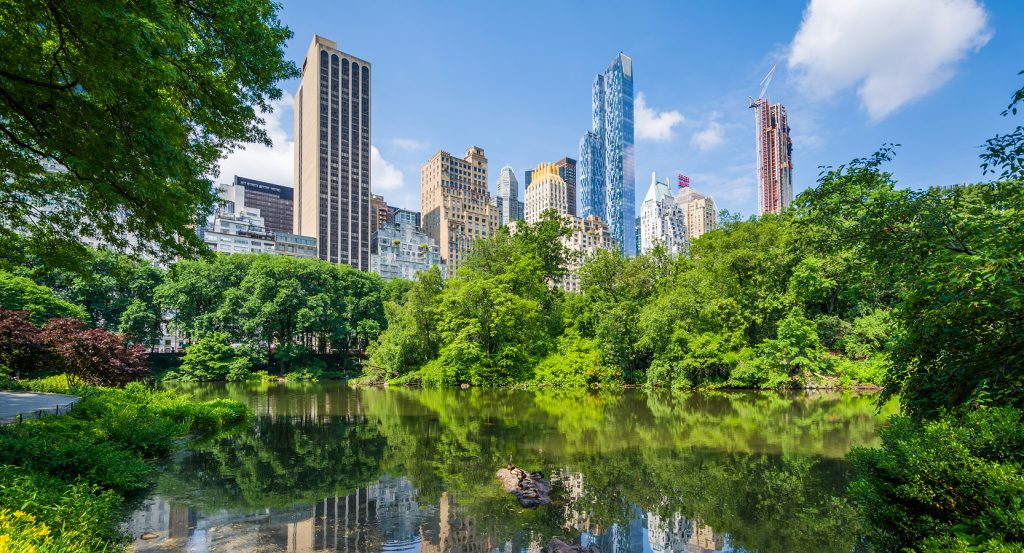
The Ramble is a secluded woodland where Central Park's pastoral character meets Frederick Law Olmsted and Calvert Vaux's intricate composition of rocky terrain, winding paths, dense vegetation and engineered waterways modeled on the wild scenery of New York State.
Set within Central Park between 73rd and 79th Streets and just steps from the Jacqueline Kennedy Onassis Reservoir, the woodland occupies 36 acres of rugged terrain near the Park's geographic center, concealing much of Manhattan behind steep slopes, trees and exposed Manhattan schist. Olmsted and Vaux preserved existing rock outcrops and hills, then reshaped the surrounding ground with native and exotic plantings, narrow trails, rustic structures and extensive hidden drainage and irrigation infrastructure. The Gill emerges from a concealed pipe beneath a rocky ledge, passes through Azalea Pond and descends through the woodland before spilling over a small cascade into the Lake, giving an engineered stream the appearance of a natural watercourse. Interlacing paths repeatedly divide, climb and disappear behind vegetation, using irregular topography and limited sightlines to sustain the intricacy and mystery Olmsted sought for his “wild garden.”  The result is a meticulously constructed woodland whose rocks, paths, plantings and water obscure the engineering required to create one of Central Park's most intricate landscapes.
What defines The Ramble.
The Ramble is best known for translating the naturalistic principles of Frederick Law Olmsted and Calvert Vaux's Greensward Plan into a deliberately complex woodland at the center of Manhattan. New York authorized the acquisition of land for Central Park in 1853, and the Commissioners of Central Park subsequently held the 1857 to 1858 competition that drew 33 proposals for the new public grounds. Olmsted and Vaux won with Greensward, a plan organized around pastoral meadows, wooded scenery and circulation systems designed to separate pedestrians, horses and carriages without surrendering the continuity of the landscape. Construction began in 1858, ultimately requiring workers to move nearly five million cubic yards of stone, earth and topsoil and construct 36 bridges and arches across the larger park. The Ramble became one of the earliest sections opened to the public, using extensive human intervention to create scenery resembling the Catskills and Adirondacks within the growing city. Rustic architecture strengthened that conception through unmilled wood structures derived from a design tradition promoted in the United States by landscape theorist Andrew Jackson Downing, whose professional partnership with Vaux helped transmit the form into Central Park. Shelters occupied high points, rustic bridges crossed water and winding trails manipulated successive views, giving the woodland a carefully staged spatial complexity beneath its uncultivated appearance. Olmsted and Vaux turned the Ramble into a concentrated demonstration of the Greensward Plan's naturalistic principles, engineering topography, circulation, architecture and vegetation into scenery intended to conceal the scale of its own construction.
Birdlife gave the woodland another consequential chapter as Central Park became an important stopping point along the Atlantic Flyway, the migration corridor linking breeding and wintering territories across eastern North America. More than 210 bird species appear in Central Park during a year, with spring and fall migrations bringing birds into woodland habitat where seeds, berries, insects, vegetation and water support feeding and shelter. The Ramble's dense plant communities and varied terrain made the area particularly significant for bird observation, developing an international reputation among birders inside a park surrounded by dense urban construction. Twentieth-century deterioration threatened that habitat as erosion, invasive species, silt accumulation in the Gill and declining paths and rustic structures altered the woodland Olmsted and Vaux had created. The Central Park Conservancy undertook a multi-year restoration that improved soils, removed invasive plants, restored native plant communities and deepened sections of the Gill after removing accumulated sediment. Aquatic planting increased habitat complexity along the restored watercourse, and work on rustic bridges, overlooks and historic stone crossings renewed architectural elements distributed through the woodland. Later reconstruction returned open-air shelters to elevated points where nineteenth-century predecessors had provided shaded places for viewing the surrounding scenery. Migration, ecological stewardship and architectural restoration have given Olmsted and Vaux's constructed woodland a second life as one of Central Park's principal habitats for birds and other wildlife.
How The Ramble fits.
The Ramble works as the anchor for an afternoon tracing Central Park through a transplanted Swedish structure, a literary garden and an architectural lookout built into one of the Park's highest natural outcrops.
Begin at Swedish Cottage, a timber building constructed in Sweden and transported to Philadelphia for the 1876 Centennial Exhibition, the first world's fair held in the United States. Created as an example of Swedish wood craftsmanship and schoolhouse architecture, the structure subsequently reached Central Park and initially functioned as a tool house before passing through uses as a restroom, entomological laboratory and World War II Civil Defense headquarters. The building entered another chapter in 1947 as the workshop for NYC Parks' traveling marionette theater, then became the permanent theater for its puppet productions during the 1970s, giving an international exhibition building an enduring place within New York's performing-arts history. Continue to Shakespeare Garden, whose origins reach to 1912, when NYC Parks entomologist Edmond Bronk Southwick developed the Garden of the Heart as a place where public-school children studied plants and natural history. The garden was dedicated to William Shakespeare on April 23, 1916, marking the tricentennial of his death, and plantings associated with his plays and poems were joined by bronze plaques carrying botanical passages from his work. Central Park Conservancy restoration during the late 1980s extended the garden toward higher ground, adding winding paths, rustic benches and railings across the steep four-acre site. Conclude at Belvedere Castle, conceived by Calvert Vaux in 1858 and completed with Jacob Wrey Mould in 1872 atop Vista Rock, Central Park's second-highest natural point. The open-air lookout originally contained no windows or doors, with Manhattan schist construction visually joining the building to the rock beneath it and terraces commanding broad views across the surrounding park. The U.S. Weather Bureau enclosed the structure in 1919 and operated a weather station there until the 1960s; the Central Park Conservancy restored the deteriorated building in 1983 and completed another comprehensive restoration in 2019. The progression moves from an 1876 Swedish exhibition structure through Southwick's botanical tribute to Shakespeare into Vaux and Mould's stone lookout, revealing how architecture, education and horticulture accumulated across Central Park without erasing the nineteenth-century landscape beneath them.
Where your story begins.
Foresyte Travel reveals places that feel extraordinary long before you arrive.
Enjoy editorial crafted for luxury travelers.
Foresyte may earn a commission when you book.







































































































