
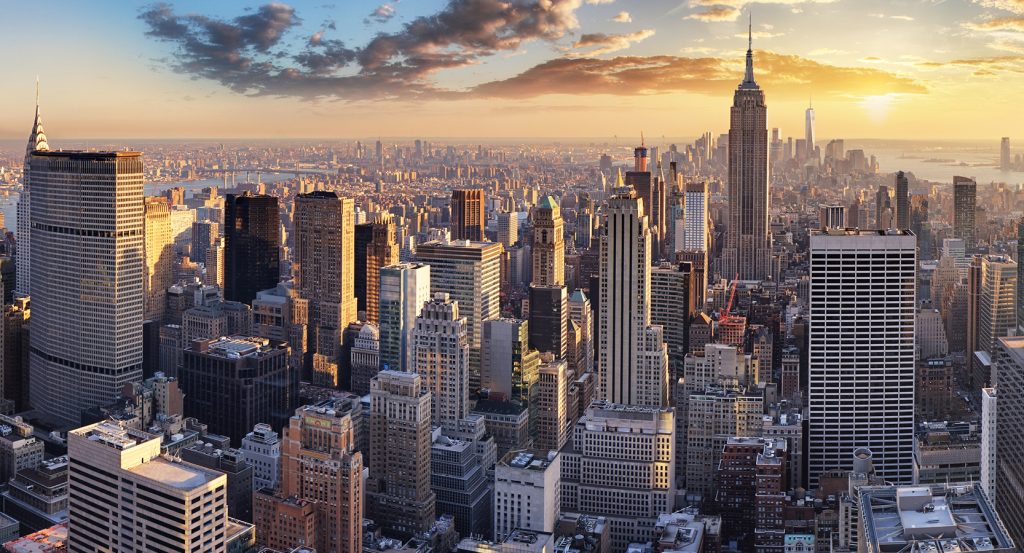
Why Manhattan matters.
Manhattan is a defining enclave where New York City's commercial influence, architectural achievement, cultural leadership, and historical legacy converge into one of the world's most recognized urban landscapes.
Positioned between the Hudson River, the East River, and Harlem, soaring skylines, historic neighborhoods, waterfront parks, and globally influential institutions create an environment shaped by more than four centuries of continuous growth. Colonial origins, sustained architectural innovation, and successive waves of immigration distinguish Manhattan while reflecting the broader evolution of New York City itself. Historic districts, celebrated cultural institutions, and internationally significant business centers collectively reinforce a borough whose influence extends far beyond its shoreline. The result is an experience defined by historical depth, architectural ambition, and a place where successive generations have continually reshaped one of the world's foremost urban centers.
What defines Manhattan.
Manhattan is best known for occupying the original core of New York City after Dutch settlers established New Amsterdam at its southern tip in 1624, beginning more than four centuries of commercial, political, and cultural development that transformed the island into one of the world's leading financial and urban centers. Covering 22.8 square miles of land, Manhattan became one of New York City's five boroughs following the 1898 consolidation while remaining the seat of city government, the location of Wall Street, and the headquarters of numerous international corporations, cultural institutions, and nonprofit organizations. The Commissioners' Plan of 1811 established the borough's celebrated street grid north of Houston Street, creating a systematic structure that guided nineteenth- and twentieth-century residential, commercial, and architectural expansion across much of the island. Manhattan also contains dozens of designated historic districts and thousands of protected buildings recognized by the New York City Landmarks Preservation Commission, reflecting architectural styles ranging from Federal and Greek Revival to Art Deco, International Style, and contemporary high-rise design.
Commercial leadership encouraged successive generations of architects, engineers, and developers to experiment with structural steel, elevator technology, zoning regulations, and high-rise construction, establishing Manhattan as an international center for architectural innovation throughout the late nineteenth and twentieth centuries. That concentration of economic activity also fostered nationally influential publishing houses, theaters, museums, universities, financial institutions, and philanthropic organizations whose work helped shape American literature, performing arts, higher education, and commerce. Immigration from Europe, Latin America, Asia, the Caribbean, and elsewhere continually reshaped the borough's neighborhoods, introducing new languages, religious traditions, cuisines, and entrepreneurial networks that remain embedded within Manhattan's cultural identity. Together, these architectural advances, institutional achievements, and demographic transformations demonstrate how Manhattan has continually reinvented itself while remaining the civic, economic, and cultural heart of New York City.
How Manhattan fits.
Manhattan works as a full-day exploration of New York City's history, architecture, and cultural breadth.
Begin at Battery Park, where waterfront promenades, harbor views, and centuries of maritime history introduce the island's earliest period of settlement and its enduring relationship with New York Harbor. Continue to Central Park, whose expansive landscapes and masterful design provide a compelling contrast to the surrounding urban fabric while illustrating nineteenth-century planning on an unprecedented scale. Conclude at The Metropolitan Museum of Art, where collections spanning thousands of years provide a memorable finale celebrating the artistic and cultural traditions that have long helped define Manhattan's global influence. The progression moves naturally from the island's colonial origins through its celebrated landscape architecture before concluding with one of the world's foremost art museums, demonstrating how history, design, and culture collectively define Manhattan.
Where your story begins.
Foresyte Travel reveals places that feel extraordinary long before you arrive.
Enjoy editorial crafted for luxury travelers.
Foresyte may earn a commission when you book.







































































































