
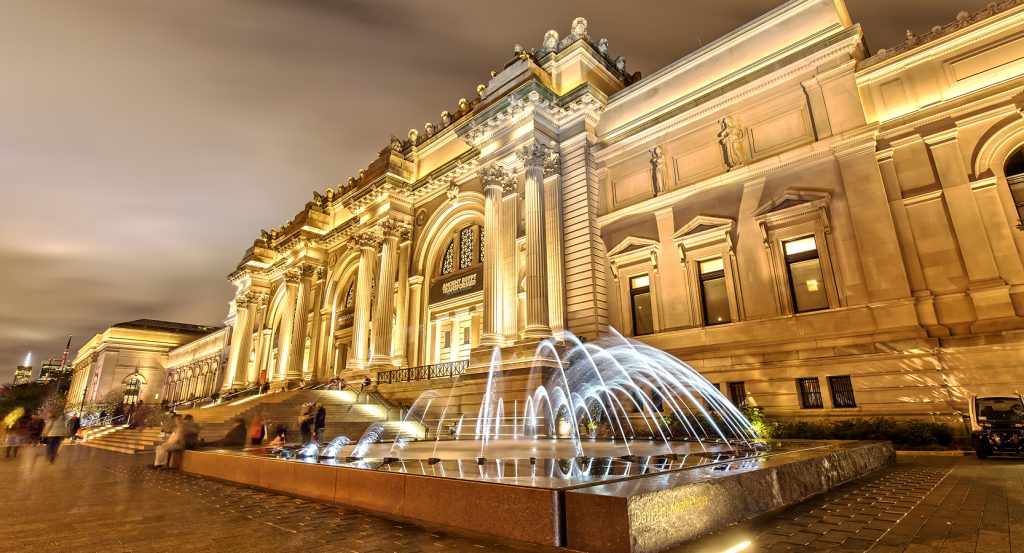
Why The Metropolitan Museum of Art matters.
The Metropolitan Museum of Art is an encyclopedic museum where the Upper East Side's Museum Mile character meets 5,000 years of global art across a vast architectural complex shaped by successive generations of architects, collectors, curators and patrons.
Set along 5th Avenue near East 82nd Street and just steps from the Jacqueline Kennedy Onassis Reservoir, the museum occupies more than two million square feet along Central Park's eastern edge, its long limestone frontage concealing a building assembled through more than a century of additions. Richard Morris Hunt designed the Beaux-Arts Fifth Avenue façade and Great Hall that opened in December 1902, placing three immense entrance arches between freestanding columns and carrying the ceremonial scale into the vaulted interior. Kevin Roche John Dinkeloo and Associates later organized decades of expansion through a comprehensive architectural plan approved in 1971, adding major wings around the earlier museum fabric through 1991. Galleries now move between intimate rooms, immense sculpture courts, period interiors and architectural settings large enough to contain complete historic structures, giving the museum striking changes of scale across its interconnected footprint. The result is an immense cultural complex whose Beaux-Arts entrance, accumulated wings and changing gallery dimensions give thousands of years of art a physical setting commensurate with the breadth of the collection.
What defines The Metropolitan Museum of Art.
The Metropolitan Museum of Art is best known for building one of the world's broadest art collections from an institution incorporated in 1870 by American citizens seeking a major museum for New York. Its first home opened in 1872 at 681 5th Avenue, and the collection moved to the Douglas Mansion on West 14th Street before reaching its Central Park site in 1880 inside the Ruskinian Gothic building designed by Calvert Vaux and Jacob Wrey Mould. The 1874 to 1876 purchase of Luigi Palma di Cesnola's Cypriot antiquities gave the young museum a major body of ancient art spanning the Bronze Age through the Roman period, and Cesnola subsequently became The Met's first director in 1879. John Kensett's death in 1872 brought 38 of his canvases into the collection, followed in 1889 by two paintings from Édouard Manet, marking early growth in American and European painting alongside the archaeological holdings. The Egyptian Expedition opened another path in 1906 through excavations directed by Albert M. Lythgoe, whose teams worked at sites including Lisht and Deir el-Bahri under a system that divided finds with Egyptian authorities. Excavations at Hatshepsut's funerary complex yielded major royal sculpture during the 1920s, including colossal kneeling figures carved for the processional route toward the sanctuary of Amun and statues presenting the female ruler through the established visual conventions of Egyptian kingship. The collection expanded again through Robert Lehman, whose parents Philip and Carrie began acquiring art 1905 and whose 1969 bequest brought 2,600 works spanning Renaissance painting, Old Masters, drawings, manuscripts, maiolica, Venetian glass, bronzes and furniture into The Met. A dedicated Robert Lehman Wing opened in 1975 with rooms recalling the family's private interiors, preserving the character of a major New York collection within the larger museum. Cesnola, Kensett, Lythgoe and Lehman mark distinct routes through which archaeology, artist bequests, excavation and private collecting built an institution responsible for 1.5 million objects spanning five millennia.
The Temple of Dendur brought another major chapter through an international campaign linking archaeology, diplomacy and museum architecture. Construction of Egypt's Aswan High Dam threatened ancient Nubian sites with inundation beneath Lake Nasser, prompting UNESCO to organize an international campaign in which fifty countries helped relocate 22 temples and protect archaeological sites across the region. Egypt gave Dendur to the United States in 1965 in recognition of American participation, and President Lyndon B. Johnson awarded the temple to The Met on April 28, 1967 after a federal commission reviewed competing proposals for its permanent home. Completed by 10 BCE under Augustus, the sandstone temple had stood in Lower Nubia and honored Isis alongside the brothers Pedesi and Pihor, incorporating a gateway, portico, offering chamber and sanctuary into a compact sacred complex. The monument opened at The Met on September 27, 1978 inside a purpose-built wing developed within the Roche master plan, placing the ancient structure beside a broad pool beneath an expansive glazed enclosure. The Costume Institute followed a different institutional route: Irene Lewisohn led the independent Museum of Costume Art from its formation in 1937, the organization merged with The Met in 1946 with fashion-industry support and became a curatorial department in 1959. Diana Vreeland served as special consultant from 1972 until 1989, developing exhibitions including The World of Balenciaga, The Glory of Russian Costume and Vanity Fair that expanded fashion's presence within the museum. Dendur's international relocation and the Costume Institute's evolution from an independent organization reveal two sharply different paths through which The Met enlarged both the physical scale and intellectual range of its collections.
How The Metropolitan Museum of Art fits.
The Metropolitan Museum of Art works as the anchor for an afternoon extending north along 5th Avenue through formal horticulture, a museum devoted to New York itself and an institution born from Puerto Rican cultural activism.
Begin at Conservatory Garden, whose six-acre site carried a horticultural purpose long before the present formal composition opened in 1937. Calvert Vaux designed an early greenhouse for cultivating plants used throughout Central Park, followed by a glass conservatory erected in 1899 for public floral displays; its demolition in 1934 cleared the ground for the present French, Italianate and English gardens. George B. Post's wrought-iron Vanderbilt Gate arrived in 1939 after Gertrude Vanderbilt Whitney gave the former Cornelius Vanderbilt II mansion entrance to New York, and Walter Schott's Three Dancing Maidens entered the French garden in 1947 through the Untermyer family. Continue to Museum of the City of New York, founded in 1923 by Scottish-born writer Henry Collins Brown and first housed in Gracie Mansion before Hardinge Scholle began pursuing a permanent home. New York supplied 5th Avenue land, and Joseph H. Freedlander designed the Georgian Colonial Revival building completed in 1932. The collection grew to 750,000 objects, including Eugene O'Neill manuscripts, 412 Jacob Riis glass negatives, a complete room of Duncan Phyfe furniture, clothing associated with George Washington's inaugural festivities and Carrie Walter Stettheimer's dollhouse containing a miniature work by Marcel Duchamp. Conclude at El Museo del Barrio, founded in 1969 after artist and educator Raphael Montañez Ortiz received an assignment from School District 4 superintendent Martin W. Frey to develop curriculum centered on Puerto Rican history, culture, folklore and art. Montañez Ortiz reconceived the assignment as a community museum, beginning operations in a classroom at PS 125 before moves through schools and neighborhood spaces. Jack Agüeros negotiated the institution's 1977 relocation to the city-owned Heckscher Building on 5th Avenue, where an initial 12,000-square-foot lease led to renovated galleries and a permanent institutional home. The progression moves from Central Park's transformation of nineteenth-century horticultural grounds through Brown and Freedlander's museum devoted to New York into Montañez Ortiz's community-born institution, tracing three distinct ways landscape, civic collecting and cultural advocacy acquired permanent places along 5th Avenue.
Where your story begins.
Foresyte Travel reveals places that feel extraordinary long before you arrive.
Enjoy editorial crafted for luxury travelers.
Foresyte may earn a commission when you book.







































































































