
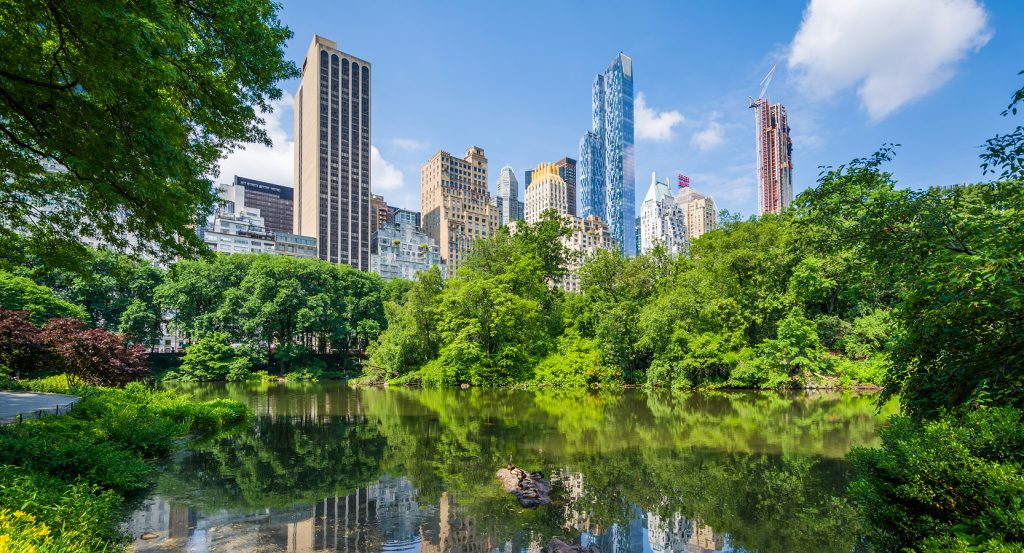
Why Conservatory Garden matters.
Conservatory Garden is a refined formal garden where Central Park's northern landscape meets European garden traditions, intricate horticulture and six acres divided into three distinct compositions.
Set along 5th Avenue between East 104th and 106th Streets and just steps from the Untermyer Fountain, the garden occupies an enclosed section of Central Park where the surrounding terrain gives way to carefully ordered lawns, paths, planting beds and architectural features. Three adjoining landscapes divide the site into a French-style North Garden, Italianate Center Garden and English-style South Garden, allowing changes in symmetry, planting structure and enclosure to distinguish one section from the next. The Italianate center arranges a long lawn between flowering crabapple allées and a semicircular wisteria pergola, using a single fountain jet to reinforce the central axis. The English section gathers bulbs, perennials, shrubs and small trees around a water-lily pool, with denser planting producing a more intimate spatial character than the formal geometry elsewhere. The result is a six-acre composition whose changing garden traditions, carefully controlled planting and shifts between open axes and enclosed horticultural rooms create an unusually concentrated work of landscape design within Central Park.
What defines Conservatory Garden.
Conservatory Garden is best known for transforming a site devoted to Central Park horticulture since the nineteenth century into the park's principal formal garden in 1937. Frederick Law Olmsted and Calvert Vaux initially conceived the area as an arboretum, and the site subsequently became a nursery supplying plants for the developing park. Greenhouses arrived during the late nineteenth century, followed by a large glass conservatory built in 1898 for public displays of tropical plants and flowers. The aging conservatory disappeared during the 1930s, clearing the site for a six-acre outdoor garden developed under New York City's Parks Department. Landscape architect Gilmore D. Clarke directed the design, Thomas Price handled site design and M. Betty Sprout developed the planting scheme between 1935 and 1937. Sprout brought substantial professional preparation to the commission: she earned a landscape architecture degree from the Cambridge School of Architecture and Landscape Architecture in 1928, worked for Annette Flanders on private estates and joined the New York City Parks Department in 1934. Her municipal work extended to the Central Park Zoo, Staten Island Zoo, Henry Hudson Parkway and Bryant Park before the Conservatory Garden commission, followed later by projects at the 1939 New York World's Fair, Battery Park, Cadman Plaza Park and Stuyvesant Town-Peter Cooper Village. The garden's 1937 completion joined a much older horticultural site with the work of designers operating during one of New York's most consequential periods of public landscape construction.
A major renewal during the 1980s began another chapter after decades of deterioration had compromised the garden's planting and physical character. Landscape designer Lynden B. Miller directed the horticultural restoration, bringing extensive attention to the crabapples, perennial beds and other planting elements as the Central Park Conservancy expanded its rehabilitation of the park. Another comprehensive campaign began decades later, addressing pavements, fountains, furnishings, utilities, the pergola and the crabapple allées across all three sections. The multi-phase undertaking reconstructed aging infrastructure and architectural features whose origins reached back to the 1937 construction, with the work completed in spring 2025 after three years. That campaign preserved the garden's historic organization while renewing physical systems beneath its horticultural displays, extending an approach established by the earlier Miller rehabilitation. The two restoration periods place Conservatory Garden within Central Park's broader late twentieth- and early twenty-first-century recovery, preserving a formal landscape whose survival depends on both exacting horticultural stewardship and periodic reconstruction of the physical structure supporting it.
How Conservatory Garden fits.
Conservatory Garden works as the anchor for an Upper Manhattan outing connecting New York history, Puerto Rican and Latin American art and the nineteenth-century landscape engineering of Central Park's northern edge.
Begin at Museum of the City of New York, founded in 1923 by Scottish-born writer Henry Collins Brown with an ambition to create an institution devoted specifically to New York City. The museum first occupied Gracie Mansion before Hardinge Scholle, Brown's successor, pursued a permanent home on 5th Avenue land supplied by the city. Joseph H. Freedlander designed the Georgian Colonial Revival building completed in 1932, which became the repository for a collection now numbering 750,000 objects. Its holdings include Eugene O'Neill manuscripts, Jacob Riis glass negatives, Duncan Phyfe furniture, clothing associated with George Washington's Inaugural Ball and the Carrie Walter Stettheimer dollhouse containing a miniature work by Marcel Duchamp. Continue to El Museo del Barrio, founded in 1969 after School District 4 superintendent Martin W. Frey appointed artist and educator Raphael Montañez Ortiz to develop curriculum devoted to Puerto Rican history, culture, folklore and art. Montañez Ortiz recast the assignment as a community museum supported by Puerto Rican parents, educators, artists and activists, opening operations inside a classroom at PS 125 before subsequent moves through East Harlem. Marta Moreno Vega became the second director in 1971, the same year the institution received its first permanent-collection donation, a graphic-art portfolio from Centro de Arte Puertorriqueño. The collection has since grown beyond 8,500 objects, with the 2023 exhibition Something Beautiful: Reframing La Colección presenting its most extensive permanent-collection installation in more than two decades. Conclude at Harlem Meer, the artificial lake created from a former tidal marsh at Central Park's northeast corner as part of Olmsted and Vaux's linked sequence of northern waterways. The Pool drains into the Loch before water reaches the Meer, connecting engineered hydrology with the rocky Fort Landscape rising to the south. Severe deterioration led the Central Park Conservancy to begin a major rehabilitation during the 1980s; workers eventually removed 34,000 cubic yards of sediment and debris, rebuilt the shoreline with Manhattan schist and wetland plantings, and opened the Buttrick White & Burtis-designed Charles A. Dana Discovery Center on the north shore in 1993. The progression moves from a museum assembled around New York's urban history through an institution born from Puerto Rican cultural advocacy and culminates at Olmsted and Vaux's reconstructed northern water landscape, tying collecting, community institution-building and landscape engineering to the territory surrounding Conservatory Garden.
Where your story begins.
Foresyte Travel reveals places that feel extraordinary long before you arrive.
Enjoy editorial crafted for luxury travelers.
Foresyte may earn a commission when you book.







































































































