
Why Bow Bridge matters.
Bow Bridge is an elegant cast-iron span where Central Park's pastoral design meets Victorian engineering, ornamental metalwork and a low arch carried directly across the Lake.
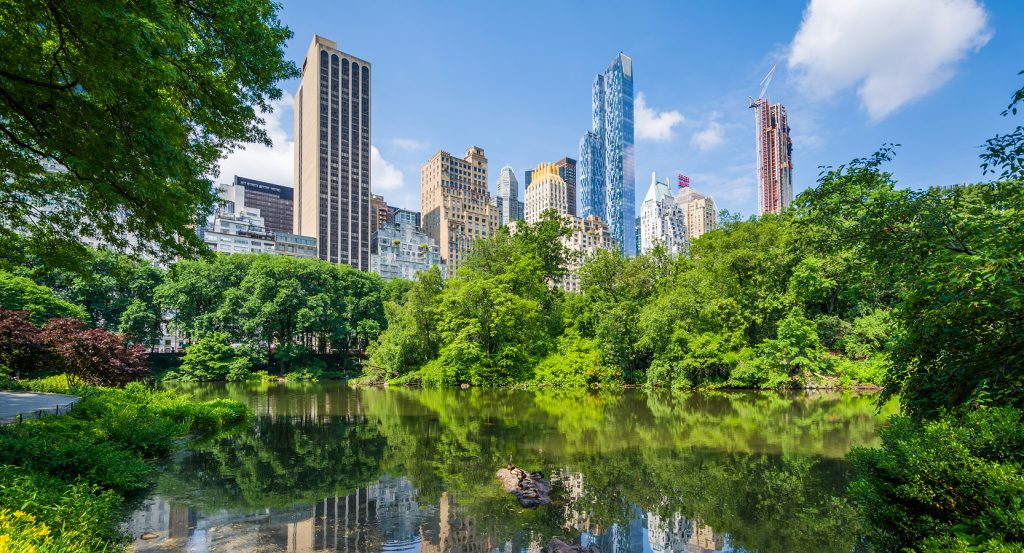
Set across the Lake at 74th Street near the Ramble and just west of Bethesda Terrace, the bridge occupies a pivotal crossing between the wooded shoreline and Central Park's formal core, with open water extending on both sides and Manhattan towers rising beyond the trees. Its shallow cast-iron arch follows a long horizontal curve above the water, pairing a narrow timber walkway with delicate railings of interlocking circles and ornamental details that lighten the appearance of the iron structure. The crossing places pedestrians directly above the Lake, where the low elevation preserves close views across the water and toward the surrounding woodland instead of lifting the path high above the scenery. Bow Bridge also functions as a principal entrance to the Ramble, turning a practical crossing into the transition between open shoreline and the densely planted paths beyond it. The result is a bridge whose restrained height, curved ironwork, intimate relationship with the Lake and position between contrasting landscapes give a short pedestrian crossing unusual architectural and spatial consequence.
What defines Bow Bridge.
Bow Bridge is best known for translating Frederick Law Olmsted and Calvert Vaux's ambitious Central Park circulation plan into one of its most refined pieces of nineteenth-century engineering. New York selected Olmsted and Vaux's Greensward plan from 33 competition entries in 1858, beginning the construction of an 843-acre park organized through lawns, woodlands, waterways and separate circulation routes. Vaux took primary responsibility for the ornamental bridges and arches required to carry those routes through changing terrain, sometimes working with British-born architect Jacob Wrey Mould, who had assisted with the competition submission before joining the park project. Between 1859 and 1866, 27 arches and bridges were constructed as the original circulation network took physical form. Bow Bridge was completed in 1862 from designs by Vaux and Mould, with its cast-iron construction distinguishing it from the masonry structures deployed elsewhere across the park. The Metropolitan Museum of Art places the span at 87 feet and calls it the largest bridge in Central Park, dimensions that gave the designers enough reach to cross open water. Bow Bridge became the sole cast-iron bridge in the park to cross a body of water; the other ornamental iron bridges carried routes above the bridle path. That distinction made the bridge an especially clear demonstration of Vaux's larger architectural role in Greensward, using a purpose-built structure to preserve movement through a carefully composed landscape without allowing engineering to overwhelm the scenery.
Successive preservation campaigns have kept the nineteenth-century iron structure in service as enormous pedestrian traffic placed recurring pressure on its deck and decorative elements. A major rehabilitation in 1974 addressed deterioration that had accumulated across more than a century, beginning a modern sequence of interventions focused on retaining the bridge's historic fabric. Work undertaken between 2008 and 2015 restored missing ornamental urns, repaired the structure and abutments, repainted iron surfaces and replaced the deck. The urn project reinstated decorative elements that had disappeared from the bridge, returning vertical accents to the ends of the otherwise low horizontal composition. Another concentrated campaign began in late 2023 after heavy pedestrian use wore down the timber surface. Conservators used historic photographs to determine the appropriate plank count and deck dimensions, replaced the tongue-and-groove pine decking in kind and addressed vulnerable structural areas beneath it. Bow Bridge reopened in January 2024 after completion of the work, preserving a structure whose cast-iron components have survived repeated cycles of repair since the nineteenth century. The restoration history demonstrates how sustained conservation has retained Vaux and Mould's original iron architecture even as replaceable timber and decorative components have required renewal under intensive public use.
How Bow Bridge fits.
Bow Bridge works as the anchor for a Central Park outing connecting nineteenth-century ornamental architecture, an imported Swedish building and one of ancient Egypt's great surviving monoliths.
Begin at Bethesda Terrace, conceived as Central Park's principal gathering place and its most elaborate formal architectural composition. Calvert Vaux designed the two-level structure with Jacob Wrey Mould, whose sculptural program covers ramps, balustrades and piers with imagery tied to nature, art, science and love. Mould also developed the richly patterned ceiling of the lower arcade using tiles manufactured by Minton in Stoke-on-Trent, England, creating an unusual application of decorative ceramic work within an American public park. Deterioration eventually required removal of the ceiling tiles in 1983; a $7 million campaign returned the restored assembly in 2007 with renewed structural support, waterproofing and lighting. Continue to Swedish Cottage (Marionette Theatre), constructed in Sweden as a model schoolhouse before crossing the Atlantic for Philadelphia's 1876 Centennial Exhibition, the first world's fair held in the United States. The timber building subsequently arrived in Central Park and passed through an extraordinary sequence of uses as a tool house, restroom, entomological laboratory and World War II Civil Defense headquarters. NYC Parks converted it into the workshop for its traveling marionette theater in 1947, and productions later moved inside the building during the 1970s. That history makes the cottage an uncommon surviving connection between an international nineteenth-century exhibition, Scandinavian wood craftsmanship and New York's municipal puppet-theater tradition. Conclude at Obelisk (Cleopatra's Needle), carved from a single piece of Aswan granite 1425 BCE for Pharaoh Thutmose III and first erected at the Temple of the Sun in Heliopolis. Romans moved the fallen monolith to Alexandria in 12 BCE, and Egypt later gave it to the United States in connection with the opening of the Suez Canal. Transport to New York required an elaborate transatlantic and overland engineering operation before the 220-ton stone was raised in Central Park on January 22, 1881. A major conservation campaign completed in 2014 used laser cleaning across its 2,112-square-foot surface and stabilized fragile stone, preserving hieroglyphs cut more than three millennia before Central Park existed. The progression moves from Vaux and Mould's intricate nineteenth-century architectural craftsmanship through a Swedish exhibition building repurposed for puppetry and culminates at an Egyptian monolith whose route from Heliopolis through Alexandria to Manhattan compresses thousands of years of architectural and cultural history into Central Park.
Where your story begins.
Foresyte Travel reveals places that feel extraordinary long before you arrive.
Enjoy editorial crafted for luxury travelers.
Foresyte may earn a commission when you book.







































































































