
Why Bethesda Terrace matters.
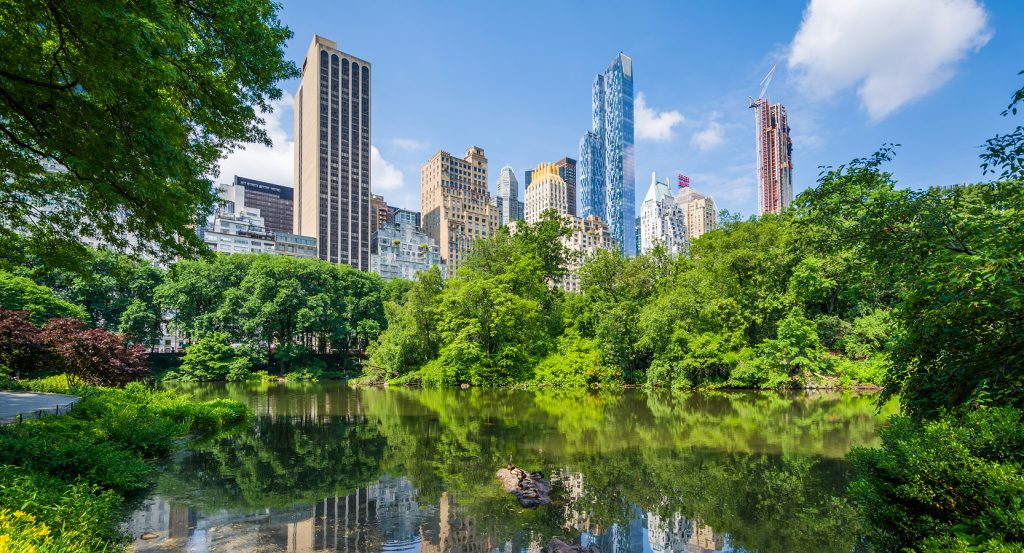
Bethesda Terrace is an ornate architectural ensemble where Central Park's pastoral character meets carved sandstone, ceremonial stairways and a formal plaza descending toward the Lake.
Set at the northern end of the Mall near the 72nd Street Cross Drive and just steps from Naumburg Bandshell, the two-level terrace occupies the transition between the park's long elm-lined promenade and the water, with the Ramble rising across the Lake beyond it. Broad symmetrical stairs descend around a central arcade, and ramps, balustrades and piers carry an extensive program of carved plants, birds, fruit and animals across the sandstone architecture. The upper level creates a formal overlook before the stairs draw movement beneath the transverse road and into the lower plaza, allowing pedestrian circulation to continue through an architectural passage. Day and Night appear through rooster, owl and bat carvings near the southern entrance, with seasonal imagery developing through additional flora and fauna across the descending stonework. The result is a carefully staged sequence of promenade, overlook, stairs, ornament and waterfront plaza that gives Central Park's principal formal landscape a physical character distinct from the wooded and pastoral terrain surrounding it.
What defines Bethesda Terrace.
Bethesda Terrace is best known for serving as the architectural centerpiece of Frederick Law Olmsted and Calvert Vaux's Greensward Plan, the competition-winning scheme selected for Central Park in 1858. The designers conceived the park around broad pastoral landscapes, yet the terrace received an exceptional role as a formal gathering place at the terminus of the Mall, with Vaux taking principal responsibility for its architecture. English-born architect and designer Jacob Wrey Mould became Vaux's essential collaborator, translating the architectural conception into drawings and developing an elaborate sculptural program tied to nature, art, science, love and cycles of time. Construction advanced during the Civil War, with substantial work underway by 1861, incoming stonework during 1862 and much of the masonry completed by the middle of the decade. Mould's ornament extended across architectural elements throughout the ensemble, giving birds, insects, flowers and other natural forms an unusually extensive place within nineteenth-century public architecture. A surviving 1869 lithograph from the Commissioners of Central Park's thirteenth annual report credits Vaux and Mould as architects, preserving a contemporary image of the completed composition during Central Park's formative decades. The terrace belonged to a much larger circulation strategy in which Olmsted and Vaux separated pedestrians, carriages and riders through bridges, arches and sunken transverse roads, allowing the formal gathering place to participate directly in the engineering of movement through the park. Vaux regarded Bethesda Terrace as the most important architectural achievement of his career, making its exceptional degree of ornament a deliberate departure within a park where architecture ordinarily remained subordinate to landscape.
The Bethesda Arcade carries another chapter of the site through a ceiling assembled from 16,000 encaustic tiles manufactured by Minton and Company in Stoke-on-Trent, England. Forty-nine panels containing 324 tiles apiece suspend patterns of colored clay overhead, reversing a tile technology associated primarily with floors and producing the only known ceiling of its kind. Decades of water infiltration and the immense weight of the installation damaged the ceiling, leading the Central Park Conservancy to remove the tiles in 1983 and place them in storage as the surrounding terrace underwent extensive rehabilitation. The larger campaign dismantled sections of deteriorated stonework, sourced replacement stone from original quarries and brought sculptors into the project to recreate lost ornamental details. The Conservancy eventually raised $7 million for the arcade ceiling, beginning intensive work in 2002 that cleaned, repaired and repainted surviving tiles and commissioned replacements from Minton for pieces too damaged for reuse. New waterproofing, structural steel supports and lighting accompanied the conservation work before the ceiling returned to the arcade in 2007. Landscape architect Philip N. Winslow also played an important role in the wider twentieth-century rehabilitation of Bethesda Terrace and neighboring Central Park landscapes, extending the recovery beyond architectural stonework into the surrounding planted terrain. The restored arcade now preserves both Mould's nineteenth-century decorative ambition and a decades-long conservation undertaking that rescued one of Central Park's most technically unusual architectural features.
How Bethesda Terrace fits.
Bethesda Terrace works as the anchor for a Central Park outing connecting nineteenth-century model boating, ancient Egyptian engineering and an open-air lookout conceived above Manhattan bedrock.
Begin at Conservatory Water, constructed during the 1860s as the reflecting pool for a glass conservatory that was planned but never built. Model boating soon became associated with the basin, adapting a pastime already popular in Paris and London, and enthusiasts founded the Central Park Model Yacht Club in 1916 before organized races expanded through the 1940s. Parks Commissioner Robert Moses reshaped the surrounding program during the early 1950s with a plan centered on water and children's recreation, and a gift from Jeanne Kerb financed the boathouse that opened in 1954 with boat storage and supporting facilities. The regular geometry of the basin preserves the architectural logic of its unrealized conservatory even as miniature sailing became the enduring use of the water. Continue to Obelisk (Cleopatra's Needle), a granite monolith carved in Egypt 3,500 years ago for Pharaoh Thutmose III and originally erected at Heliopolis. Roman Emperor Caesar Augustus later moved the fallen monolith to Alexandria, where bronze crabs supported it near a temple associated with Cleopatra. The Egyptian government presented the stone to the United States during the nineteenth century, and transporting the 69-foot, 200-ton shaft from Alexandria to Central Park became an immense engineering operation involving the ship Dessoug, a specially built railroad and 112 days of movement after its arrival at the Hudson. Workers raised the stone on January 22, 1881 before thousands of spectators, establishing the oldest human-made object in Central Park at its permanent site. Conclude at Belvedere Castle, conceived by Olmsted and Vaux in 1866 as an open-air folly on Vista Rock, the park's second-highest natural point. Construction began in 1867, and the completed complex used Manhattan schist to visually bind its architecture to the rock beneath it; Jacob Wrey Mould contributed to the terraces and pavilions that formed the wider Belvedere composition. The U.S. Weather Bureau converted the structure into a working weather station in 1919, adding doors, windows and offices before departing during the 1960s. After subsequent deterioration, the Central Park Conservancy reopened the building as a visitor center in 1983 and completed another comprehensive rehabilitation in 2019 that reinstated clear-pane openings and reconstructed architectural elements associated with its original open-air conception. The progression moves from a nineteenth-century basin transformed by model-yachting culture through the transatlantic engineering feat that carried an Egyptian monolith into Manhattan and culminates at Vaux and Mould's elevated architectural folly, tracing three radically different approaches to water, stone and designed landscape within Central Park.
Where your story begins.
Foresyte Travel reveals places that feel extraordinary long before you arrive.
Enjoy editorial crafted for luxury travelers.
Foresyte may earn a commission when you book.







































































































