Why Castello di Amorosa matters.
Castello di Amorosa is a medieval-style winery castle where Calistoga's northern Napa Valley wine country meets Dario Sattui's reconstruction of Tuscan defensive architecture, traditional Italian masonry and the production of estate-grown Cabernet Sauvignon and other California wines.
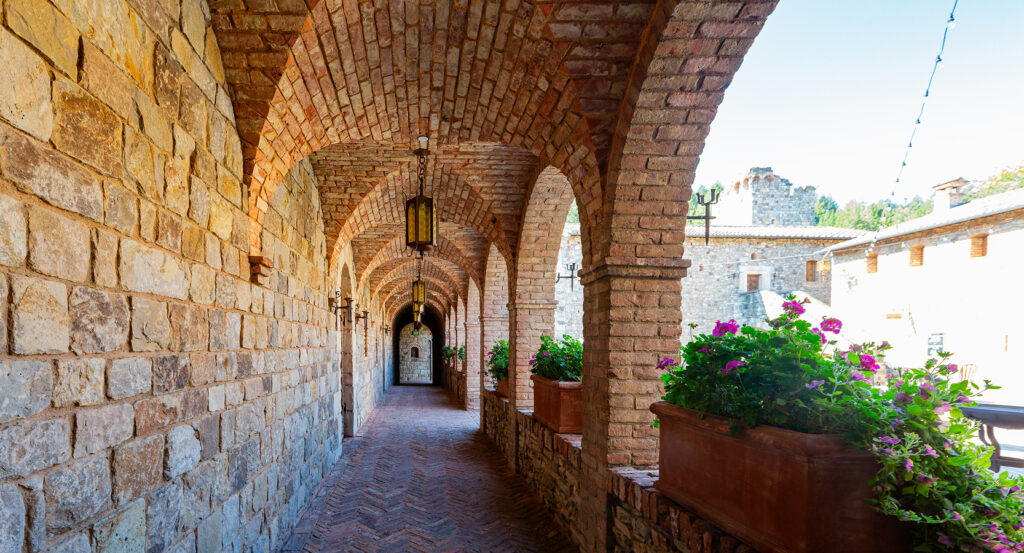
Set along St. Helena Highway near Larkmead Lane and a short drive south of Downtown Calistoga, the winery occupies a hillside estate above the valley's western agricultural corridor, where vineyard terraces climb toward wooded slopes beneath the eastern foothills of the Mayacamas Mountains. Stone towers, battlemented walls and a fortified entrance establish the property's castle-like silhouette. Courtyards, arched passages and masonry staircases connect buildings arranged around the sloping terrain. Vineyard plantings extend below the principal structures, separating the hilltop complex from the highway. The result is a winery whose physical arrangement combines medieval Italian architectural precedents with the agricultural landscape of northern Napa Valley.
What defines Castello di Amorosa.
Castello di Amorosa is best known for its reconstruction of a thirteenth-century Tuscan castle, its extensive stone-built interiors and its founding by fourth-generation California vintner Dario Sattui. Sattui belongs to a family whose American winemaking history began when his great-grandfather Vittorio Sattui established a San Francisco winery in 1885. Prohibition interrupted the original business, and the family's commercial winemaking activities ceased for several decades. Dario revived the family enterprise in 1975, opening V. Sattui Winery in St. Helena and developing a business centered on direct sales and winery visitation. His interest in European castles grew through extensive travels in Italy, where medieval fortifications and historic wine estates provided architectural precedents for a new Napa Valley project. Sattui acquired a hillside property near Calistoga in 1993 and began planning a winery modeled on a fortified Tuscan residence. Construction commenced in 1994, initiating a thirteen-year undertaking involving specialist craftspeople, imported building components and historically inspired construction methods. The project incorporated 8,000 tons of hand-chiseled stone, eight levels and 107 rooms distributed through the castle complex. European artisans contributed masonry, ironwork, decorative painting and other architectural elements associated with medieval building traditions. Antique bricks, roof tiles and architectural fittings were incorporated into the construction to establish continuity with the Italian precedents. The castle opened to the public in 2007, creating a winery whose production facilities were integrated into an elaborate architectural reconstruction. Its development expanded the range of architectural approaches represented within Napa Valley's winery industry. The Glass Fire of 2020 damaged the estate, destroying a farmhouse containing wine production and storage facilities. The principal castle survived, preserving the extensive investment in its stone architecture and underground cellars. Castello di Amorosa continues the Sattui family's winemaking enterprise through a property conceived as both a working winery and an architectural reconstruction.
Dario Sattui's architectural program extends through a sequence of fortified spaces whose construction incorporates techniques and decorative forms associated with medieval Tuscany. The entrance passes through defensive walls and leads toward an internal courtyard enclosed by stone buildings. A drawbridge, moat, towers and battlements reproduce elements associated with fortified Italian residences. The Great Hall contains painted frescoes, vaulted ceilings and substantial timber furnishings developed through specialist decorative craftsmanship. A chapel incorporates religious architectural details and painted ornament associated with medieval ecclesiastical interiors. Stone passages connect rooms distributed across multiple levels, creating a complex internal arrangement of staircases and chambers. The armory contains historical weapons and armor associated with European military traditions. A reconstructed torture chamber includes instruments illustrating methods of punishment associated with medieval and early modern Europe. Underground barrel rooms incorporate vaulted masonry construction, providing substantial spaces for wine maturation. The Grand Barrel Room contains rows of oak barrels arranged beneath stone arches, connecting the castle's architectural program with its winemaking operations. Cabernet Sauvignon forms an important component of the winery's production, drawing upon fruit grown in Napa Valley vineyards. Sangiovese connects the estate's Italian architectural influences with a grape variety closely associated with Tuscany. The winery also produces other red, white and dessert wines, including styles influenced by European winemaking traditions. Guided tours move through selected architectural spaces before concluding with structured tastings of the estate's wines. The castle's arrangement places winemaking, historical reconstruction and visitor circulation within a single hillside complex.
How Castello di Amorosa fits.
Castello di Amorosa works as the architectural centerpiece for a northern Napa Valley itinerary connecting nineteenth-century wine production, the agricultural settlement of Calistoga and the geothermal landscape beneath the Mayacamas Mountains.
Begin at Beringer Vineyards, the historic winery established in St. Helena in 1876 by German immigrant brothers Jacob and Frederick Beringer. The brothers developed their enterprise during Napa Valley's early commercial wine expansion, introducing production facilities and cellars associated with European winemaking traditions. The estate contains the Rhine House, completed in 1884 and designed with architectural influences drawn from German country residences. Its elaborate woodwork, decorative glass and substantial stone construction preserve the family's ambitions for the property. Underground wine caves excavated into the hillside provided temperature-stable storage for aging wines. The winery's surviving buildings connect Napa Valley's nineteenth-century development with immigrant entrepreneurship and European architectural influences. Continue to Sharpsteen Museum, the Calistoga institution devoted to the history of the Upper Napa Valley. Founded through the efforts of artist and former Disney animator Ben Sharpsteen, the museum preserves objects, photographs and exhibits associated with Calistoga's settlement and commercial development. Its collections examine the influence of Samuel Brannan, whose nineteenth-century investments helped establish the town as a resort centered on geothermal waters. Historical displays address the region's transportation, agriculture and community life. The museum also contains a detailed diorama representing Calistoga during an earlier period of its development. Its exhibits connect the city's resort history with the agricultural economy of northern Napa Valley. Conclude at Old Faithful Geyser of California, the geothermal attraction situated north of Downtown Calistoga. The geyser occupies an area of volcanic and hydrothermal activity associated with the geological development of the northern Napa Valley. Underground water heated by geothermal processes periodically erupts through an opening at the surface, producing a column of water and steam. The surrounding property contains open grounds and facilities devoted to the area's natural features. The geyser's activity belongs to a broader geothermal system that also supports Calistoga's historic mineral-water and mud-bath traditions. The progression moves from nineteenth-century winery architecture through Calistoga's settlement history and culminates at a geothermal feature, connecting Castello di Amorosa with the agricultural and geological development of northern Napa Valley.
Where your story begins.
Foresyte Travel reveals places that feel extraordinary long before you arrive.
Enjoy editorial crafted for luxury travelers.
Foresyte may earn a commission when you book.