
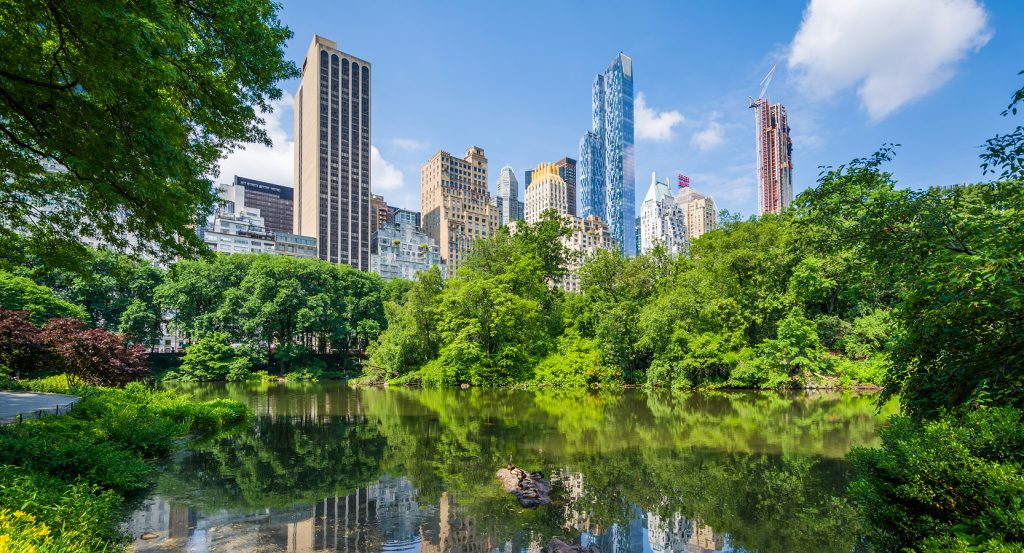
Why Central Park Zoo matters.
Central Park Zoo is a compact zoological enclave where Central Park's wooded southeastern landscape meets carefully constructed wildlife habitats, historic brick architecture and an intimate garden plan organized around its central sea lion pool.
Set along the East Drive near East 64th Street and just steps from Wollman Rink, the zoo occupies a sheltered tract near Central Park's Fifth Avenue edge, with mature trees and rock outcrops separating its interior from the dense buildings beyond the park boundary. The grounds divide into distinct climatic zones linked by paths and arcades, placing tropical, temperate and polar environments within a site measuring only several acres. A glass-fronted sea lion pool forms the central gathering point, giving underwater movement equal architectural prominence with the animals visible above its rocky perimeter. Nearby habitats use vegetation, water, constructed rockwork and changes in elevation to establish close viewing relationships without returning to the rows of exposed cages that characterized earlier incarnations of the facility. The result is a tightly composed zoological garden whose habitat zones, central pool, enclosed paths and surrounding park landscape concentrate substantial environmental variation within one of Central Park's smallest institutional sites.
What defines Central Park Zoo.
Central Park Zoo is best known for developing from an unplanned nineteenth-century collection of donated animals into one of the earliest municipal zoological sites in the United States, followed by a comprehensive 1930s reconstruction under Parks Commissioner Robert Moses. Frederick Law Olmsted and Calvert Vaux had omitted a zoo from the Greensward Plan, yet animals began arriving through private donations soon after Central Park opened, and enclosures accumulated near the Arsenal as the collection grew. New York formally chartered the menagerie in 1864, giving municipal standing to a facility that had emerged without a place in the original park design. August Belmont contributed two Virginia deer and three Canadian wild geese in 1870, Hamilton Fish followed with six wild turkeys, and P. T. Barnum and George F. Bailey lent additional specimens during the institution's early decades. By the early twentieth century, the collection occupied deteriorated wooden structures with poor light and little systematic organization, conditions that became a target of the citywide park campaign launched after Fiorello H. La Guardia appointed Moses in 1934. Architect Aymar Embury II designed the replacement menagerie with the Parks Department architectural staff, exchanging the old wooden enclosures for a formal ensemble of brick masonry buildings around a courtyard. Sculptor Frederick George Richard Roth and assisting sculptors carved animal friezes directly into the limestone, adding a substantial program of architectural sculpture to the new complex. The rebuilt menagerie opened in December 1934 as one component of Moses's sweeping expansion of recreation facilities across Central Park and New York's municipal park system.
A second reconstruction began after prolonged negotiations transferred management of Central Park Zoo, its children's facility, Prospect Park Zoo and Queens Zoo to the New York Zoological Society in 1980, launching the organization's City Zoos Project. Education curator Richard L. Lattis directed the undertaking, which required staged animal transfers, closure, demolition, architectural redesign and construction across the municipal facilities. Central Park Zoo closed in 1983 as animals moved to other institutions, and architect Kevin Roche of Kevin Roche John Dinkeloo and Associates led a plan replacing the former cage system with three habitat zones based on climatic regions. Roche retained four structures from the preceding complex and enlarged the sea lion facility, using glass to permit underwater viewing within the reconstructed central garden. Archival project holdings trace design development from 1980 through the middle of the decade, including studies for polar bears, penguins, the central garden and the surrounding arcades, followed by construction photographs from 1987 and 1988. The reconstructed zoo reopened on August 8, 1988 under the management of the New York Zoological Society, later renamed the Wildlife Conservation Society, with Mayor Ed Koch marking the occasion by throwing the inaugural fish into the Sea Lion Pool. That intervention shifted Central Park Zoo from a traditional municipal menagerie toward the habitat-centered zoological institution operating inside the park in the present century.
How Central Park Zoo fits.
Central Park Zoo works as the anchor for a southern Central Park outing connecting pre-park military architecture, Olmsted and Vaux's nineteenth-century Children's District and an American folk-art carousel with roots in Coney Island.
Begin at Arsenal, among only two buildings inside Central Park that predates the park itself, constructed between 1847 and 1851 from plans by architect Martin E. Thompson as a munitions depot for the New York State militia. New York City acquired the Gothic Revival structure and surrounding land for $275,000 soon after its completion as the future park took shape, and succeeding decades brought an unusual succession of occupants including a police precinct, weather bureau, the first home of the American Museum of Natural History and municipal park administration. Works Progress Administration murals added during the 1930s depict nineteenth-century park scenes and soldiers in formation, preserving the building's military origins within the interior; municipal protection followed in 1967. Continue to Dairy Visitor Center & Gift Shop, designed by Central Park co-creator Calvert Vaux and built between 1869 and 1871 as a Victorian cottage within the original Children's District. Fresh milk and snacks were sold beneath its open loggia at a period when safe milk was not readily available to many urban families, placing the building within a larger zone created specifically for children and caregivers. The structure deteriorated by the 1950s, lost its loggia and became a maintenance shed before reopening in 1979 as Central Park's first visitor center. An early Central Park Conservancy campaign restored the missing porch during the 1980s, and another restoration completed in 2021 repaired the masonry, slate roof, windows and historic woodwork. Conclude at Central Park Carousel, whose lineage inside the park began in 1871 when a rival administration installed an amusement that Olmsted and Vaux had opposed as inconsistent with their pastoral plan. The earliest carousel relied on a horse or mule working below the ride, trained to start and stop in response to taps from the operator above; two succeeding carousels were destroyed by fires in 1924 and 1950. NYC Parks found the present machine abandoned in a Coney Island trolley terminal and installed it in Central Park in 1951. Built in 1908, the surviving carousel carries 57 carved horses and two chariots accompanied by a mechanical organ and is valued as an important work of American folk art. The progression moves from Thompson's antebellum militia depot through Vaux's purpose-built refuge for nineteenth-century children and culminates in a 1908 carousel rescued from Coney Island, revealing how military, social and recreational structures accumulated within Central Park across successive generations.
Where your story begins.
Foresyte Travel reveals places that feel extraordinary long before you arrive.
Enjoy editorial crafted for luxury travelers.
Foresyte may earn a commission when you book.







































































































