
Why American Museum of Natural History matters.
American Museum of Natural History is a vast scientific museum where the Upper West Side's institutional character meets expansive architecture, global collections and research spanning human cultures, Earth and the universe.
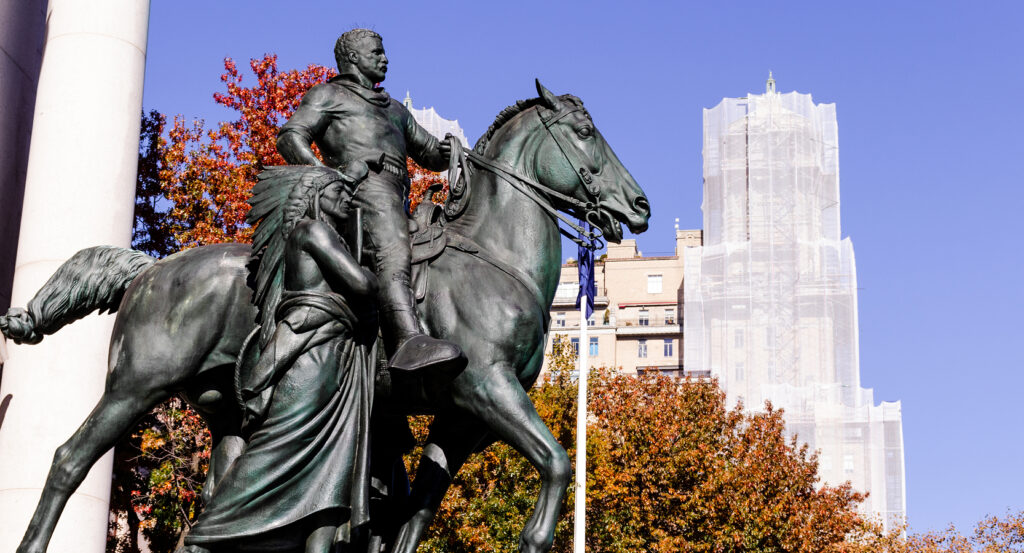
Set along Central Park West near West 79th Street and just steps from the New York Historical, the museum occupies a full superblock facing Theodore Roosevelt Park, with successive wings accumulated across 150 years of construction. The Central Park West frontage centers on John Russell Pope's Roman-style Theodore Roosevelt Memorial, whose expansive arch, colonnade and broad terrace give the sprawling complex its principal eastern face. Interior circulation moves through more than 40 permanent galleries devoted to subjects extending from dinosaurs and biodiversity to ocean life, meteorites and human cultures, with major halls arranged across multiple interconnected buildings. The western edge now opens through the Richard Gilder Center for Science, Education, and Innovation, where sweeping concrete forms create new internal connections across four floors of the older complex. The result is an immense museum campus whose historic wings, ceremonial eastern facade, interconnected galleries and sculpted western addition make architecture itself part of the movement across natural history.
What defines American Museum of Natural History.
American Museum of Natural History is best known for joining a globally significant scientific collection with an institution whose origins reach to a New York State charter signed on April 6, 1869. Albert Smith Bickmore drove the founding campaign, and Theodore Roosevelt Sr. belonged to the group that created the institution before its earliest displays opened inside the Central Park Arsenal in 1871. New York City subsequently granted the museum land at Manhattan Square, where President Ulysses S. Grant laid the cornerstone of its first permanent building in 1874. Calvert Vaux and Jacob Wrey Mould designed that Victorian Gothic structure as the opening component of an ambitious 1872 master plan envisioning a square complex divided by cross-axial wings and four internal courts. President Rutherford B. Hayes presided over the public opening on December 22, 1877, placing a purpose-built scientific institution on what remained a sparsely developed section of Manhattan. Cady, Berg & See recast the architectural plan in 1897 through a Romanesque Revival approach, producing the West 77th Street frontage during a construction campaign extending from 1890 to 1900. Scientific fieldwork simultaneously expanded the institution far outside New York: museum expeditions have operated on every continent since 1887, feeding collections used for taxonomy, evolutionary biology and other branches of research. Paleontology became one particularly consequential field, strengthened by the 1897 acquisition of Edward Drinker Cope's fossil collection and later expeditions led by figures including Walter Granger, Barnum Brown and George Gaylord Simpson. The fossil mammal holdings alone now contain 400,000 specimens representing 3,000 extinct genera, including 2,000 type specimens. The institution's scientific holdings exceed 30 million specimens and objects, preserving evidence extending across 4.5 billion years of geological change and 3.5 billion years of biological history.
A major twenty-first-century expansion began with the Richard Gilder Center for Science, Education, and Innovation, designed by Studio Gang under Jeanne Gang and opened in 2023. The project reorganized circulation through new connections into the existing campus and placed collections storage, scientific work and public exhibition in unusually close physical proximity. Its Louis V. Gerstner, Jr. Collections Core exposes portions of the museum's holdings through floor-to-ceiling displays, shifting objects normally associated with scientific storage into public view. The Susan and Peter J. Solomon Family Insectarium added live insects, pinned specimens and research components, and a butterfly vivarium created a dedicated environment for hundreds of free-flying butterflies. Fifteen education spaces were developed across learning zones serving families, middle-school students, high-school students and teachers, extending the expansion into formal science instruction. Ralph Appelbaum Associates led exhibition design, joining Studio Gang's architecture with installations devoted to biological diversity and contemporary scientific investigation. The addition also created connections to the existing museum on four floors, resolving portions of a campus whose incremental construction had produced complex internal routes over successive generations. The Gilder Center places active science, collections care, education and public display within the same architectural intervention, extending the institution's founding scientific mission through a major new western entrance.
How American Museum of Natural History fits.
American Museum of Natural History works as the anchor for an Upper West Side outing connecting Central Park design, self-taught American art and advanced scholarship in decorative arts and design history.
Begin at Belvedere Castle, conceived by Central Park co-designer Calvert Vaux with architect Jacob Wrey Mould as an open-air lookout atop Vista Rock, the park's second-highest natural point. Vaux conceived the miniature castle in 1858, Olmsted and Vaux developed the surrounding terrace during the following decade, and construction beginning in 1867 transformed a site previously occupied by a utilitarian reservoir bell tower. The completed 1872 complex originally had neither windows nor doors, framing views north across the old Croton reservoir and south toward the Ramble before conversion into a U.S. Weather Bureau station in 1919 gave the building a new scientific function. Continue to American Folk Art Museum, founded in 1961 and devoted to artists whose practices developed primarily outside formal academic training. Its collection now exceeds 7,000 works spanning four centuries and nearly every continent, encompassing paintings, quilts, sculpture and major bodies of twentieth-century self-taught art. Henry Darger occupies a significant position within those holdings through large-scale works combining watercolor, pencil, carbon tracing and collage, placing an artist who spent much of his life outside professional art institutions within a museum devoted to expanding the historical boundaries of artistic authorship. Conclude at Bard Graduate Center Gallery, the exhibition arm of the institute founded by Susan Weber in 1993 for advanced study of decorative arts, design history and material culture. Its West 86th Street gallery occupies an early twentieth-century townhouse converted during the institution's formative years, with Ennead Architects completing a major renovation in 2011 that created a Main Gallery and dedicated Focus Gallery for smaller scholarly projects. Exhibitions and accompanying publications investigate significant designers, artistic movements and objects through sustained academic research, linking gallery presentation directly with Bard Graduate Center's MA and PhD programs. The progression moves from Vaux and Mould's nineteenth-century park architecture through a museum dedicated to self-taught artistic production and culminates in Weber's graduate institute for object-centered scholarship, connecting designed landscape, artistic independence and academic study across the Upper West Side.
Where your story begins.
Foresyte Travel reveals places that feel extraordinary long before you arrive.
Enjoy editorial crafted for luxury travelers.
Foresyte may earn a commission when you book.







































































































