
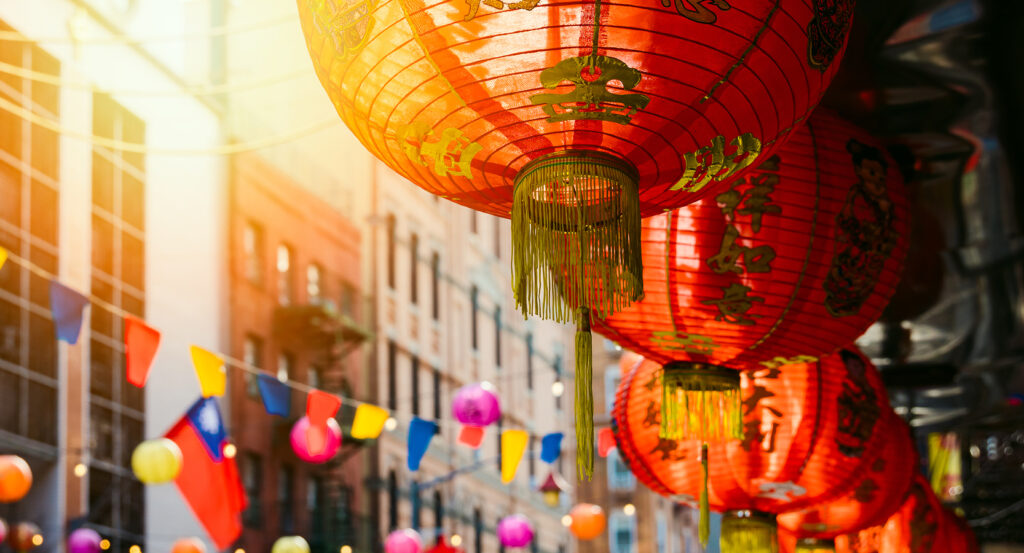
Why Chatham Square matters.
Chatham Square is a historic civic junction where Chinatown's Chinese American heritage meets one of Lower Manhattan's oldest transportation crossroads and a public space shaped by successive generations of the neighborhood.
Set where Bowery, East Broadway, Worth Street, Mott Street, Oliver Street and Park Row converge near Confucius Plaza, the square occupies a broad junction connecting Chinatown with the Civic Center and Lower East Side. Its irregular geometry comes directly from streets with origins predating Manhattan's later grid, creating triangular islands and angled approaches around a central public area. Kimlau Square occupies the eastern portion of the junction, placing planted ground and commemorative architecture amid streets carrying pedestrians between the surrounding commercial blocks. Park Row enters from the southwest beside the civic district, and East Broadway extends eastward through a corridor long associated with successive immigrant communities. The result is a multilayered urban square whose converging streets, commemorative center and position between Chinatown and the Civic Center preserve the physical imprint of Lower Manhattan's development across centuries.
What defines Chatham Square.
Chatham Square is best known for serving as a major Lower Manhattan crossroads whose history extends from colonial farmland through markets, theaters, elevated railways and the growth of modern Chinatown. The square took its name from William Pitt, Earl of Chatham, the British statesman who opposed policies leading toward war with the American colonies. During the eighteenth century, Bowery Lane followed an earlier Indigenous route north toward Harlem, with the freshwater Collect Pond lying west of the square and farms occupying much of the surrounding terrain. Chatham Square developed after the Revolution as Petrus Stuyvesant III opened roads through ancestral property, and the district accumulated residences, workshops and commercial activity as Manhattan expanded northward. A horse market, livery stable serving Boston stagecoaches, distillery, watchhouse and groups of stores occupied the vicinity by the close of the eighteenth century. Livestock trading continued in Chatham Square until 1820, and the junction subsequently developed a dense nineteenth-century commercial culture of theaters, shops, hotels, banks, workshops and entertainment establishments. Transportation reshaped the square again as Manhattan's elevated railway network expanded downtown, and Chatham Square became an important junction for the Second and 3rd Avenue lines by the late nineteenth century. A 72-foot-wide elevated station stood on the western side, and intersecting tracks cast much of the square into shadow for decades. The elevated structures disappeared in 1955 as rail service shifted below grade, restoring open sky to a junction that had spent three quarters of a century beneath railway infrastructure.
Chinese American commemoration subsequently gave the square its most consequential surviving civic structure. World War II veterans founded the Lieutenant B.R. Kimlau Chinese Memorial Post 1291 in 1945 and later sought a permanent tribute to Chinese Americans killed during military service. The memorial honors Second Lieutenant Benjamin Ralph Kimlau, a New York-born Chinese American bomber pilot killed at age 26 during a 1944 mission against Japanese military installations in the South Pacific. Architect Poy Gum Lee, born on Mott Street in 1900 and educated at Pratt Institute, MIT and Columbia University, designed the granite ceremonial gateway after a career that included two decades of architectural work in Shanghai and later service as a senior architect for the New York City Housing Authority. Lee's original four-column proposal was reduced to two columns after underground infrastructure restricted the structure's footprint, producing a 19-foot arch with a peaked roof, stylized brackets and flanking benches. The New York City Art Commission accepted the monument as a gift in 1960, Kimlau Square received its civic designation in 1961 and the arch was dedicated in 1962. The bilingual inscription honors Americans of Chinese ancestry who died in defense of freedom and democracy, placing Chinese American military service permanently within Chinatown's public realm. New York City designated the Kimlau War Memorial in 2021 as the first city-protected site specifically recognizing Chinese American history and culture. A new municipal redesign announced in 2025 proposes converting the complicated street configuration into a conventional four-way intersection, expanding pedestrian areas and retaining the arch at the center of Kimlau Square.
How Chatham Square fits.
Chatham Square works as the anchor for a Chinatown outing connecting Eastern European Jewish immigration, Chinese American historical preservation and the reform-era transformation of the former Five Points district.
Begin at Museum at Eldridge Street, housed inside the Eldridge Street Synagogue completed in 1887 during the great migration of Eastern European Jews into the Lower East Side. The building became the first synagogue in the United States purpose-built by Eastern European Jewish immigrants, with German-born architects Peter and Francis William Herter receiving the commission early in their American careers. Decades of declining congregation numbers and deterioration left major portions of the building endangered before the Eldridge Street Project undertook a restoration lasting 20 years. The synagogue reopened as the Museum at Eldridge Street in 2007, and artist Kiki Smith and architect Deborah Gans added an expansive stained-glass window in 2010, extending the building's artistic history through a contemporary commission. Continue to Museum of Chinese in America, whose origins reach to Jack Tchen and Charlie Lai's work at Basement Workshop, the Chinatown Asian American political and arts organization where the pair met in 1976. Concerned that neighborhood history was disappearing as businesses closed and possessions were discarded, they founded the New York Chinatown History Project in 1980 and moved the organization into the former P.S. 23 building at 70 Mulberry Street in 1984. Expansion carried the institution to 215 Centre Street in 2009, where architect Maya Lin converted a former automobile garage into a sixfold-larger museum and curators Cynthia Lee and Jack Tchen expanded the core exhibition With a Single Step: Stories in the Making of America. Conclude at Columbus Park, created on land once occupied by Mulberry Bend, among the most densely built sections of the nineteenth-century Five Points district. Demolition of the surrounding tenements culminated in a new park in 1894, advancing reformers' campaign to replace overcrowded housing with public open space. The grounds were initially called Mulberry Bend Park and received the Columbus Park name in 1911, leaving a public landscape on terrain associated with one of the most consequential episodes in nineteenth-century New York housing reform and immigration history. The progression moves from an 1887 synagogue built by Eastern European Jewish immigrants through Tchen and Lai's preservation of Chinese American history and culminates on the former Mulberry Bend, joining religious migration, community scholarship and urban reform across the streets surrounding Chatham Square.
Where your story begins.
Foresyte Travel reveals places that feel extraordinary long before you arrive.
Enjoy editorial crafted for luxury travelers.
Foresyte may earn a commission when you book.







































































































