
Why Cinespia matters.
Cinespia is a cinematic gathering where Hollywood's film heritage meets open-air exhibition, communal picnicking and John Wyatt's transformation of cemetery grounds into one of Los Angeles' enduring moviegoing traditions.
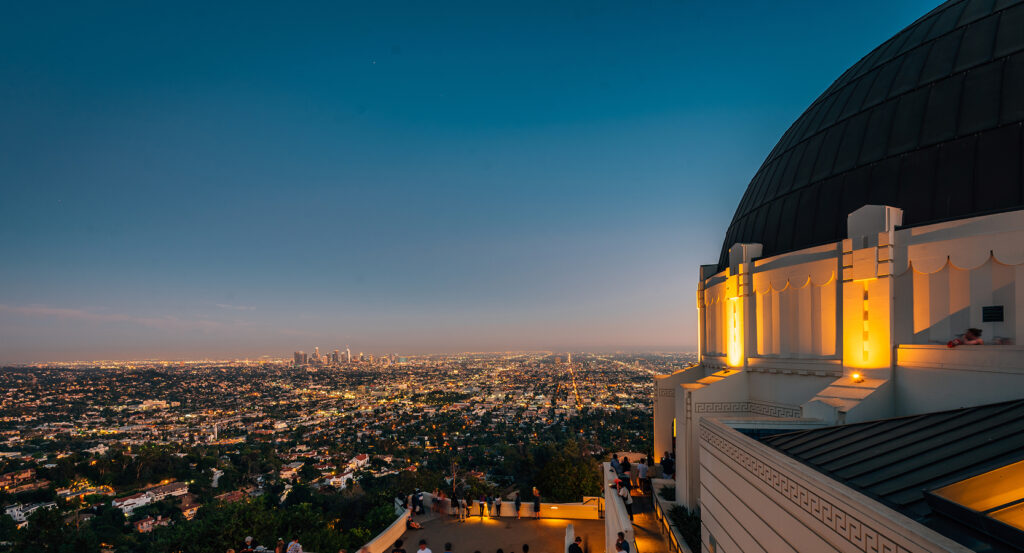
Set along Santa Monica Boulevard near Gower Street and just steps from Paramount Pictures Studios, the summer series occupies Fairbanks Lawn inside Hollywood Forever Cemetery, with the studio backlot immediately south, the Hollywood commercial grid extending west toward Vine Street and the eastern Hollywood hills rising north toward Griffith Park. The lawn creates a broad outdoor auditorium beneath mature trees, directing thousands of moviegoers toward the pale exterior wall of the Cathedral Mausoleum. Blankets, low seating and picnic spreads turn the grass into an informal viewing field before sunset, preserving an open spatial arrangement fundamentally different from fixed theatrical seating. Pre-show DJ sets and elaborate film-specific photo booths develop the gathering before projection begins, giving music and visual production their own place around the feature. The result is an outdoor cinema whose cemetery lawn, mausoleum screen, picnicking, music and Hollywood surroundings make the physical act of watching a film inseparable from the city that produced so many of them.
What defines Cinespia.
Cinespia is best known for John Wyatt's transformation of a small 2002 film-club screening into a Los Angeles series that has presented more than 650 films to more than one million people across 25 seasons. Wyatt had studied with influential film lecturer Jim Hosney at Crossroads School and operated a film club with Richard Petit before attending a Rudolph Valentino tribute at Hollywood Forever, an event that suggested the cemetery as a setting for communal cinema. He arranged Alfred Hitchcock's Strangers on a Train as the first Cinespia screening in July 2002, using two 35mm projectors mounted on the back of a pickup truck and a borrowed print. An audience of 80 attended that initial event; a subsequent presentation of Samuel Fuller's Pickup on South Street drew 1,000, and the inaugural season grew to four films. Hollywood Forever itself had entered a period of renewal after years of deterioration, allowing the screenings to develop alongside restoration of a cemetery founded in 1899 and deeply connected with the motion-picture industry through the studio property occupying part of its original southern acreage. Cinespia subsequently expanded beyond the cemetery into historic Downtown movie palaces, where many presentations retain 35mm exhibition alongside DJs, bars, concessions and themed photography. The organization reached its 25th summer season in 2026, opening the anniversary program with E.T. the Extra-Terrestrial and continuing a format that survived the pandemic before returning to Hollywood Forever in June 2021.
Music begins as the gates open, giving the gathering a curated soundtrack before the projected image takes over the mausoleum wall. Wyatt's background as a Los Angeles DJ and record collector shaped that component from the beginning, eventually bringing selectors including Questlove, Cut Chemist and Daisy O'Dell into the series. Creative director and artist Alia Penner developed another signature element through custom-built photo booths conceived around the film of the week, turning titles into temporary sets in which attendees enter the visual world surrounding the screening. The Fairbanks Lawn itself accommodates crowds reaching 4,000, with picnics spread across the grass before darkness and the feature presentation. Film selection ranges across decades and genres, with Wyatt programming established classics, cult titles and newer works whose reputations have developed since Cinespia began. The cemetery intensifies certain choices through physical association: the 2026 presentation of Mulholland Drive took place near David Lynch's final resting place, and Sunset Boulevard gains another layer from discussion naming Hollywood figures interred around the audience. Twenty-five seasons have preserved the same essential structure, joining a carefully chosen film with music, photography, picnicking and a setting embedded directly within Hollywood history.
How Cinespia fits.
Cinespia works as the anchor for a Hollywood outing connecting the architecture of big-band entertainment, the recording technology behind the West Coast music industry and an arts estate that helped redirect residential design in Southern California.
Begin at Hollywood Palladium, designed by Gordon B. Kaufmann and opened on Halloween 1940 on property formerly occupied by the original Paramount lot. Film producer Maurice Cohen developed the project with $1.6 million in financing from Los Angeles Times publisher Norman Chandler, creating a Streamline Moderne ballroom whose opening performance placed Tommy Dorsey's orchestra onstage with the young Frank Sinatra as vocalist. The circular entrance foyer, domed ceiling, curved balcony and patterned wood dance floor supported a hall built around mass dancing, and later decades carried the Palladium through big band, Latin music, rock, punk and hip-hop. Continue to Capitol Records Tower, completed in 1956 by Welton Becket and Associates with Louis Naidorf as project designer. Its 13-story circular plan made it the world's first circular office building, and the 90-foot aluminum spire carries a beacon blinking H-O-L-L-Y-W-O-O-D in Morse code. Three studios beneath the tower were conceived for high-fidelity recording, with underground reverberation chambers developed with assistance from Les Paul; Frank Sinatra, Nat King Cole, the Beach Boys and the Beatles subsequently worked within the complex. Conclude at Hollyhock House, commissioned by oil heiress and theater producer Aline Barnsdall and built from 1919 to 1921 as Frank Lloyd Wright's first Los Angeles commission. Wright integrated stylized hollyhocks into art stone, furniture, textiles and glass, and the project brought Rudolph Schindler and Lloyd Wright into work that became consequential to California Modernism. Barnsdall gave the house and surrounding acreage on Olive Hill to Los Angeles in 1927 for a public arts center; Hollyhock House entered the National Register in 1971, received National Historic Landmark status in 2007 and became Los Angeles' first UNESCO World Heritage Site in 2019. The progression moves from Kaufmann's 1940 ballroom for mass entertainment through Naidorf's technologically advanced headquarters for recorded music and culminates at Wright and Barnsdall's Olive Hill project, connecting three physical forms through which Hollywood turned performance, recording and architectural experimentation into cultural institutions.
Where your story begins.
Foresyte Travel reveals places that feel extraordinary long before you arrive.
Enjoy editorial crafted for luxury travelers.
Foresyte may earn a commission when you book.





































































































