Why citizenM San Francisco Union Square matters.
citizenM San Francisco Union Square is a progressive hotel where Union Square's metropolitan density meets citizenM's Dutch smart-luxury philosophy through compact technology-led private spaces, expansive communal living areas, contemporary art and a purpose-built California interpretation of the brand's unconventional hospitality model.
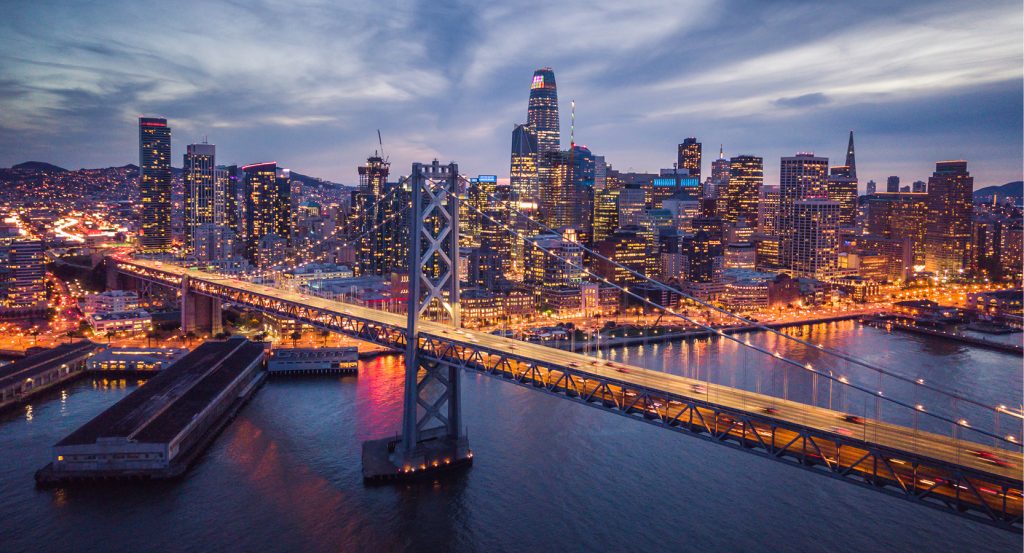
Set along Ellis Street near Powell Street and just steps from the Powell Street cable-car turnaround, the hotel occupies Union Square's southern edge between Market Street's transit spine, the retail blocks extending north toward Geary Street and the cultural district reaching southeast toward Yerba Buena. The slender tower rises from a constrained downtown parcel through a dark prefabricated facade whose metallic staining and textured panels give the exterior a strongly graphic character. A jump elevator carries arrivals above street level into a double-height communal floor organized around bookshelves, artwork, work areas and clusters of colorful furniture. Wall-to-wall glazing and integrated digital controls concentrate the private spaces around daylight, sleep and efficient use of the compact footprint. The result is a hotel whose vertical organization, technology and unusually substantial shared spaces translate citizenM's European model into the dense physical conditions of Downtown.
What defines citizenM San Francisco Union Square.
citizenM San Francisco Union Square is best known for translating Rattan Chadha's Dutch hospitality model into a purpose-built San Francisco tower whose development joined prefabrication, technology and communal design on an exceptionally constrained Union Square site. Chadha founded citizenM with Michael Levie, Campagne and Kloeg after building his career through the fashion company Mexx, and the first citizenM debuted at Amsterdam Schiphol Airport in 2008. The company developed as an integrated real-estate developer, hotel operator, design organization and project manager, allowing architecture and operations to evolve as one standardized system across major cities. citizenM purchased the Ellis Street parcel in August 2016 after earlier hotel proposals had spent years moving through the development process. The property consisted of a surface parking lot with a below-grade level inside the Kearny-Market-Mason-Sutter Conservation District, giving the company an undeveloped downtown site for its first San Francisco project. Construction began in 2019 with Amsterdam studio Concrete and Gensler directing the design, Webcor serving as general contractor and Arup providing structural engineering. Clark Pacific developed the building envelope through its Infinite Facade system, using Nawkaw metal-panel staining in Dusty Charcoal and Vintage Nickel with a Clarkstone finish. The facade system extended citizenM's broader reliance on prefabrication, an approach used across a substantial portion of the company's international portfolio to increase construction consistency and compress development schedules. The completed building received LEED Gold certification, adding environmental performance to a development strategy already centered on reduced private-space footprints and more substantial shared areas. San Francisco joined Los Angeles Downtown and Paris Champs-Elysees among three citizenM properties introduced during 2021, placing the Union Square project inside a major period of international expansion. Marriott International acquired citizenM for $355 million in 2025, bringing the Dutch-born brand into Marriott Bonvoy while preserving citizenM as a distinct global hotel flag.
Digital Sunflower gives the San Francisco property a separate cultural direction through a commissioned work by FriendsWithYou, the Los Angeles collaboration of Samuel Albert Borkson and Arturo Sandoval III. Simplified geometric forms and smiling figures extend across the installation, carrying FriendsWithYou's character-based art into the communal interior. Neo Matloga contributes another artistic language through figurative work rooted in collage, drawing and domestic scenes shaped by memories of South Africa. German painter Rainer Fetting adds a connection to the Neue Wilde movement that emerged from West Berlin during the late 1970s and early 1980s. Jonas Ohlsson, Lu Pingyuan and Lakwena Maciver extend the collection across drawing, conceptual art and bold graphic abstraction. San Francisco artists Mark Ulriksen, t.w. five and Sharon Virtue strengthen the local component within the larger international program. Vitra furniture places the artworks among recognizable modern and contemporary design pieces across the communal living room. canteenM occupies the social center of that environment through a 24-hour bar-restaurant model shared across the citizenM brand. Barista coffee and the morning buffet establish the early service before salads, sandwiches and warm dishes enter the daily food program. Cocktails, beer and wine shift the same counter toward evening drinking, keeping dining integrated with the communal floor across the day. Self-service ordering aligns the restaurant with citizenM's wider use of kiosks, tablets and app-based controls. The combination of FriendsWithYou's commissioned centerpiece, an international art collection, Vitra furniture and uninterrupted canteenM service turns the principal communal floor into the clearest expression of citizenM's decision to transfer social activity from private accommodation into shared urban living space.
How citizenM San Francisco Union Square fits.
citizenM San Francisco Union Square works as an anchor for an outing connecting San Francisco's evolving international art culture with the industrial history of book production and a major work of contemporary museum architecture.
Begin at International Art Museum of America, established in 2010 within the Central Market corridor as an institution spanning European, American and Asian art. Its permanent collection encompasses several hundred works by artists from 12 countries across a chronology extending from the sixteenth century into contemporary practice. More than 25,000 square feet of galleries combine conventional exhibition rooms with Dragon Hall, a sealed Treasure Room and an indoor garden grotto. Professor Yuhua Shouzhi Wang serves as lifetime chairperson, with a dedicated gallery presenting her abstract work. The institution's International Art Forum extends its program through multicultural art education and participation. Continue to American Bookbinders Museum, founded in 2009 by Bay Area commercial bookbinder Tim James and relocated to its Clementina Street home in 2015. The institution is the only museum in North America dedicated specifically to preserving and promoting the art and history of bookbinding. Sixteenth-century hand-binding tools establish the early craft tradition before nineteenth-century machinery demonstrates the transition toward mechanized book production. Equipment, books and ephemera trace how industrialization altered the physical construction of books and the labor surrounding them. Conclude at The Contemporary Jewish Museum, founded in 1984 and relocated in 2008 into Daniel Libeskind's 63,000-square-foot transformation of the historic Jessie Street Power Substation. Libeskind based the addition on the Hebrew letters chet and yud from L'Chaim, meaning “To Life.” The angular yud volume contains 36 windows, and luminous blue steel panels distinguish the contemporary intervention from the nineteenth-century brick structure. The progression moves from International Art Museum of America's cross-cultural collection through American Bookbinders Museum's specialized preservation of handcraft and industrial production and culminates in The Contemporary Jewish Museum's fusion of a historic power station with Daniel Libeskind's architecture of contemporary Jewish culture.
Where your story begins.
Foresyte Travel reveals places that feel extraordinary long before you arrive.
Enjoy editorial crafted for luxury travelers.
Foresyte may earn a commission when you book.