
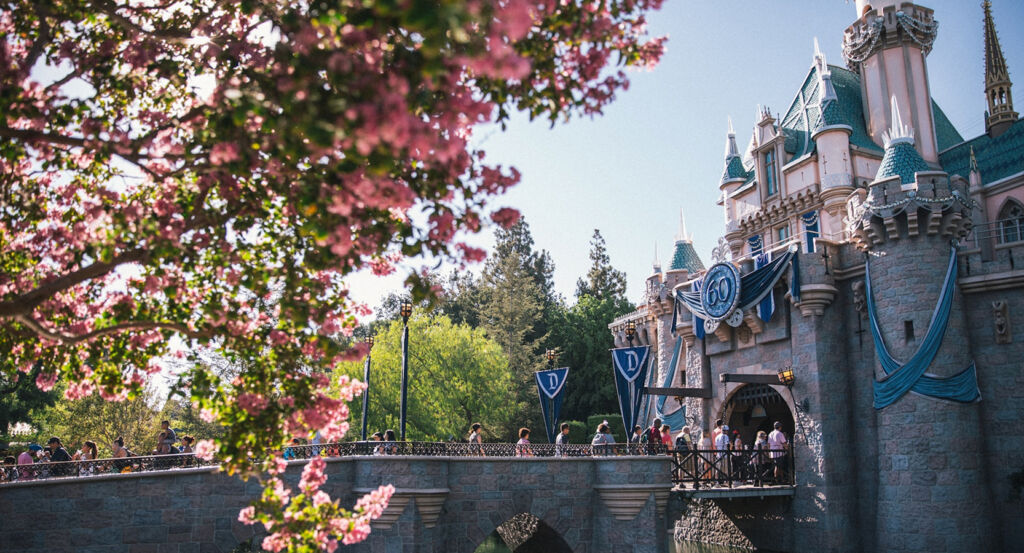
Why Disneyland Hotel matters.
Disneyland Hotel is a storied resort hotel where Disneyland Resort's immersive entertainment character meets mid-century California scale, three themed towers and a landscaped campus conceived as an extension of the destination beyond the park gates.
Set along Magic Way near Disneyland Drive and just steps from Downtown Disney District, the hotel occupies the western side of the resort between the pedestrian promenade, Pixar Place Hotel and the transportation routes surrounding Disneyland's principal entertainment campus. Three high-rise towers frame a broad interior landscape, creating a resort composition that feels spatially distinct from the denser hotel corridors beyond Disney property. Fantasy, Adventure and Frontier themes give the towers separate visual characters through artwork and decorative references drawn from Disneyland's original lands. Low-rise dining structures and tropical planting spread activity horizontally beneath the towers, preserving a strong connection between indoor social areas and the Southern California climate. The result is a hotel whose tower composition, landscaped grounds and direct relationship with Disney's pedestrian district make it a physical extension of the resort destination surrounding it.
What defines Disneyland Hotel.
Disneyland Hotel is best known for originating through Walt Disney's partnership with television producer and entrepreneur Jack Wrather after Disneyland consumed the financial resources Disney might otherwise have directed toward lodging. Disney approached Wrather in 1954 with the opportunity to develop a family hotel on land adjacent to the unfinished theme park, giving an outside entrepreneur control of a property carrying the Disney name. Wrather entered the undertaking after a career that had already extended from petroleum into film and television, where his production interests included The Lone Ranger, Sergeant Preston of the Yukon and Lassie. Bonita Granville, Wrather's wife and an Academy Award-nominated actress, became closely associated with the family enterprise as Wrather diversified further into hospitality. Jack Wrather, Bonita Granville and Anaheim Mayor Charles Pearson broke ground on March 18, 1955, only four months before Disneyland opened across West Street. The hotel began receiving patrons on October 5, 1955, completing the first permanent lodging component created specifically around Walt Disney's Anaheim destination. Rapid growth followed as Wrather expanded beyond the original low-rise motor-hotel configuration and developed a larger hospitality campus around shopping, dining, recreation and convention activity. Walt Disney and Wrather announced an extension of the Disneyland-Alweg Monorail in 1960, carrying the transportation system beyond Disneyland itself and directly into the hotel property the following year. The June 11, 1961 extension became the first monorail route to cross a public street, physically binding Wrather's privately controlled hotel to Disney's theme park through an advanced transportation system. Wrather subsequently moved the property upward through successive tower development, beginning with the Sierra Tower during the 1960s and continuing with the Marina Tower before the Bonita Tower expanded the skyline during the following decade. The Bonita Tower honored Granville and incorporated a solar water-heating system that made the structure an unusually early American hotel application of large-scale solar technology. Wrather's three decades of expansion transformed a partnership born from Walt Disney's financing limitations into a major resort complex whose physical and transportation connections became inseparable from Disneyland itself.
The Walt Disney Company took control of the hotel through its 1988 acquisition of Wrather Corporation, resolving an unusual arrangement under which Disney had spent more than three decades with its name attached to a major property it did not own. Disney initially joined Industrial Equity (Pacific) Ltd. in the $152.3 million purchase of Wrather Corporation, whose holdings also encompassed interests connected with the Queen Mary and Spruce Goose in Long Beach. Three months later, Disney paid $85.2 million for its partner's half of Wrather Corporation, giving the company sole control of the Anaheim property and exclusive use of the Disney name on Southern California hotels. A $35 million rehabilitation followed in 1989 as Disney began reshaping the inherited complex around its own resort strategy. The far larger transformation arrived during the late 1990s when Disney prepared the surrounding property for Disney California Adventure, Disney's Grand Californian Hotel & Spa and Downtown Disney District. Demolition in 1999 removed the original 1955 hotel buildings and much of Wrather's sprawling low-rise complex, fundamentally changing a campus that had accumulated structures across four decades. The surviving towers became the architectural core of a more concentrated property positioned beside the pedestrian district created during the resort expansion. Another major reinvention began in 2009 as Walt Disney Imagineering turned the three towers toward Disneyland history through new exterior treatments, interior artwork and identities derived from Adventureland, Frontierland and Fantasyland. Mary Blair artwork associated with “it's a small world” entered the Fantasy Tower lobby, and the Adventure Tower incorporated visual references to Jungle Cruise as the renovation tied the hotel more deliberately to creative traditions inside Disneyland. Trader Sam's Enchanted Tiki Bar and Tangaroa Terrace followed in 2011 with direct creative connections to Jungle Cruise and the former Tahitian Terrace, carrying the historical reinterpretation beyond the towers into the surrounding social spaces. The multi-year project reached completion in 2012, leaving Disney with a hotel physically transformed from Wrather's independent resort yet deliberately grounded in the Disneyland history that had made the original partnership valuable in 1955.
How Disneyland Hotel fits.
Disneyland Hotel works as a western resort base for an outing connecting Anaheim's agricultural beginnings, its early investment in civic recreation and the cultural institution created through Andrew Carnegie's international library philanthropy.
Begin at Founders' Park, positioned along the western boundary of the original Anaheim Colony and centered on two houses preserving different stages of the city's agricultural development. George Hansen built Mother Colony House in 1857 after the Los Angeles Vineyard Society selected him to lay out the settlement for German vintners, and the three-room structure later survived demolition through preservation work by the Mother Colony Chapter of the Daughters of the American Revolution. John Woelke's 1894 Queen Anne residence represents the citrus prosperity that followed Pierce's Disease and the destruction of hundreds of thousands of grapevines during the 1880s. Continue to Pearson Park, created after Anaheim acquired land for its first municipal park in 1927 and later named for former mayor Charles A. Pearson. Landscape architect Herbert J. Kellogg developed the grounds, and Pearson Park Amphitheatre followed in 1933 as a Spanish-style open-air performance setting whose stage embedded organized cultural programming within the municipal landscape. Conclude at Carnegie Library, where Anaheim's effort to secure a permanent public library culminated in a $10,000 contribution from Andrew Carnegie. John C. Austin designed the Classical Revival building, and Kuechel and Rowley completed construction after submitting a $9,589 bid that fit within the Carnegie funding limit. The cornerstone was laid on November 21, 1908, and the library opened on January 1, 1909 before later becoming part of Anaheim's museum complex. The progression moves from the vineyard and citrus families who shaped early Anaheim through the city's first municipal park and culminates inside a Carnegie-funded cultural institution, tracing the civic development that preceded Anaheim's emergence as an international destination.
Where your story begins.
Foresyte Travel reveals places that feel extraordinary long before you arrive.
Enjoy editorial crafted for luxury travelers.
Foresyte may earn a commission when you book.





































































































