
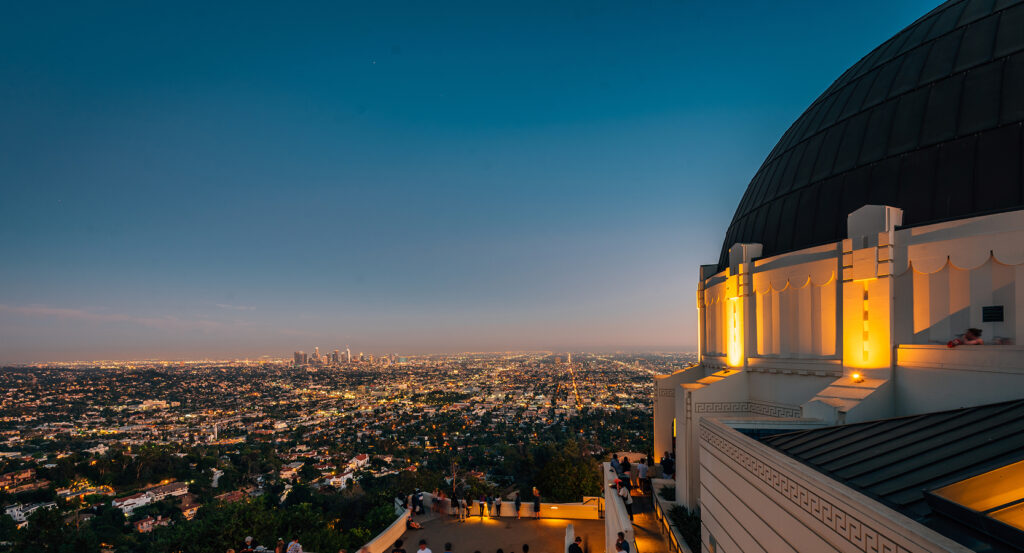
Why Downtown Inglewood matters.
Downtown Inglewood is a historic enclave where the South Bay's metropolitan character meets an 1888 railroad townsite, a century-old commercial spine and a dense collection of prewar buildings shaped during one of Southern California's most dramatic periods of early suburban growth.
Positioned between Morningside Park, North Inglewood, and Century Heights, the neighborhood occupies gently rolling terrain within the Centinela Valley, where the compact commercial core rises subtly from Florence Avenue before extending south across a street grid framed by Manchester Boulevard and La Brea Avenue. Narrow masonry storefronts, former department stores, movie houses and later civic buildings create a low-rise physical fabric whose short blocks preserve the proportions of a commercial center built before postwar development dramatically enlarged the surrounding city. Market Street supplies the primary encounter through six concentrated blocks, its central median and continuous storefront frontages retaining the dimensions of the shopping corridor that became Inglewood's commercial heart during the opening decades of the twentieth century. Manchester Boulevard creates a secondary passage at a broader metropolitan scale, crossing the historic core through larger commercial parcels before continuing toward Prairie Avenue and the extensive development beyond Downtown. The result is a neighborhood whose compact streets and surviving commercial architecture preserve the physical center of early Inglewood inside a city repeatedly reshaped by population growth, transportation change and metropolitan expansion.
What defines Downtown Inglewood.
Downtown Inglewood is best known for developing from the townsite created after Daniel Freeman transformed part of the immense Centinela Ranch into a new settlement connected directly with the expanding Southern California railway network. Scottish landowner Sir Robert Burnett had assembled Rancho Aguaje de la Centinela and adjoining property into a holding encompassing 25,000 acres before leasing the estate to Freeman, a Canadian immigrant who subsequently purchased it. Freeman established extensive dry-farming operations and shipped millions of bushels of barley from his wharf at Playa Del Rey, turning the rancho into a substantial agricultural enterprise. He sold 11,000 acres to the Centinela-Inglewood Land Company as the agricultural property entered subdivision during Southern California's late-1880s development boom. The company platted Inglewood in 1888 shortly after a railroad station had been constructed, placing transportation at the center of the new community's geography. 300 people inhabited the settlement during its founding year, and the first school opened on May 21 with thirty-three children temporarily taught inside a livery stable. F.B. Mitchell became deputy county clerk and A.M. Rollins deputy sheriff during the same year, giving the young settlement its first local officials. Growth remained modest until the opening years of the twentieth century, when a poultry colony and expanding transportation connections strengthened the community after an earlier financial downturn. Inglewood incorporated on February 8, 1908 with 1,200 residents, transforming Freeman's former agricultural subdivision into an independent city twenty years after the townsite appeared.
A destructive earthquake in 1920 initiated Downtown's most consequential early building period, drawing investment into a city whose population then expanded at exceptional speed through the first half of the decade. Inglewood became the fastest-growing city in the United States between 1920 and 1925, and Market Street acquired the architecture of a substantially wealthier commercial center as banks, theaters and sidewalks joined the corridor. The Bank of Inglewood completed its Mediterranean Revival building at Market and Queen streets in 1927, the same year S.H. Kress established its chain store farther south at 233 South Market Street. A Professional Building followed at Market Street and Manchester Boulevard in 1928, extending substantial commercial construction toward the southern end of the corridor. Movie houses strengthened the district's entertainment role, and the 1937 Ritz joined a concentration of cinemas that eventually made Market Street a destination for Hollywood premieres. J.C. Penney moved into 139 South Market Street in 1940 and enlarged its successful store in 1954, demonstrating the corridor's continuing retail importance after World War II. The Granada Theatre burned in 1945, and Fox West Coast Theatres subsequently commissioned S. Charles Lee and Carl G. Moeller to remake the surviving site into the Fox Theatre, which opened in 1949 with Shirley Temple attending the premiere of Mr. Belvedere Goes to College. Streetcar service disappeared from Market Street in 1957, ending a transportation system that had physically occupied its median and connected Downtown with the wider Los Angeles railway network. Civic construction shifted development south of Market Street during the late 1960s, yet the surviving corridor retained buildings spanning the commercial expansion of the 1920s through the postwar era, preserving the architectural imprint of the decades when Downtown functioned as Inglewood's dominant shopping and entertainment center.
How Downtown Inglewood fits.
Downtown Inglewood works as the anchor for an outing connecting the surviving birthplace of the Centinela Valley's rancho era, an ambitious early twentieth-century memorial landscape and one of Southern California's most recognizable examples of postwar roadside architecture.
Begin at Centinela Adobe, where Ignacio Machado built a ranch house in 1834 on Rancho Aguaje de la Centinela, decades before the subdivision that produced Inglewood. Machado was the son of a soldier associated with the original Los Angeles settlers, and his adobe subsequently passed through several owners before Daniel Freeman occupied the property during the nineteenth century. The surviving complex also contains Freeman's 1887 Land Office and the Walter Haskell Heritage and Research Center, which incorporates architectural elements salvaged from Freeman's mansion before its 1972 demolition. The adobe entered the National Register of Historic Places in 1974, preserving a physical connection with the ranching landscape that preceded the modern city. Continue to Inglewood Park Cemetery, established in 1905 when Centinela Valley businessmen formed an association and acquired extensive acreage east of the developing town. Its first interment occurred on July 20, 1906, and funeral parties initially arrived by horse-drawn carts before electric funeral cars carried coffins and mourners directly to the grounds. The Inglewood Mausoleum, built between 1911 and 1915, became California's first community mausoleum and incorporated stained glass produced by Judson Studio. Early Centinela Valley settlers and nearly three dozen Civil War veterans share the cemetery with later cultural figures including Ray Charles, Ella Fitzgerald and architect Paul Williams, extending the property's significance across multiple generations of Southern California history. Conclude at Randy's Donuts, completed in 1953 as the second location of Russell C. Wendell's Big Donut Drive-In chain. Architect Henry Goodwin designed the drive-up building, and structural engineer Richard Bradshaw developed its enormous rooftop doughnut from rolled steel bars covered with gunite. The restaurant became Randy's during the 1970s and has been owned by Ron and Larry Weintraub since 1978, preserving both the building and the immense rooftop form that turned a modest food stand into an internationally recognizable artifact of Southern California automobile culture. The progression moves from Machado's surviving rancho residence through a memorial landscape connected with electric railway travel and culminates at a vivacious roadside structure, tracing the Centinela Valley from nineteenth-century ranching through metropolitan expansion into the automobile age.
Where your story begins.
Foresyte Travel reveals places that feel extraordinary long before you arrive.
Enjoy editorial crafted for luxury travelers.
Foresyte may earn a commission when you book.





































































































