
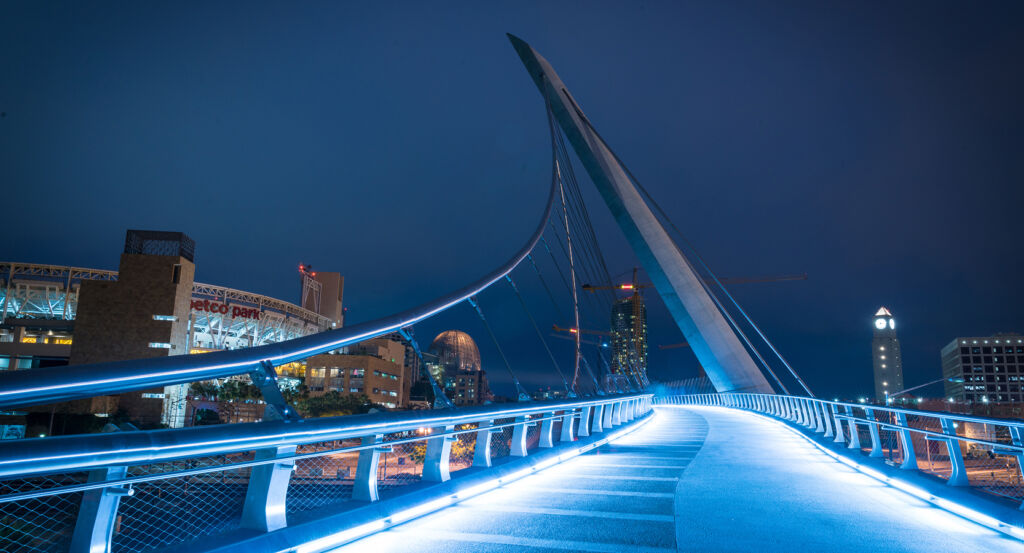
Why Fashion Valley Road matters.
Fashion Valley Road is an elegant corridor where Mission Valley's commercial ambition, riverside landscapes, architectural refinement, and contemporary vitality converge along one of San Diego's premier urban boulevards.
Running through Mission Valley between Mission Hills and Serra Mesa, the corridor follows the San Diego River while connecting landscaped promenades, architect-designed commercial districts, mature tree canopies, and hospitality destinations that collectively reflect the valley's transformation into one of Southern California's foremost retail and business centers. Contemporary commercial architecture, Mediterranean-inspired façades, public plazas, California sycamores, Canary Island date palms, coast live oaks, and carefully designed pedestrian landscapes establish a streetscape where urban development remains closely integrated with the surrounding river valley. Throughout the corridor, thoughtful planning, architectural sophistication, and sustained reinvestment reinforce an atmosphere shaped by decades of regional economic leadership. The result is an experience defined by refined public spaces, riverside scenery, and one of Mission Valley's most distinguished commercial corridors.
What defines Fashion Valley Road.
Fashion Valley Road is best known for serving Mission Valley, whose modern character emerged during the 1950s and 1960s following extensive San Diego River flood-control projects that enabled one of California's largest concentrations of regional commercial, residential, and hospitality development. The corridor developed alongside Fashion Valley, which opened in 1969 under the direction of Ernest W. Hahn, introducing an open-air regional shopping center whose landscaped courtyards, luxury retail program, and pedestrian-oriented design established a new benchmark for upscale commercial development throughout Southern California. Buildings surrounding the corridor introduced Contemporary, Mediterranean Revival, and Postmodern architectural influences distinguished by reinforced concrete framing, structural steel construction, natural stone cladding, decorative fountains, shaded arcades, curtain-wall glazing, and carefully integrated landscape architecture designed to complement the river valley setting. California sycamores, coast live oaks, Canary Island date palms, great blue herons, snowy egrets, Anna's hummingbirds, western fence lizards, and riparian vegetation continue reinforcing the corridor's ecological character. Together, these engineering milestones, commercial innovations, architectural traditions, construction materials, and environmental resources establish Fashion Valley Road as a defining expression of Mission Valley's historical evolution.
Civil engineers reshaped the surrounding valley through channel improvements, bridge construction, flood-control embankments, engineered drainage systems, and transportation infrastructure that permanently altered Mission Valley's capacity for large-scale commercial investment. Granite paving, structural steel canopies, decorative limestone, ornamental water features, mature landscape plantings, and expansive pedestrian plazas remain defining elements throughout the corridor, illustrating how architecture and public space were conceived as complementary components of the district's long-term identity. Continuous redevelopment has enabled the corridor to accommodate evolving retail, hospitality, and office uses while preserving the landscape structure that distinguishes Fashion Valley from conventional commercial districts. Together, these engineering achievements, enduring construction techniques, and landscape-centered planning principles demonstrate how Fashion Valley Road developed into one of San Diego's most significant urban commercial corridors.
How Fashion Valley Road fits.
Fashion Valley Road works as an exploration of Mission Valley's architecture, river landscapes, and contemporary urban culture.
Begin at Fashion Valley, where landscaped courtyards and architect-designed public spaces introduce the sophisticated commercial environment that defines the corridor. Continue to Riverwalk Golf Club, whose mature fairways and San Diego River setting deepen appreciation for the valley's balance between recreation and urban development. Conclude at Mission San Diego de Alcalá, where California's first Franciscan mission provides the historical payoff by connecting Mission Valley's contemporary character with the origins of European settlement in Alta California. The progression moves naturally from contemporary urban design through riverside recreation before culminating in one of California's most historically significant religious sites, revealing why Fashion Valley Road remains one of Mission Valley's defining corridors.
Where your story begins.
Foresyte Travel reveals places that feel extraordinary long before you arrive.
Enjoy editorial crafted for luxury travelers.
Foresyte may earn a commission when you book.





































































































