
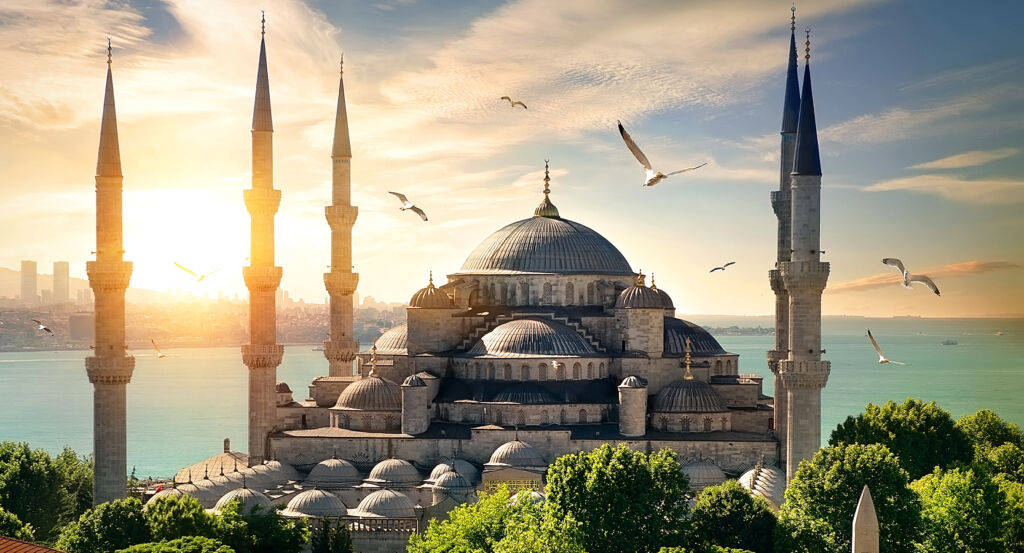
Why Four Seasons Hotel Istanbul at Sultanahmet matters.
Four Seasons Hotel Istanbul at Sultanahmet is a historic luxury hotel where Sultanahmet's Byzantine and Ottoman heritage meets Turkish neoclassical architecture, twentieth-century literary history, and the transformation of a former prison into international hospitality.
Occupying a corner of Tevkifhane Street near Kutlugün Street, Four Seasons Hotel Istanbul at Sultanahmet stands within the historic peninsula's expansive core, between the residential streets descending toward the Sea of Marmara and the expansive religious architecture surrounding Sultanahmet Square. The three-story building presents a symmetrical Turkish neoclassical façade with pale yellow plasterwork, white architectural detailing, arched windows, and projecting corner volumes. Its pitched roofs and ornamental cornices establish a restrained interpretation of the First National Architectural Movement, connecting Ottoman decorative traditions with European neoclassical proportions. The building's principal wings enclose a landscaped courtyard, creating a sheltered garden environment within the densely built historic district. A formal entrance introduces the original southwest wing, where preserved stonework, marble surfaces, and carefully proportioned interiors retain elements of the building's institutional origins. The surrounding accommodation wings incorporate tall windows, decorative timber, and architectural details inspired by traditional Turkish craftsmanship. Upper-level terraces overlook the domes and minarets of the historic peninsula, with the Marmara coastline extending toward the southeastern horizon. The result is an intimate historic hotel whose enclosed architecture preserves the character of an early twentieth-century Istanbul institution within one of the city's most consequential architectural landscapes.
What defines Four Seasons Hotel Istanbul at Sultanahmet.
Four Seasons Hotel Istanbul at Sultanahmet is best known for transforming the former Sultanahmet Prison into a luxury hotel while preserving a building associated with the final Ottoman decades and the political and literary history of modern Türkiye. Architect Mimar Kemaleddin Bey designed the original structure during the First National Architectural Movement, which revived Ottoman architectural forms through a modern interpretation of Turkish cultural identity. The project began as a French-inspired guesthouse before its conversion into a detention facility constructed between 1918 and 1919. The resulting Sultanahmet Prison became the Ottoman capital's first modern prison, accommodating defendants awaiting trial and prisoners serving relatively short sentences. Its location beside the former courthouse established a direct institutional relationship between detention and judicial proceedings. The prison operated through successive periods of political upheaval, including the dissolution of the Ottoman Empire and the establishment of the Turkish Republic. Its inmates included poet Nâzım Hikmet, novelist Kemal Tahir, writer Orhan Kemal, and humorist Aziz Nesin, connecting the building with major figures in twentieth-century Turkish literature. Hikmet's imprisonment contributed to his literary engagement with the lives of ordinary Turkish people, and Kemal Tahir's prison experiences informed the historical and social concerns of his fiction. Orhan Kemal developed part of his literary career during imprisonment, establishing another connection between the institution and Türkiye's modern literary tradition. The prison closed in 1969 before reopening for another period of detention between 1980 and 1986. Plans to convert the abandoned building into a luxury hotel emerged in 1992, introducing a new architectural function for a property whose historical significance extended beyond its original institutional purpose. The redevelopment incorporated structural reinforcement, interior reconstruction, and the preservation of surviving architectural elements. Four Seasons Hotel Istanbul at Sultanahmet opened in January 1996, establishing the international hospitality brand within the historic peninsula. A comprehensive renovation subsequently transformed the accommodations, public interiors, and dining environments, culminating in the hotel's reopening in 2022. British design studio Goddard Littlefair directed the refurbishment, introducing contemporary residential interiors while maintaining the building's Turkish architectural identity. The project also reconfigured the central garden and introduced additional hospitality facilities, extending the original conversion through another major architectural intervention. The hotel's significance rests on this succession of Ottoman institutional architecture, Republican literary history, historic preservation, and contemporary luxury hospitality.
Goddard Littlefair's interior transformation develops the building's Turkish architectural inheritance through handcrafted furnishings, decorative stonework, and residential environments influenced by Ottoman design traditions. Bespoke cabinetry incorporates carved timber and inlaid detailing, establishing a relationship between contemporary accommodation design and traditional Anatolian craftsmanship. Decorative mosaics, embroidered textiles, and carefully selected lighting introduce additional references to the artistic traditions of Istanbul. The suites develop this approach through separate reception spaces, marble bathrooms, and private terraces overlooking the surrounding historic district. The Marmara Suite extends the residential program through an expansive terrace and substantial living areas, connecting private accommodation with the architectural panorama of the old city. Avlu Restaurant occupies the landscaped central garden, establishing the property's principal culinary setting around contemporary Anatolian cuisine. Seasonal ingredients and regional preparations shape a menu connecting Türkiye's agricultural diversity with modern restaurant techniques. The courtyard's ornamental planting and sheltered dining terraces introduce a garden atmosphere within the building's enclosed architectural arrangement. Lingo Lingo provides a complementary social environment through contemporary furnishings, cocktails, and lighter dining preparations. The Rooftop extends the hospitality program above the principal building, establishing an outdoor setting with views across Istanbul's expansive skyline and surrounding maritime landscape. Traditional Turkish breakfast introduces regional cheeses, olives, preserves, breads, and other preparations associated with the country's established morning dining culture. Kurna Spa incorporates preserved marble and stone surfaces into a therapeutic environment inspired by Turkish bathing traditions. Its treatment program combines massage therapies, contemporary wellness practices, and a dedicated fitness area. The intimate scale of the property connects these dining and wellness environments through short internal passages and landscaped courtyards, maintaining a residential atmosphere throughout the historic complex. The combination of Turkish decorative craftsmanship, Anatolian cuisine, garden-centered hospitality, and carefully integrated wellness facilities establishes a distinctive interpretation of luxury accommodation within Istanbul's historic peninsula.
How Four Seasons Hotel Istanbul at Sultanahmet fits.
Four Seasons Hotel Istanbul at Sultanahmet works as the starting point for an exploration connecting Byzantine engineering, Ottoman imperial collecting, and the preservation of Islamic artistic traditions across successive centuries of Istanbul's history.
Begin at Basilica Cistern, the expansive underground reservoir constructed during the reign of Byzantine Emperor Justinian I in the sixth century. The structure incorporates 336 marble columns arranged in twelve rows, supporting a vaulted ceiling above a reservoir originally supplied through the city's extensive aqueduct network. Its architectural fabric includes columns and capitals reused from earlier Roman buildings, connecting Byzantine infrastructure with the architectural inheritance of classical antiquity. Two expansive Medusa heads support columns in the northwestern corner, preserving sculptural fragments whose original architectural setting has disappeared. A major restoration completed in 2022 introduced new walkways and lighting, revealing the reservoir's expansive proportions and surviving masonry. Continue to Istanbul Archaeological Museums, the institutional complex whose development established one of the Ottoman Empire's principal collections of ancient art and archaeological objects. The Imperial Museum received a substantial new building in 1891 under the direction of archaeologist and museum administrator Osman Hamdi Bey. Architect Alexandre Vallaury designed its neoclassical façade, introducing a formal architectural setting for antiquities excavated across the empire. The collection includes the Alexander Sarcophagus, discovered during Hamdi Bey's excavations at Sidon in 1887, and the Treaty of Kadesh, a major surviving artifact of ancient Near Eastern diplomacy. The adjoining Museum of the Ancient Orient and Tiled Kiosk Museum extend the institution's collections across additional civilizations and artistic traditions. Conclude at Museum of Turkish and Islamic Arts, the institution established in 1914 to preserve the artistic heritage of Islamic societies. Its original collections occupied the Süleymaniye Mosque complex before the museum relocated in 1983 to the historic İbrahim Pasha Palace. Sultan Süleyman I commissioned the palace in the early sixteenth century and presented it to his grand vizier Pargalı İbrahim Pasha, connecting the building with the political and ceremonial life of the Ottoman court. The collection encompasses Qur'an manuscripts, illuminated calligraphy, Seljuk and Ottoman carpets, carved woodwork, ceramics, and metalwork from successive Islamic dynasties. A major restoration preceded the museum's reopening in 2014, introducing renewed galleries for its centennial. The progression moves from Basilica Cistern's Byzantine engineering through Istanbul Archaeological Museums' imperial collecting traditions and culminates in Museum of Turkish and Islamic Arts' preservation of Ottoman and Islamic craftsmanship, connecting the infrastructure, scholarship, and artistic inheritance of Istanbul's successive civilizations.
Where your story begins.
Foresyte Travel reveals places that feel extraordinary long before you arrive.
Enjoy editorial crafted for luxury travelers.
Foresyte may earn a commission when you book.





































































































