
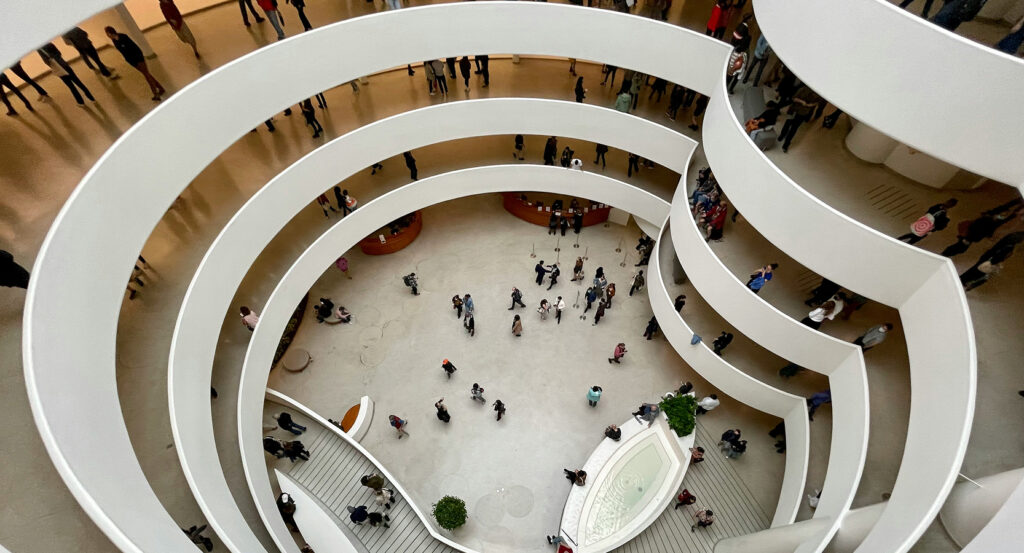
Why you should experience The Frank Lloyd Wright Rotunda in New York, NY.
The Frank Lloyd Wright Rotunda is a space that doesn't just house art but choreographs how you experience it.
The rotunda's spiraling ramp pulls you gently upward, a continuous motion that feels more like floating than walking. Natural light floods from the glass oculus above, refracting against the pale curves and transforming every moment into living sculpture. You're not simply in a museum; you're inside an idea, Wright's vision of harmony between human perception and organic form. Each step reveals new vantage points of both the art and the building itself, the two locked in dialogue. The air carries a cathedral hush, punctuated only by the shuffle of footsteps and the occasional gasp of wonder. The rotunda's genius isn't in its scale, but in its serenity, it makes you aware of movement as art, of stillness as revelation.
What you should know about The Frank Lloyd Wright Rotunda.
When Wright first unveiled his plans for the Guggenheim Museum, the spiral rotunda was nothing short of heresy in the world of museum design.
He envisioned it as “a temple of the spirit,” where visitors would journey upward in one unbroken line, art flowing like thought, uninterrupted and alive. The rotunda's dimensions are calculated with mathematical precision: each curve widening in perfect proportion to the human eye's perspective. Wright used reinforced concrete to achieve those organic shapes, creating one of the most daring architectural feats of the 20th century. Even the lighting was revolutionary, sunlight streams from above, softening as it spirals downward through the atrium, casting art in shifting tones. Critics once called it impractical; now, it's one of the most beloved interiors on Earth. The rotunda became the Guggenheim's beating heart, a physical manifestation of Wright's belief that beauty should be both lived and moved through.
How to fold The Frank Lloyd Wright Rotunda into your trip.
Enter the museum with patience, this is not a place to rush, but to ascend like a thought unfolding.
Start at the base of the rotunda and slowly follow the spiral upward, letting the space guide your pace. As you climb, look down often; the sight of people weaving below you through the curves is part of the artwork itself. Pause at mid-level to absorb how the architecture and exhibits converse, color against curvature, motion against light. When you reach the top, stand beneath the skylight for a moment of stillness. It's the building's quiet crescendo, where all lines and light meet in calm convergence. Before you leave, step back to the rotunda floor and look up one last time, you'll see not just a ceiling, but a vortex of imagination, proof that Wright didn't build a museum. He built a movement.
Where your story begins.
Foresyte Travel reveals places that feel extraordinary long before you arrive.
Experience premium editorial crafted for luxury travelers.







































































































