
Why Guggenheim Museum matters.
Guggenheim Museum is a dramatic modern-art museum where Carnegie Hill's cultural character meets Frank Lloyd Wright's spiraling architecture, Solomon R. Guggenheim's commitment to abstraction and an exhibition building conceived as a continuous spatial composition.
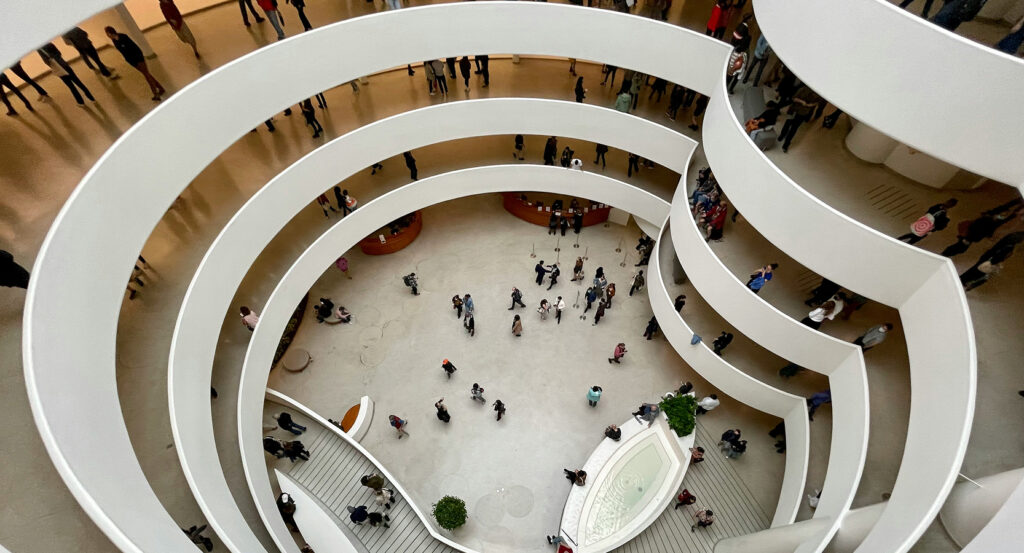
Set along 5th Avenue near East 89th Street and just steps from the Jacqueline Kennedy Onassis Reservoir, the museum occupies a corner facing Central Park where its curving concrete mass breaks decisively from the rectilinear apartment buildings lining Museum Mile. Wright organized the principal volume around an expanding inverted ziggurat, placing a broad rotunda beneath a domed skylight and wrapping the interior with a continuous ramp that rises through six levels around a central void. Reinforced concrete permitted parapets, curved walls and projecting forms to operate as one sculptural composition, with the low Monitor Building beside the rotunda extending Wright's geometry horizontally across the 5th Avenue frontage. The interior ramp descends at a gentle grade around the open center, establishing changing relationships among artwork, architecture, daylight and the opposite side of the rotunda throughout the circuit. The result is a museum whose spiral ramp, immense central void, curved concrete shell and 5th Avenue profile make the building itself inseparable from the modern art institution it contains.
What defines Guggenheim Museum.
Guggenheim Museum is best known for the collaboration among Solomon R. Guggenheim, Hilla Rebay and Frank Lloyd Wright that transformed a private commitment to nonobjective art into one of the twentieth century's most consequential museum buildings. Rebay became Guggenheim's artistic adviser after the two met in 1928 and directed his collecting toward abstraction, particularly Vasily Kandinsky, whose work became a major foundation of the collection. A 1930 European trip brought Guggenheim and Rebay into contact with Kandinsky and Paul Klee at the Bauhaus and Marc Chagall in Paris, deepening a collection that reached 800 works by the end of the decade. Guggenheim created the Solomon R. Guggenheim Foundation in 1937, followed in 1939 by the Museum of Non-Objective Painting in rented quarters on East 54th Street, with Rebay serving as its first director. The expanding collection led Rebay to approach Wright in June 1943 for a permanent museum unlike existing institutions, beginning a sixteen-year architectural undertaking marked by repeated revisions, disputes with officials and disagreements over the relationship between Wright's building and the art it would contain. Wright produced hundreds of drawings and multiple schemes as the commission evolved, eventually concentrating the galleries around the continuous spiral that became the building's central architectural idea. Guggenheim died in 1949 and Wright in April 1959, leaving neither man to see the completed museum open on October 21, 1959. The institution had adopted Solomon R. Guggenheim's name in 1952, after Rebay's departure from the directorship, joining the founder's patronage permanently to a building completed a decade after his death. Wright's final museum commission united Guggenheim's collecting, Rebay's advocacy for abstraction and an architectural project that took sixteen years to move from commission to public opening.
Justin K. Thannhauser redirected the collection's historical reach in 1963 when the German-born dealer announced a permanent loan and promised gift of major Impressionist, Post-Impressionist and modern French works assembled through his family's decades in the European avant-garde. Heinrich Thannhauser had opened Munich's Moderne Galerie in 1909, where the program subsequently included the first Blaue Reiter group exhibition in 1911-12, and Justin mounted one of Germany's earliest major Picasso exhibitions in 1913 before expanding the family's activity to Lucerne and Berlin. Nazi persecution pushed Justin and his family from Germany to Paris and eventually New York, where he settled during the early 1940s and continued refining a private collection shaped by longstanding relationships with modern artists. His 1963 commitment brought works by Degas, Manet, Monet, Renoir, Cézanne, Gauguin, Van Gogh and Picasso into an institution whose founding holdings had concentrated on later abstraction. Thannhauser died in 1976, and the promised paintings and sculptures formally entered the Guggenheim collection in 1978; Hilde Thannhauser expanded the gift between 1981 and 1991. Another major transformation followed from 1990 through 1992, when purchase and gift brought more than 350 works from Giovanna and Giuseppe Panza di Biumo into the museum, adding exceptional concentrations of Minimal, Post-Minimal and Conceptual art by figures including Dan Flavin, Donald Judd and Robert Morris. The Panza acquisition carried the collection decisively into American art of the 1960s and 1970s, extending an institutional chronology that now reached from nineteenth-century French painting through European modernism and abstraction into postwar practices. Thannhauser and Panza changed the intellectual span of Guggenheim's holdings in opposite chronological directions, surrounding the founding commitment to nonobjective art with the nineteenth-century developments that preceded it and the postwar experiments that followed.
How Guggenheim Museum fits.
Guggenheim Museum works as the anchor for a daytime Carnegie Hill sequence connecting Viennese and German modernism, New York's civic collecting and an American design institution shaped by two sisters and an industrialist's Gilded Age residence.
Begin at Neue Galerie New York, created by art dealer Serge Sabarsky and philanthropist Ronald S. Lauder around German and Austrian art and design from 1890 to 1940. The pair acquired the William Starr Miller House in 1994, a Carrère & Hastings mansion completed in 1914 and later occupied by Mrs. Cornelius Vanderbilt III and the YIVO Institute for Jewish Research, before the museum opened there in November 2001. Its Austrian holdings connect Gustav Klimt, Egon Schiele, Oskar Kokoschka and Richard Gerstl with Wiener Werkstätte designers Josef Hoffmann, Koloman Moser and Dagobert Peche, allowing painting and decorative art to reconstruct the creative world of Vienna 1900; German holdings extend through Brücke, Blaue Reiter, Neue Sachlichkeit and Bauhaus figures including Ernst Ludwig Kirchner, Vasily Kandinsky, Otto Dix and Marianne Brandt. Continue to Museum of the City of New York, founded in 1923 by Scottish-born writer Henry Collins Brown around an ambitious institution devoted specifically to New York's history. The museum first occupied Gracie Mansion before director Hardinge Scholle pursued a permanent home on 5th Avenue, where Joseph H. Freedlander's Georgian Colonial Revival building was begun in 1929 and completed in 1932. A collection now numbering 750,000 objects grew to include Eugene O'Neill manuscripts, 412 Jacob Riis glass negatives, a Duncan Phyfe room, a suit worn to George Washington's Inaugural Ball and Carrie Walter Stettheimer's dollhouse containing a miniature work by Marcel Duchamp, compressing political, photographic, theatrical and decorative history into a single city collection. Conclude at Cooper Hewitt, Smithsonian Design Museum, whose origins reach to Sarah and Eleanor Hewitt's 1897 Cooper Union Museum for the Arts of Decoration, conceived as a working laboratory where designers and students learned directly from objects. Cooper Union moved to dissolve the museum in 1963, triggering a preservation campaign before the Smithsonian acquired its collection in 1967 and secured Andrew Carnegie's former 5th Avenue mansion as its new home. Babb, Cook & Willard had built the 64-room residence from 1899 to 1902 with a steel frame, electric elevators and advanced climate technology; Hardy Holzman & Pfeiffer Associates converted it for the museum's 1976 opening, and a 2011-14 reconstruction involving Beyer Blinder Belle, Gluckman Mayner, Diller Scofidio + Renfro and other firms expanded exhibition space from 10,000 to 17,000 square feet. The progression moves from Lauder and Sabarsky concentrating Central European modernism inside a Carrère & Hastings mansion through Brown and Freedlander building an institution around New York itself into the Hewitt sisters' teaching collection and Carnegie's technologically ambitious residence, revealing how Carnegie Hill turned private collecting, civic history and design education into three distinct museum traditions.
Where your story begins.
Foresyte Travel reveals places that feel extraordinary long before you arrive.
Enjoy editorial crafted for luxury travelers.
Foresyte may earn a commission when you book.







































































































