
Why The Getty Villa Amphitheater matters.
The Getty Villa Amphitheater is an intimate classical theater where Pacific Palisades' coastal character meets ancient performance traditions, contemporary stagecraft and an architectural composition embedded into the museum's canyon setting.
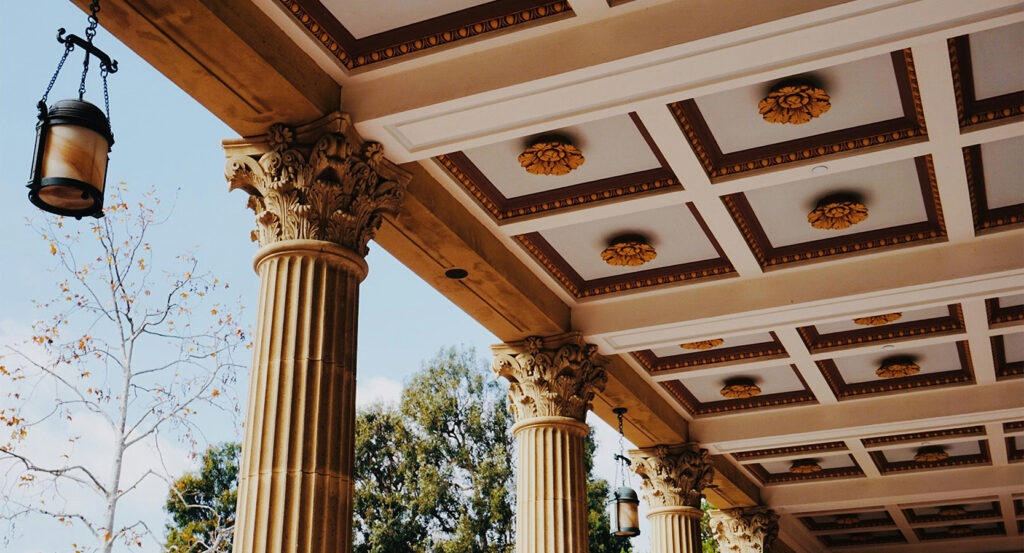
Set along the central axis of the Getty Villa near its main museum entrance and just steps from the Arrival Balcony, the outdoor theater occupies a descending space between the hillside approach and the reconstructed Roman villa, making its stepped seating both a performance setting and part of the route into the museum. Pale stone seating faces a compact stage backed by the Villa's colonnaded architecture, placing performers against columns, painted surfaces and open sky without introducing a freestanding theatrical building between audience and museum. Descending the broad seating steps draws the encounter toward the stage as the reconstructed architecture gradually rises into view behind it, joining movement through the site with the spatial form of an ancient theater. Evening performances alter that relationship as stage lighting isolates actors against the surrounding architecture and the open-air auditorium becomes increasingly enclosed by darkness across the canyon. The result is a theater whose seating, stage and architectural backdrop bind live performance directly to the museum setting, restoring classical drama to an outdoor spatial form closely connected with the ancient culture that produced it.
What defines The Getty Villa Amphitheater.
The Getty Villa Amphitheater is best known as the 450-seat Barbara and Lawrence Fleischman Theater, an outdoor venue modeled on ancient Greek and Roman prototypes and created during the Getty Villa's extensive late-twentieth-century redevelopment. The J. Paul Getty Trust decided during the mid-1980s to recast the property as a center devoted to classical art and culture, prompting an invited 1993 competition among six architectural firms for a new master plan. Rodolfo Machado and Jorge Silvetti received the commission after proposing a scheme that treated the existing museum as an archaeological object encountered through a newly choreographed canyon landscape. Their completed 1995 master plan introduced contemporary structures for entry, conservation, research and public use without replicating the Roman architecture already occupying the property. The theater became the centerpiece of the revised arrival sequence, positioned so the path from the Entry Pavilion reaches an elevated balcony before descending directly through its seating toward the museum entrance. Machado and Silvetti strengthened that alignment through a new staircase on the museum's east side, carrying the axis from the amphitheater through the building toward the East Garden. Wood, bronze, glass, travertine and wood-formed concrete distinguished the new architectural interventions from the reconstructed Roman villa while maintaining compatible scale and surface character across the canyon. The theater opened with the renewed Getty Villa in January 2006, giving live performance a permanent architectural position at the threshold of an institution devoted to ancient Mediterranean culture.
Annual Outdoor Classical Theater productions subsequently turned the new venue into a laboratory for contemporary reinterpretations of Greek and Roman drama. The series began in 2006 and reached its ninth annual production in 2014 with SITI Company's Persians, directed by Anne Bogart in a new translation by Aaron Poochigian after the ensemble had previously developed Villa versions of Antigone, Trojan Women, Bacchae and Ion. Culture Clash brought Aristophanes into contemporary Los Angeles performance through Peace in 2009 under director Bill Rauch, joining the company with choreographer Ken Roht and actors John Fleck and Amy Hill. Court Theatre presented Euripides's Iphigenia in Aulis in 2017 under Charles Newell after developing the production in Chicago, then returned in 2023 with Lee Breuer and Bob Telson's The Gospel at Colonus, merging Sophocles's Oedipus at Colonus with Black gospel music. Classical Theatre of Harlem premiered Will Power's Memnon there in 2024 under director Carl Cofield, recovering the Ethiopian king from the Trojan War tradition as the central figure of a newly written play. Troubadour Theater Company followed in 2025 with Matt Walker's Oedipus the King, Mama!, combining Sophocles with Elvis Presley songs in the company's third outdoor production at the Villa. The 2026 presentation of Antigone: In the Language of Kings marks the series' twentieth annual production, relocating Sophocles's conflict to pre-conquest Tenochtitlan through Latino Theater Company. Two decades of commissions, adaptations and visiting ensembles have made the amphitheater an active counterpart to the museum collection, using performance to test how ancient texts acquire fresh theatrical forms before contemporary audiences.
How The Getty Villa Amphitheater fits.
The Getty Villa Amphitheater works as the anchor for a coastal sequence tracing how private recreation, elite social clubs and Hollywood wealth produced three radically different institutional landscapes across the foothills and shoreline west of Los Angeles.
Begin at Will Rogers State Historic Park, where Will Rogers assembled a ranch during the 1920s as his career expanded from trick roping and vaudeville into radio, newspaper columns and motion pictures. By his death in a 1935 plane crash, the property contained a 31-room ranch house, stable, corrals, riding ring, roping arena, polo field, golf course and riding trails across land overlooking the Pacific. Rogers used the estate for riding, roping and polo with family and friends, and Betty Rogers later ensured its preservation by leaving the property to California after her death in 1944. The surviving polo field remains the last grass public outdoor polo field in Los Angeles County, preserving the equestrian culture around which Rogers organized his private retreat. Continue to Rustic Canyon Recreation Center, whose property Harry Haldeman purchased in 1920 for the Uplifters, a Los Angeles Athletic Club group devoted in equal measure to artistic pursuits and social recreation. Fire destroyed the Edmond ranch house that initially served as their clubhouse in 1922, and architect William Dodd designed its 1923 replacement with a large dining room, auditorium, stage and pipe organ for the group's annual performances. Members leased surrounding lots for $100 and constructed cabins across roads laid out by Howard Latimer, creating a secluded colony whose membership included figures such as Will Rogers, Walt Disney, Clark Gable and Harold Lloyd. The club disbanded in 1947, and a $200,000 gift from Maybell Machris later enabled the Santa Monica Canyon Civic Association to purchase the eight-acre property and donate it for public recreation in 1953. Conclude at Annenberg Community Beach House, occupying the five-acre oceanfront estate William Randolph Hearst developed for Marion Davies during the 1920s with architect Julia Morgan. The property originally centered on a mansion exceeding 100 rooms and an ornate marble pool, becoming a Gold Coast gathering place for figures including Charlie Chaplin, Greta Garbo, Clark Gable, Louis B. Mayer and Samuel Goldwyn. Joseph Drown purchased the estate in 1947 and converted it into the Oceanhouse hotel and Sand & Sea Club before the mansion was demolished in 1956; California acquired the property three years later. Severe Northridge earthquake damage in 1994 eventually prompted a public reinvention supported by a $27.5 million Annenberg Foundation grant, with Frederick Fisher Partners leading a project that rehabilitated the surviving Marion Davies Guest House and pool before the Beach House opened in 2009. The progression moves from Rogers's equestrian retreat through the Uplifters' private canyon colony into Hearst and Davies's Gold Coast estate, tracing how exclusive twentieth-century landscapes along the western edge of Los Angeles ultimately entered public stewardship.
Where your story begins.
Foresyte Travel reveals places that feel extraordinary long before you arrive.
Enjoy editorial crafted for luxury travelers.
Foresyte may earn a commission when you book.





































































































